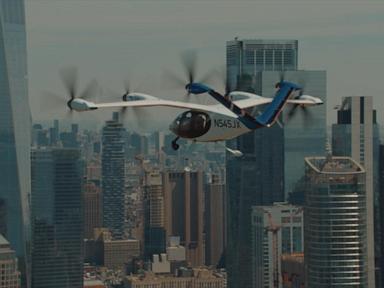
The obsession with electric vertical takeoff and landing (eVTOL) aircraft has reached a fever pitch of collective delusion. Investors and tech enthusiasts point to sleek, multi-rotor prototypes as the ultimate solution to urban congestion. They promise a world where you fly over gridlock in a silent, green bubble. It is a beautiful vision that ignores every fundamental law of physics, economics, and urban sociology.
The "lazy consensus" suggests that because these vehicles are electric and take off vertically, they are essentially flying Teslas. This comparison is a category error. A Tesla fights rolling resistance; an eVTOL fights gravity. Gravity does not care about your venture capital valuation.
The Physics of Failure
The fundamental problem is energy density. Jet fuel (A-1) packs roughly 12,000 Wh/kg. Even the most optimistic battery projections for 2026 struggle to hit 300-350 Wh/kg at the pack level. When you are moving a car on the ground, weight is a nuisance. When you are trying to lift a 3,000-pound carbon-fiber fuselage vertically, weight is a death sentence for efficiency.
To achieve vertical lift, an eVTOL must expend a massive burst of energy just to leave the ground. This "hover penalty" eats into the already meager energy reserves of the battery. The result is a vehicle with a pathetic range—often less than 50 miles once you factor in mandatory FAA safety reserves.
"I have seen companies blow millions on flight tests that prove what we already knew in the 1950s: vertical flight is the most energy-expensive way to move a human being from point A to point B."
The industry claims that "distributed electric propulsion" makes these craft quiet and efficient. Compared to a Black Hawk helicopter? Sure. Compared to a subway or even a modest electric bus? It is an environmental disaster. The energy required to move one person in an air taxi is roughly 10 to 20 times higher than moving them via high-speed rail or efficient ground transit. Calling this "green" is a marketing heist.
The Vertiport Bottleneck
The "Air Taxi" name implies a level of convenience that the infrastructure simply cannot support. Proponents talk about "vertiports" on every skyscraper. This ignores the reality of urban wind shears, weight limits on aging rooftops, and the nightmare of battery charging.
To keep these vehicles in the air, they need ultra-fast charging. We are talking about megawatt-scale draws on a power grid that is already struggling to handle 5:00 PM air conditioning loads. If you want to land ten eVTOLs on a roof in Midtown Manhattan and charge them simultaneously, you don't just need a "vertiport." You need a dedicated substation.
Furthermore, the "point-to-point" promise is a lie. You still have to get to the vertiport. If you have to take an Uber for 20 minutes to reach a launch pad, wait for a security check, fly for 8 minutes, and then take another Uber to your final destination, you haven't saved time. You have just paid $200 to experience a very loud, very expensive elevator ride.
The Noise of 10,000 Rotors
The industry loves to show videos of eVTOLs filmed from 500 feet away with a soundtrack of soft ambient music. In reality, the sound of a multi-rotor electric aircraft is not a "hum." It is a high-pitched, directional whine caused by blade-vortex interaction.
NASA’s 2025 VANGARD study confirmed what many suspected: urban residents are more annoyed by the "novel" sound of eVTOLs than they are by the familiar rumble of a truck. Imagine the psychological toll of a city where thousands of these machines are buzzing overhead every three minutes. Public acceptance will vanish the moment the first "commuter route" starts operating over a residential neighborhood at 6:00 AM.
The Elite Escape Hatch
The most offensive part of the eVTOL narrative is the claim that it will "democratize" flight. This is nonsense.
Operational costs for these vehicles—insurance, pilot salaries (until "autonomy" arrives, which is a decade away), and constant battery replacements due to high-cycle stress—mean seats will cost hundreds of dollars.
- Helicopter services (like Blade) have existed for decades.
- They haven't solved traffic. * They have only allowed the ultra-wealthy to ignore it.
By pivoting investment toward air taxis, we are effectively subsidizing an escape hatch for the 1% instead of fixing the ground-based transit that 99% of the population actually uses. Every dollar spent on a vertiport is a dollar not spent on a bus rapid transit lane or a subway extension.
The Regulatory Wall
The FAA and EASA are not going to allow "thousands" of autonomous drones to swarm over Manhattan or London anytime soon. The certification of "powered-lift" aircraft is the most complex regulatory hurdle in the history of aviation. These vehicles are neither airplanes nor helicopters; they are a weird hybrid that the current air traffic control system is not equipped to handle.
The moment a single eVTOL has a bird strike or a battery thermal runaway event over a populated area, the industry will face a regulatory freeze that will last years.
The future of urban mobility isn't in the sky. It is on the ground, in high-capacity, low-friction transit. The air taxi is a shiny distraction for people who think technology can bypass the hard work of urban planning.
Stop trying to fly over the problem. Fix the streets.


