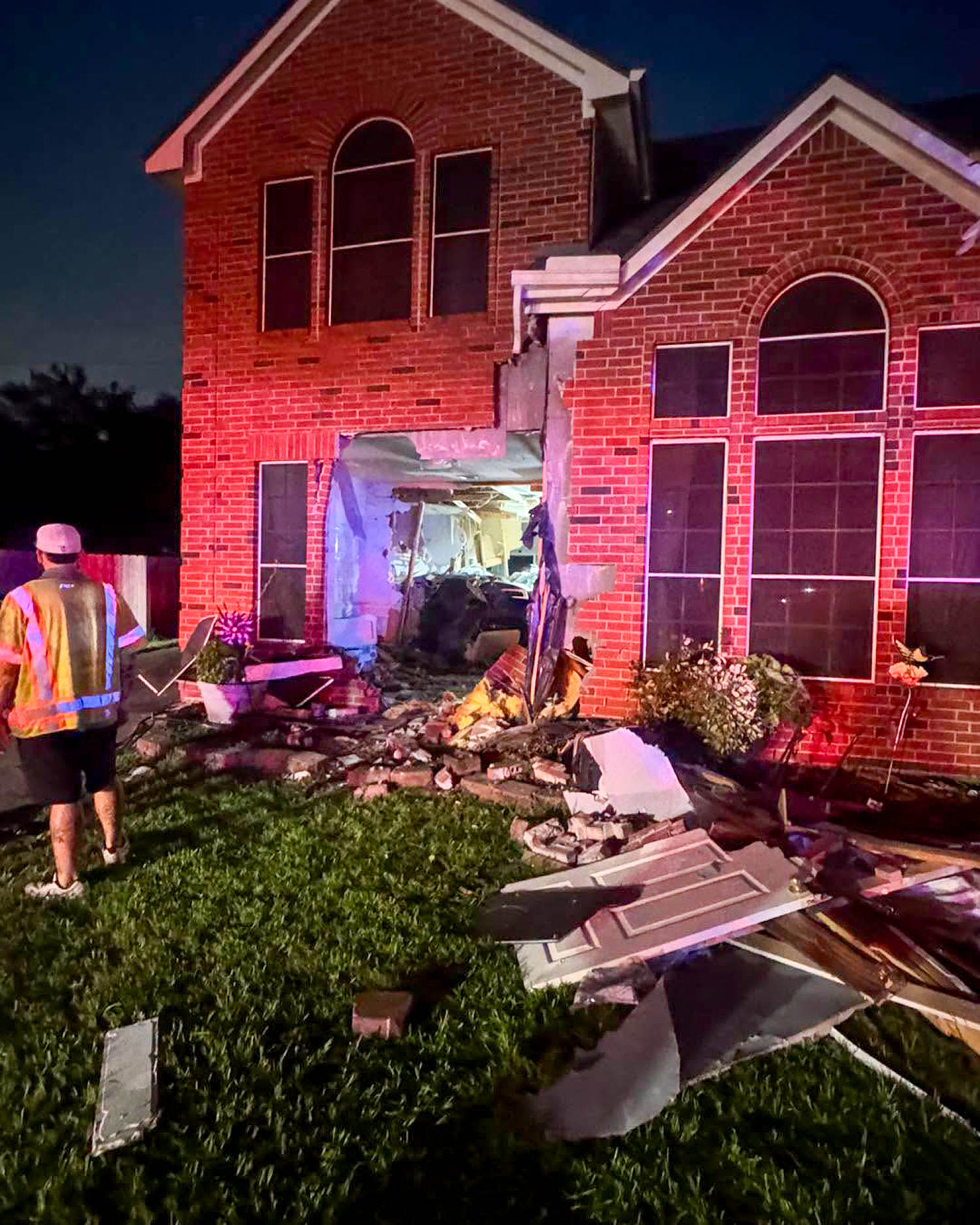
Automated driver-assistance software does not eliminate vehicular risk; it redistributes it, often compounding the severity of failures by introducing severe human cognitive friction. When a Tesla Model 3 left its lane, failed to execute a turn at an intersection, and propelled through a brick residence in Katy, Texas, at an estimated speed of 60 to 70 miles per hour, the mechanical reality stripped away marketing nomenclature. The fatal impact, which resulted in the death of 76-year-old Martha Avila inside her home, highlights a systemic point of failure in Level 2 automation: the transition of control bottleneck.
Analyzing this incident requires looking past the localized variable of driver statements to examine the structural mechanics governing human-machine interfaces in semi-autonomous transportation. The core failure mode resides at the intersection of automation complacency, mechanical kinematics, and regulatory latency. You might also find this connected article useful: Why Apps Won’t Save Us From The Next Great Flood.
The Automation Complacency Loop
Human operators behave predictably when tracking loops are automated. When a system handles lateral steering and longitudinal acceleration successfully for extended intervals, the human operator undergoes cognitive offloading. This psychological shift alters the user's role from an active driver to a passive monitor.
The Out-of-the-Loop Performance Penalty
Human beings are notoriously poor monitors of automated systems. The Out-of-the-Loop (OOL) performance penalty dictates that when a automated system encounters an edge case that it cannot resolve, the time required for a human operator to regain situational awareness, evaluate the spatial variables, and execute a corrective physical maneuver is significantly higher than if they were driving manually. As discussed in detailed articles by Wired, the implications are notable.
[System Operational] -> [Cognitive Offloading] -> [Environmental Edge Case] -> [Alert/Failure] -> [Latency to Re-engage] -> [Catastrophic Outcome]
In standard driving conditions, a human operator responds to an unexpected obstacle or trajectory deviation in approximately 1.5 seconds. When the operator is offloaded via an advanced driver-assistance system (ADAS), that latency can balloon past 4 to 7 seconds. At a velocity of 60 miles per hour, a vehicle travels 88 feet per second. A five-second cognitive delay translates to 440 feet of unmonitored, uncorrected kinetic travel.
Systemic Mislabeling and Trust Inflation
The terminology used to describe software functions shapes operator risk tolerance. Semantic constructs like "Autopilot" or "Full Self-Driving" establish an inaccurate mental model for the end user. Although corporate documentation mandates that hands must remain on the steering wheel and visual attention must remain uninterrupted, the consumer-facing branding implies absolute autonomy. This friction between operational limits and marketing framing fosters a systemic environment where operators routinely game torque-based steering wheel sensors or cabin-facing camera monitoring arrays.
The Kinematics of Structural Penetration
Media reports often describe a vehicle "plunging" or "crashing through" buildings as an isolated act of misfortune. From an engineering perspective, this represents a predictable transfer of kinetic energy derived from vehicular mass and velocity meeting residential structural limits.
Kinetic Energy Scaling
The energy equation governing a vehicular impact is calculated using the standard formula:
$$E_k = \frac{1}{2}mv^2$$
Where:
- $m$ is the mass of the vehicle
- $v$ is the velocity at impact
A standard Tesla Model 3 maintains a curb mass of approximately 3,800 to 4,000 pounds (roughly 1,723 to 1,814 kilograms). When velocity doubles, the destructive energy quadruples.
| Velocity (mph) | Velocity (m/s) | Approximate Kinetic Energy (Kilojoules) |
|---|---|---|
| 30 | 13.4 | 163 |
| 45 | 20.1 | 366 |
| 60 | 26.8 | 651 |
| 70 | 31.3 | 888 |
A vehicle traversing a residential intersection at 60 to 70 miles per hour yields between 650 and 888 kilojoules of kinetic energy. Standard residential wood-frame and unreinforced brick-veneer construction methods are designed to withstand static loads and localized lateral wind forces; they possess minimal resilience against large-scale dynamic kinetic impacts. The energy envelope is entirely absorbed by the collapse of the building envelope and any objects or occupants in the direct path of travel.
Software Control of Acceleration Trajectories
Witness accounts from the Katy, Texas crash noted the vehicle appeared to accelerate rapidly or maintain an elevated velocity through a standard neighborhood street prior to leaving the asphalt. In a traditional internal combustion engine vehicle, unintended acceleration is frequently linked to mechanical floor-mat interference or acute driver panic causing pedal misapplication. In an electric vehicle operating under ADAS, acceleration profiles are digitally mediated.
If the software fails to perceive a dead-end, a sharp curve, or a T-junction due to sensor blinding, localized mapping errors, or camera-glare saturation, it will attempt to maintain its set speed or target trajectory. If the driver panics and misidentifies the brake pedal, or hesitates due to the OOL penalty, the electric motors deliver immediate torque, maximizing kinetic energy build-up right up to the point of impact.
Regulatory Deficits and Data Asymmetry
The recurring pattern of ADAS crashes hitting residential infrastructure points to an underlying regulatory deficit. The National Highway Traffic Safety Administration (NHTSA) has initiated multiple investigations into automated driving platforms, yet systemic enforcement relies primarily on retrospective recalls rather than proactive software validation.
The Problem with Post-Facto Recalls
In late 2023, a sweeping over-the-air software update was mandated across millions of vehicles to integrate more aggressive driver-monitoring alerts. The objective was to force operators to keep their eyes on the road. The persistence of high-velocity lane departures and structural impacts into 2026 demonstrates that software patches modifying alert frequencies are insufficient countermeasures against deep-seated psychological complacency loops.
The Architecture of Telemetry Secrecy
A distinct hurdle to public infrastructure safety is the asymmetry of telemetry access. Following a catastrophic event, local law enforcement agencies lack the specialized diagnostic tools needed to extract proprietary, encrypted onboard computer logs immediately. Investigations rely heavily on the driver’s verbal narrative until federal agencies like the National Transportation Safety Board (NTSB) issue a subpoena for the manufacturer's cloud-stored telemetry.
This data gap creates a period of public uncertainty where the root cause—whether it was pure human pedal misapplication, an unmitigated software hallucination, or a combination of both—remains obfuscated.
Technical Mitigation Vectors
Resolving the systemic failure of Level 2 automation requires a fundamental overhaul of human-machine collaboration frameworks. Moving forward, the industry must transition from passive monitoring loops to active, co-operative control systems.
1. Direct Driver-Engagement Verification
Torque-based steering wheel verification must be completely phased out across all vehicle production lines. Drivers easily spoof these sensors by applying static weights, which tricks the vehicle into registering active human participation.
Vehicles must utilize high-frequency infrared eye-tracking cameras capable of calculating cognitive gaze metrics. If the driver’s eyes leave the projected dynamic safety envelope of the road for more than 1.5 consecutive seconds, the vehicle must initiate an immediate, staged escalation sequence: audible alarms, seat belt vibration, and a controlled deceleration path within the current lane.
2. Geofencing and Velocity Governors
Autonomous driving software should not allow users to select target speeds that violate local infrastructure realities. Implementing strict geofencing protocols based on real-time GPS and high-definition mapping data can prevent the activation of highway-centric driver-assistance modes on suburban residential roads.
If a vehicle detects it is operating in a zone classified with a high density of single-family housing or pedestrian traffic, maximum velocity limits should be software-locked to matching local limits, preventing high-speed trajectories through neighborhood properties.
3. Fail-Safe Sensor Redundancy
The heavy reliance on pure optical camera streams creates acute vulnerabilities to weather conditions, direct sunlight blinding, and unexpected geometric profiles. Incorporating a diverse sensor stack—specifically integrating solid-state LiDAR and high-resolution radar networks—adds critical structural context to the vehicle's environment. When optical systems misclassify an upcoming curve or fail to distinguish a residential structure from an open horizon, secondary sensor frequencies can detect the solid spatial barrier and force an emergency automated braking sequence, overriding both driver inaction and software pathing errors.
The recurring incidents of semi-autonomous vehicles penetrating residential structures show that relying entirely on an off-the-loop human operator to act as the ultimate safety backstop is a flawed engineering approach. True system safety requires implementing hard software boundaries that proactively account for human cognitive limits, rather than expecting a passive driver to instantly correct for complex machine failures. Shifting away from marketing labels toward strict operational guardrails is the only viable path to protecting both vehicle occupants and the communities they traverse.