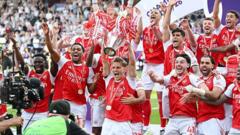
The football media is addicted to the myth of the dynasty. The moment a club lifts the Premier League trophy, pundits rush to print the same copy-pasted narrative: Is this the start of an empire? We saw it with Manchester City, we saw it briefly with Liverpool, and now, as Mikel Arteta’s Arsenal hovers on the precipice of domestic glory, the machinery is churning out the same lazy consensus. They point to the young squad, the long-term contracts, and the tactical discipline. They tell you that a breakthrough title will unlock a decade of supremacy.
They are completely wrong.
A title win for Arsenal wouldn't be the foundation of a new era of dominance. It would be the absolute peak of it. The modern football ecosystem has fundamentally changed, yet the analytical framework used to judge it is stuck in 1999. In the current financial and regulatory environment, winning a title doesn't make you invincible; it makes you a target, exposes your structural vulnerabilities, and triggers a mathematical regression to the mean.
The question isn't whether Arsenal can build a dynasty. The question is why anyone thinks a dynasty is still possible in England.
The Mirage of the Young Core
The central pillar of the "Arsenal Dominance" argument relies on age profiling. The logic seems ironclad on the surface: William Saliba, Bukayo Saka, Martin Ødegaard, and Declan Rice are all tied down to long-term deals, approaching or entering their prime years. The assumption is that these players will continue to improve linearly while playing together for the next five seasons.
Football tracking data and historical squad building reveal this to be a fantasy. Squads do not mature in perfect harmony. They fracture under the weight of their own success.
Consider the financial mechanics of success. When a young squad wins, every agent in world football walks into the executive offices demanding a market-rate salary upgrade. Players who signed five-year deals as "promising talents" suddenly want parity with the highest earners in Europe.
I have watched sporting directors navigate this exact inflection point. It is a mathematical trap. To keep the squad together, you blow up your wage structure. When you blow up your wage structure, your financial flexibility vanishes.
Look at the numbers. Arsenal’s wage bill has already surged significantly over the last three seasons to keep pace with their competitive leap. Winning the league pushes that over the edge. You are no longer paying for potential; you are paying premium prices for realized performance. This kills your ability to regenerate the squad.
Furthermore, player development is cyclical, not linear. Marcus Rashford looked like a global superstar at 25; his trajectory since has been a rollercoaster. Dele Alli was statistically ahead of Kevin De Bruyne at age 21. If you assume Saka or Saliba will simply maintain an upward trajectory without a plateau or a devastating injury cycle, you are ignoring the brutal reality of modern, high-intensity elite football.
The Financial Fair Play Paradox
The lazy consensus ignores how Profit and Sustainability Rules (PSR) and UEFA’s Squad Cost Rules actually function in practice. The old blueprint for dominance—pioneered by Manchester United in the 90s and replicated by Chelsea and Manchester City—relied on financial asymmetry. You won, you generated more cash, and you spent that cash to buy the best players from your direct competitors, effectively weakening them while strengthening yourself.
That avenue is dead.
The current regulatory framework locks the traditional big clubs into a tight financial box. Arsenal cannot simply go out and buy three £80 million players next summer to refresh their bench, even if they win the league and pocket the Champions League television bounty.
Every pound spent on amortized transfer fees and wages is strictly monitored against revenues. Winning the Premier League brings a marginal increase in prize money compared to finishing second—roughly a few million pounds. The real commercial upside comes from sustained global merchandising and sponsorship renegotiations, which take years to materialize.
Meanwhile, the cost of maintaining the current squad skyrockets.
Imagine a scenario where Arsenal wins the league this season. By July, the market value of their squad is artificially inflated. If they want to add depth to compete on four fronts—something they have notably struggled to do under Arteta, often crashing out of domestic cups early to protect their league form—they will face a "champions tax." Selling clubs will demand premium fees, and incoming players will demand premium wages. Arsenal’s efficiency in the transfer market, which has been excellent recently, will be severely tested. They will no longer be the hunters; they will be the hunted, operating with zero financial margin for error.
The Myth of Tactical Invincibility
Tactically, Mikel Arteta has constructed a magnificent machine. His deployment of a rigid out-of-possession structure, coupled with positional fluidity in the final third, has turned Arsenal into Europe’s most elite defensive unit. They choke space, dominate set-pieces, and suffocate transitions.
But dominance requires tactical longevity, and tactical longevity is an oxymoron in the Premier League.
The league is a crucible of elite coaching. The moment a specific tactical system wins a title, twenty opposition video analysts spend the entire summer breaking down its mechanical flaws.
We saw this happen to Jürgen Klopp’s Liverpool. Their intense, high-pressing 4-3-3 terrified Europe for three years. Then, opposition teams learned to drop deeper, bypass the press entirely with direct balls to the flanks, and exploit the space left by advancing full-backs. Liverpool had to evolve, a process that cost them titles and forced a midfield rebuild.
Arteta’s system relies on immense physical output and highly specific profiles. If Thomas Partey’s fitness wavers, or if Jorginho’s legs finally go, the structural integrity of the midfield changes. The drop-off from Arsenal's starting eleven to their second string is still sharper than that of Manchester City.
To dominate, you need a squad deep enough to change tactical blueprints entirely from one week to the next. Arsenal wins by perfecting one highly complex blueprint. If an opponent finds the wrench to throw into that specific gear, Arteta has historically struggled to find an immediate plan B within his squad depth.
Dismantling the Premier League Questions
When people ask the wrong questions about footballing success, they get useless answers. Let’s address the real, uncomfortable truths behind the queries dominating the football landscape right now.
Does a young squad guarantee a long trophy window?
Absolutely not. A young squad guarantees nothing but rising market values and impending contract disputes. The assumption that youth equals longevity ignores the psychological toll of elite football. Winning a title requires an emotional and physical output that is rarely repeatable back-to-back. The hunger changes. The media scrutiny intensifies. Suddenly, a draw away at Everton isn't a minor bump in the road; it's a full-blown crisis.
Can anyone replicate Manchester City's decade of dominance?
No, because the conditions that allowed Manchester City to dominate are gone. City built their foundation in an era of lax financial regulation, allowing them to accumulate an unprecedented stockpile of world-class talent. They created a squad where Jack Grealish, Julian Alvarez, and Kalvin Phillips could sit on the bench while Riyad Mahrez and Ilkay Gündogan operated on the pitch. No club, including Arsenal, can assemble that level of redundant talent under today's financial restrictions without triggering immediate regulatory sanctions.
Does winning a trophy change a club's DNA?
This is romantic nonsense peddled by broadcasters. "Winning DNA" is just a retrospective label we apply to teams that had better squad depth and fewer injuries than their rivals. Winning a trophy gives a squad confidence, sure, but it also breeds complacency. It convinces players that their current level is sufficient, when history proves you must constantly improve just to stay in the same place.
The Reality of the New Era
If Arsenal wins the Premier League title, celebrate it for what it is: a spectacular, hard-fought, single-season achievement that validates years of meticulous planning by Arteta and Edu.
But do not mistake it for the start of an empire.
The future of the Premier League is not a monopoly; it is a chaotic, cyclical battlefield. The financial gaps between the top six are narrowing in terms of what they are legally allowed to spend. Newcastle United, Aston Villa, and a rebuilt Manchester United will continue to disrupt the upper echelons. The physical demands of the expanded Champions League format will break squads that lack genuine, world-class secondary depth in every position.
Arsenal's current model is built for the chase. It is lean, focused, and highly optimized. But the traits required to hunt down a champion are entirely different from the traits required to fend off five hungry challengers simultaneously while managing a bloated wage bill and an exhausted squad.
Enjoy the peak, Arsenal fans. Just don't expect the view to stay this clear for long.