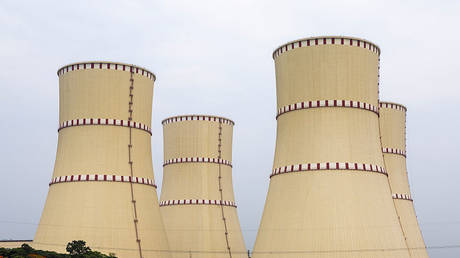
The air in Rooppur doesn't just hang; it clings. It is a thick, humid curtain smelling of river silt and the diesel exhaust of a thousand construction trucks. For decades, this patch of land on the bank of the Padma River was defined by the slow, rhythmic toil of agriculture. But today, the horizon is dominated by two massive, concrete silhouettes that look like they belong in a different century—or perhaps on a different planet.
These are the cooling towers of Bangladesh’s first nuclear power plant. They are monuments to an ambition that has been simmering since the 1960s, a dream deferred by wars, poverty, and the complex shifting sands of global geopolitics. Now, as the project enters its final, most critical stage, the stakes are no longer theoretical. They are measured in megawatts and the daily survival of 170 million people.
The Weight of a Flickering Bulb
To understand why a nation would invest $12.65 billion—much of it borrowed from Russia—into a single patch of riverside earth, you have to talk to someone like "Arif." Arif is a hypothetical shopkeeper in Ishwardi, but his reality is shared by millions. When the sun dips below the horizon, Arif’s world used to go dark. Not the soft darkness of a suburban evening, but the sharp, frustrating blackout of a "load shedding" event.
Imagine trying to run a business where the tools of your trade—refrigerators, sewing machines, computers—simply die for four hours a day without warning. The heat becomes a physical weight. The silence of a dead fan is deafening. For Arif, and for the garment factories that form the backbone of the Bangladeshi economy, electricity isn't a luxury. It is oxygen.
The Rooppur Nuclear Power Plant is designed to pump 2,400 megawatts of that oxygen into the national grid. It is the difference between a child studying by a kerosene lamp and a child studying under a LED bulb. It is the difference between a factory meeting its export deadline and a factory shuttering its doors.
The Russian Blueprint
This isn't a homegrown miracle. It is a Russian export, a VVER-1200 reactor design that brings with it a small army of engineers from Moscow and Saint Petersburg. Walking through the Rooppur complex feels like stepping into a bilingual bubble. Signs are in Bengali and Cyrillic. The canteen serves borsch alongside spicy lentil dal.
Russia’s Rosatom isn't just providing the steel and the uranium; they are providing the technical DNA for a country that has never handled a radioactive isotope on this scale. The partnership is a marriage of necessity. Bangladesh needed a partner willing to provide a turnkey solution and, more importantly, a massive loan covering 90% of the cost. Russia needed to prove that its nuclear technology remains a viable global commodity despite the crushing weight of international sanctions.
The physics of the VVER-1200 is a marvel of redundant safety. It utilizes a "passive" safety system, meaning that even if the power fails—a nightmare scenario in a country prone to cyclones and flooding—the reactor is designed to cool itself through natural convection. It is a heavy, physical answer to the ghosts of Chernobyl and Fukushima.
The Invisible Geopolitics of Uranium
In late 2023, the project hit a milestone that changed everything: the arrival of the first shipment of uranium. When those fuel rods were lowered into the facility, Bangladesh officially became the 33rd nuclear power-producing nation in the world.
But fuel is never just fuel.
Every bundle of uranium represents a thread tying Dhaka to Moscow for the next sixty to eighty years. Nuclear plants are not like gas-fired stations where you can simply buy fuel from the highest bidder on the open market. The technology is proprietary. The waste management is specialized. By choosing Russian reactors, Bangladesh has made a generational bet on its relationship with the Kremlin.
This creates a delicate dance. While the West watches with a mixture of caution and skepticism, the Bangladeshi government maintains that this is a move of pure pragmatism. They point to the skyrocketing cost of Liquefied Natural Gas (LNG) and the unreliability of coal. In a world where energy prices are weaponized, having a steady, base-load power source that doesn't fluctuate with the price of a barrel of oil is a form of national sovereignty.
The Shadow of the River
Then there is the Padma. The river is the lifeblood of the region, but it is also a mercurial neighbor. Critics of the project point to the changing climate—the intensifying monsoons and the unpredictable shifts in water levels. A nuclear plant requires a staggering amount of water for cooling. If the river shrinks or if the siltation patterns change, the "heart" of the plant could struggle to beat.
Engineers at the site dismiss these fears with the confidence of people who have calculated the math a thousand times over. They speak of reinforced embankments and intake channels designed to withstand "once-in-a-century" floods. Yet, for the farmers living downstream, the fear remains visceral. It is a fear of the unknown. They see the steam rising from the towers and wonder if the water they use for their paddies will ever be the same.
The reality is that Rooppur is a gamble against time. Bangladesh is one of the most climate-vulnerable nations on earth. Its transition away from fossil fuels is not a choice; it is a survival tactic. Solar and wind are part of the mix, but they cannot yet power the massive industrial zones that drive the GDP. Nuclear is the "heavy lifter" in this scenario, providing a low-carbon backbone that renewables can’t yet match.
The Final Stretch
We are now in the "hot functional" testing phase. This is the dress rehearsal. No nuclear reaction is happening yet, but the systems are being pushed to their limits with heat and pressure to ensure every weld, every valve, and every sensor performs under stress.
It is a period of intense, quiet anxiety. Thousands of workers move through the site with a sense of purpose that borders on the religious. They know that the world is watching. They know that a single mistake here wouldn't just be a localized disaster; it would be the end of nuclear aspirations for the entire region.
The cost is immense. The debt is real. The geopolitical ties are complicated. But as the sun sets over the Padma, and the lights in Ishwardi begin to flicker, the promise of Rooppur feels less like a political project and more like a bridge to a different kind of future.
It is a future where a teenager in a rural village can boot up a laptop without checking the clock. Where a surgeon in a district hospital doesn't have to worry about the backup generator failing mid-procedure. It is the sound of a turbine spinning at 3,000 revolutions per minute, turning the invisible power of the atom into the very visible light of a nation finally waking up.
The towers stand tall against the darkening sky, white giants in a land of green. They don't speak, but their presence says everything. The era of the flickering bulb is coming to an end, replaced by the steady, unyielding hum of a high-tech heart beating on the riverbank.