The surge in intercepted Russian loitering munitions reported by Ukrainian defense officials is not merely a tactical victory; it is a manifestation of a fundamental shift in the volume-to-effectiveness ratio of modern aerial warfare. While media narratives focus on the record-breaking "headline numbers" of downed drones, a rigorous analysis must prioritize the underlying economic and technical metrics: the cost-exchange ratio, the saturation threshold of electronic warfare (EW) systems, and the industrial throughput of the Shahed-136 production lines.
The Triad of Modern Air Defense Efficiency
To understand why a "record number" of shoot-downs may be a lagging indicator of security rather than a leading one, we must examine the three pillars of air defense sustainability.
1. The Cost-Exchange Ratio (CER)
The primary objective of mass-produced, low-cost loitering munitions is to force the defender into an "asymmetric depletion" trap. If a $20,000 Geran-2 (Shahed variant) is intercepted by a $2 million Patriot or IRIS-T missile, the attacker wins the economic engagement regardless of whether the target was hit. Ukrainian defense strategy has pivoted toward mitigating this through:
- Mobile Fire Groups (MFGs): Utilizing heavy machine guns and MANPADS to keep the CER in favor of the defender.
- Electronic Warfare Intervention: Neutralizing GPS/GLONASS signals to force the drone into inertial navigation, significantly reducing its CEP (Circular Error Probable).
2. The Saturation Point
Saturation occurs when the number of incoming threats exceeds the number of available tracking and engagement channels. By launching record numbers of drones, the offensive strategy seeks to "blind" or overwhelm local radar arrays, allowing a small percentage of high-value cruise missiles to slip through the gaps created by drone-induced chaos.
3. Kinetic vs. Non-Kinetic Interception
A record number of shoot-downs indicates high kinetic success, but it also signals a massive expenditure of ammunition. The sustainability of this defense depends on the replenishment rate of Western-supplied interceptors versus the scale of Russian domestic production in facilities like the Alabuga Special Economic Zone.
Technical Evolution of the Shahed Class Munition
The record numbers reported last month are a byproduct of Russia’s transition from procurement to indigenous mass production. This shift has introduced several technical iterations that complicate the interception process.
- Carbon Fiber and Radar Absorbent Materials: Newer iterations have shown increased use of composites designed to reduce the Radar Cross Section (RCS), making them harder for older detection systems to track at long ranges.
- Integrated SIM Cards and 4G Modems: By utilizing local cellular networks, these drones can provide real-time telemetry back to the operator, allowing for mid-flight rerouting based on active air defense positions. This turns a "dumb" one-way drone into a dynamic reconnaissance asset.
- Warhead Optimization: The shift from generic high-explosives to thermobaric or tungsten-shrapnel warheads increases the lethality of the munitions that do manage to bypass the defense perimeter.
The Geometry of Air Defense Networks
Air defense is not a static wall but a layered, geometric problem. The effectiveness of a record-setting month is determined by the "Success-to-Resource" ratio. The Ukrainian defense relies on three distinct layers:
The Outer Layer: Long-Range Detection
Early warning systems, including NATO-integrated AWACS and ground-based passive sensors, provide the initial vector data. The limitation here is the curvature of the earth; low-flying drones can exploit terrain masking to stay below the radar horizon until they are within the inner defense rings.
The Middle Layer: Electronic Suppression
This layer is the most cost-effective but the least documented. Fixed and mobile EW units (such as the Bukovel-AD) jam the control and navigation frequencies. A drone "downed" by EW is a total victory, as it preserves kinetic ammunition. However, the move toward CRPA (Controlled Reception Pattern Antennas) in Russian drones is making them increasingly resistant to localized jamming.
The Inner Layer: Point Defense
This is where the record numbers are typically generated. Flak guns like the Gepard or C-RAM systems offer a high volume of fire with a low cost-per-kill. The bottleneck here is physical coverage. To protect a nation the size of Ukraine, the density of these systems must be immense. A record number of shoot-downs in one month often indicates that the attacker is probing specific corridors to identify where these point-defense systems are concentrated or absent.
Economic Bottlenecks in the Production-Interception Cycle
The conflict has devolved into a contest of industrial endurance. We can model the current state of the drone war using a basic production-attrition function.
If $P$ represents the monthly production rate of drones and $A$ represents the attrition rate (shoot-downs), the effectiveness of the offensive is $E = P - A$. A record number of $A$ (attrition) is only significant if $P$ (production) remains constant. Data suggest that Russian production capacity is scaling faster than the Ukrainian ability to field new mobile fire groups. This creates a "volume gap" where, despite high interception percentages, the absolute number of drones hitting targets could still increase.
The Logistic Burden
Intercepting 500 drones a month creates a massive recovery and disposal burden. Each downed drone must be treated as Unexploded Ordnance (UXO). Furthermore, the intelligence gathered from the wreckage—analyzing serial numbers and foreign-sourced microelectronics—is a race against time before the manufacturer patches the vulnerability.
Strategic Pivot to Counter-Battery and Deep Strike
The current Ukrainian response to record drone waves is shifting from "Active Defense" (shooting them down) to "Proactive Neutralization" (destroying them on the ground). This involves:
- Targeting Storage Facilities: Using long-range assets to strike warehouses before the drones are deployed.
- Disrupting the Supply Chain: Mapping the flow of components from third-party nations to the assembly lines.
The limitation of the "record shoot-down" metric is that it measures the symptom, not the cause. A defense strategy that only reacts to the volume of incoming fire is fundamentally reactive and eventually unsustainable.
Operational Recommendations for Defensive Parity
To move beyond the cycle of reactive interception, the defense must optimize its internal processes across three vectors:
- Sensor Fusion Automation: Reducing the "sensor-to-shooter" time by using AI-driven acoustic sensors that can detect the specific frequency of a lawnmower engine (characteristic of the Shahed) before it enters radar range.
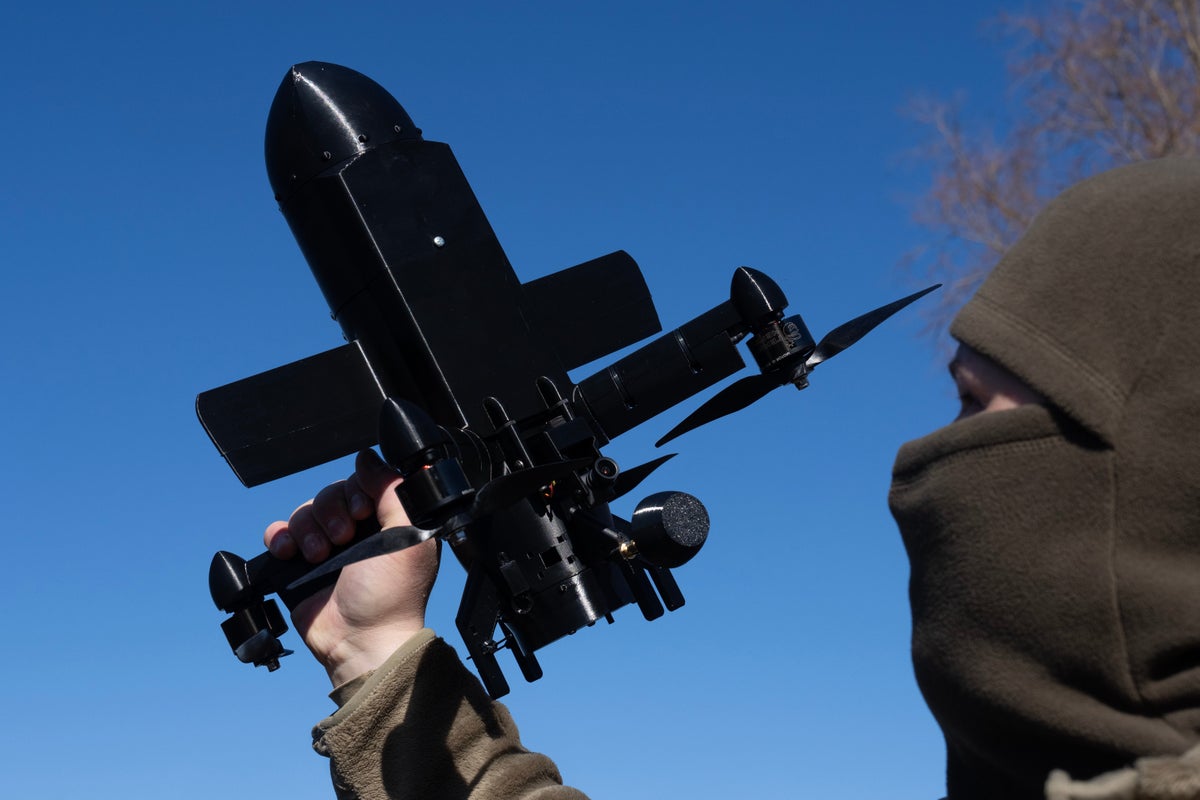
- Ammunition Diversification: Decreasing reliance on expensive missiles by increasing the deployment of FPV (First Person View) interceptor drones. These are small, agile drones designed to crash into and destroy larger loitering munitions at a fraction of the cost of a MANPADS.
- Infrastructure Hardening: Recognizing that 100% interception is impossible, the focus must shift toward passive defense—physical barriers, underground cabling, and decoy targets to absorb the kinetic energy of the drones that inevitably get through.
The record numbers reported last month signify a maturing of the defensive layer, but they also serve as a stark warning of the attacker's ability to scale. The victory is not in the number of drones destroyed, but in the preservation of the CER and the continuous denial of the attacker's primary objectives. Success in this theater is defined by the ability to make the attacker's "cost of failure" higher than the "value of the target."
Deploy FPV interceptor swarms as the primary layer for low-altitude, low-speed targets. This preserves high-tier interceptors for ballistic threats and shifts the economic burden back onto the aggressor.