You didn't have to wait long after the graphic video hit social media on Monday night to know what would happen next. In North Belfast, a man in his 40s named Stephen Ogilvie was brutally attacked on the street with a kitchen knife. The assault was horrifying. Ogilvie suffered deep lacerations to his head, face, and back, and a police detective later confirmed the attack blinded him in his left eye.
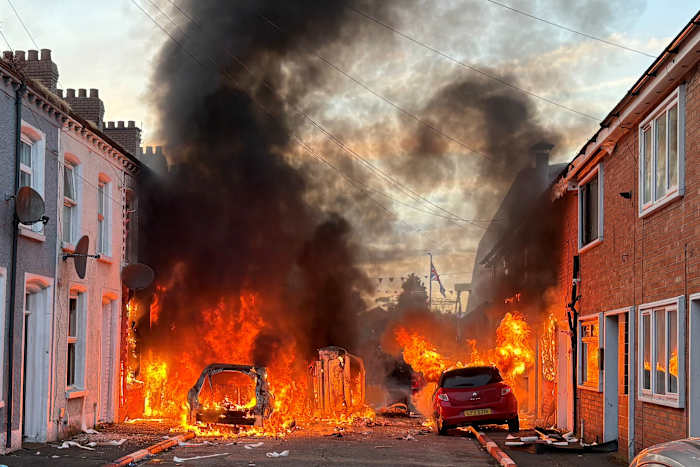
The suspect, 30-year-old Sudanese national Hadi Alodid, was found by police still on top of the victim. But before the police could even process the crime scene, the footage was already being weaponized online. By Tuesday night, parts of Belfast were burning. Masked men roamed the streets, setting fire to homes, torching a transit bus, and forcing terrified families—including one with a two-month-old baby—to flee for their lives.
When Alodid appeared via video link in Belfast Magistrates' Court on Wednesday, June 10, 2026, he faced charges of attempted murder, possession of an offensive weapon, and making threats to kill. He refused legal representation, spoke through an Arabic interpreter, and entered no plea. He's being held in custody. But while the legal process against the suspect is just beginning, the broader social explosion on the streets shows that Northern Ireland's underlying tensions are closer to the surface than many want to admit.
From a Crime Scene to Urban Warfare
The escalation from a localized violent crime to city-wide rioting happened with terrifying speed. It's a pattern we're seeing repeated across the UK. Right-wing activists and online agitators immediately jumped on the suspect’s immigration status to mobilize crowds. Alodid had entered Northern Ireland from the Republic of Ireland in 2023, applied for asylum, and was granted a five-year permit to remain.
For those looking to stoke anger, this was fuel for the fire.
By Tuesday evening, the response wasn't a peaceful protest or a demand for justice. It was targeted violence. Around 100 masked men gathered on Newtownards Road in East Belfast. They didn't just chant slogans; they kicked in doors, smashed windows, and threw bricks. They set fire to trash bins and torched a public bus, which forced transit authorities to suspend all bus services across the entire city.
Most disturbingly, the crowds targeted residential homes they believed belonged to immigrants. Firefighters had to rescue multiple people from burning buildings. Police Service of Northern Ireland (PSNI) Chief Constable Jon Boutcher didn't mince words when describing the aftermath, noting that police spent the night moving innocent families to safety inside police stations.
Local community leaders reported that families who had lived in those neighborhoods peacefully for two decades were suddenly forced out. A local pastor shared that members of his own congregation were among those targeted simply because of their racial background.
The Political Fallout and the Open Border Dilemma
The political reaction was swift, coming from both sides of Northern Ireland’s fractured power-sharing government. First Minister Michelle O’Neill of the Irish nationalist party Sinn Féin called the riots "disgusting cowardice" and pure thuggery. Deputy First Minister Emma Little-Pengelly of the pro-British Democratic Unionist Party (DUP) pointed out the obvious flaw in the rioters' logic, stating that taking out frustration over one individual's evil actions on innocent people who had nothing to do with it is completely wrong.
In London, Prime Minister Keir Starmer condemned the initial stabbing as "sickening" but made it clear that the government has zero tolerance for racist violence. Justice Minister Naomi Long took aim at the online influencers driving the chaos from afar, noting that many social media agitators pushing for violence would have struggled to find Belfast on a map a day earlier.
But beneath the standard political condemnation lies a much thornier political issue: the open border.
Northern Ireland shares a land border with the Republic of Ireland. Because of the delicate peace process and the Good Friday Agreement, this border remains entirely open with no passport checks. Police tracking showed that Alodid traveled from Sudan to Paris, then to Dublin, before taking a simple bus journey up to Belfast to lodge his asylum claim in February 2023.
Now, politicians like DUP leader Gavin Robinson are using this incident to demand a harder look at what they call "uncontrolled immigration" and the vulnerabilities of the open border. It’s a highly sensitive topic. Messing with the border dynamics risks upsetting the political balance in Ireland, but leaving it completely unmonitored is becoming a primary talking point for the anti-immigration movement.
A Familiar Script of Exploitation
This isn't an isolated incident, and that's what makes the current atmosphere so dangerous. The unrest in Belfast comes right on the heels of similar tensions in England. Just last week, a life sentence was handed down to Vickrum Digwa for the December murder of university student Henry Nowak in Southampton. Digwa used a Sikh dagger to kill Nowak and then lied to police, claiming he was the victim of a racist attack.
Even though that case didn't involve an asylum seeker—both the victim and the killer were British citizens—far-right groups and external political figures, including U.S. Vice President JD Vance, seized on it to attack UK immigration policies. That narrative sparked a protest over Nowak's death that quickly turned into an assault on police officers with chairs and rocks.
The playbook is identical. A horrific, violent crime occurs. Before the facts are fully established by the police, the details are simplified, amplified, and broadcast across social media to trigger immediate, emotional rage.
The PSNI has stated clearly that there's no evidence to suggest the Belfast stabbing was terrorism-related. They aren't looking for any other suspects. The suspect was a lone individual with no prior record on any national security database. He wasn't known to local police. Yet, an entire community is being punished for his actions.
What Happens Next on the Ground
If you're living in or traveling through Belfast right now, the immediate focus is on safety and community stability. The city is on high alert, and further disruptions are likely as the court case moves forward. Here's what needs to happen to navigate the immediate aftermath:
- Monitor transit alerts: With bus services previously suspended citywide due to the torched vehicles, public transport routes are still seeing delays and sudden diversions. Check the Translink updates before traveling through East or North Belfast.
- Support local integration networks: Organizations like the Belfast Multi-Cultural Association are actively working to provide emergency shelter and resources for the families displaced by Tuesday's arson attacks.
- Report online incitement: The PSNI is actively monitoring social media footage to identify the masked individuals involved in the riots. Sharing unverified, inflammatory videos only serves the goals of the agitators.
The legal system will handle Hadi Alodid. The evidence against him appears overwhelming, from the eyewitness accounts to the video footage and his own statements to hospital staff where he openly admitted to the attack. He'll face justice in a courtroom. The much harder task is repairing the social fabric of a city that took decades to build a fragile peace, only to watch it get pushed to the brink of arson in a single night.