The world is a machine that processes grief into data. When a notable life ends, the machinery of public record whirs into motion, stamping out a neat sequence of coordinates: a name, a birthplace, a list of achievements, and a number representing the final age. But every so often, the machine encounters a truth so devastatingly human that the cold metal of a standard obituary simply fractures under the weight.
Marjane Satrapi, the fierce, uncompromising Iranian-French visionary who taught a generation how to see through the darkness of tyranny using nothing but black ink and white paper, has left us at 56.
To report that she died in Paris is factually accurate. To report her cause of death using standard medical jargon, however, would be a profound lie. Those closest to her did not speak of cardiovascular failure or respiratory arrest. They spoke the truth of the poet and the exile.
She died of sadness.
It is a diagnosis that science struggles to quantify, yet anyone who has ever felt the crushing weight of a fractured heart knows it to be entirely real. A little over a year ago, on April 8, 2025, the anchor of her world snapped. Her husband, the Swedish producer and actor Mattias Ripa—the man she publicly called the absolute love of her life—passed away.
For twelve months, her existence became a quiet, heartbreaking performance of mourning. If you happened to glance at her Instagram page over the last few weeks, you would not have seen the fiery political commentary or the vibrant updates of a celebrated artist. Instead, you would have seen a fragmented, multi-post message, painstakingly arranged to spell out a single, haunting phrase for the world to witness: For I lost the love of my life.
The grid of her digital presence became a monument to an empty chair. When the heart refuses to beat without its counterweight, the body eventually listens.
The Language Before Words
To understand the depth of the sorrow that finally claimed Satrapi, one must understand what she spent her entire life fighting against. She was born in 1969 in Rasht, Iran, near the shores of the Caspian Sea. Raised in Tehran by intellectual, Marxist parents—an engineer father and a dress-designer mother—she was just ten years old when the world she knew dissolved. The Shah fell, the Islamic Revolution swept across the nation, and suddenly, the willful, rock-and-roll-loving girl found herself suffocating under a mandatory veil and a regime that viewed free expression as a capital offense.
Fearful for her survival, her parents made the agonizing sacrifice that defines the modern immigrant story: they sent her away. At fourteen, she was thrust alone into the cold unfamiliarity of Vienna, and later, she found a permanent refuge in France.
Exile is a strange kind of ghosthood. You walk through streets that are not yours, speaking a tongue that isn't native to your dreams, constantly forced to explain your homeland to people who only know it as a violent soundbite on the evening news. Satrapi once noted that she grew weary of constantly defending Iran to Westerners who viewed her people as an monolithic mass of religious fanatics.
She realized that text was a clumsy tool. Words are filters. They require translation, and in the space between languages, nuance dies. So, she went backward to the oldest form of human connection.
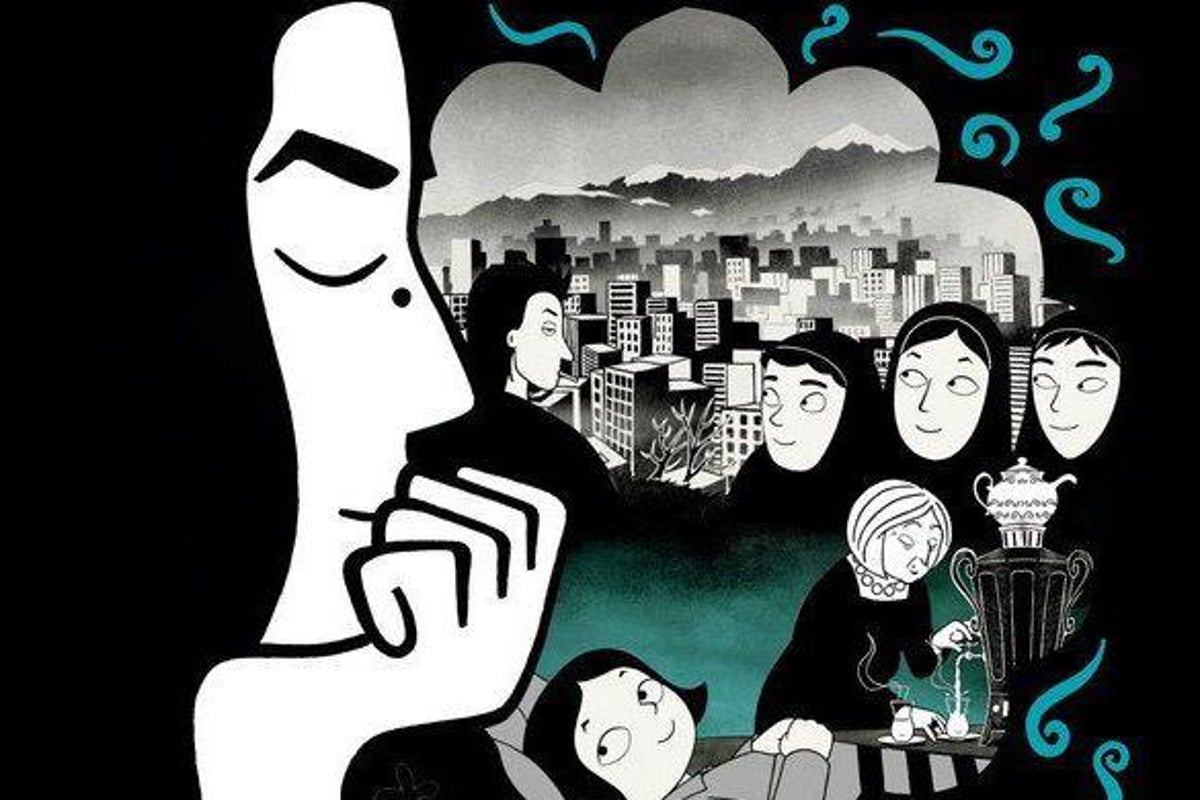
Consider the act of drawing. Long before humanity invented grammar, syntax, or alphabetized law, we scratched shapes onto the walls of caves to say I was here, and this is what I loved. Satrapi understood this implicitly. In 2000, she unleashed Persepolis, a monochrome graphic memoir that stripped away the geopolitical noise and laid bare the beating heart of an Iranian childhood.
The drawings were deceptively simple, rendered in stark, bold blocks of black and white. Yet, within those minimalist lines lay a universe of rebellion, humor, terror, and profound empathy. She showed a young girl secretly buying a smuggled Iron Maiden tape on the black market. She showed a mother weeping. She showed that beneath the headlines, the people of Iran loved, laughed, dreamed, and bled just like anyone else.
The book became an international phenomenon, selling millions of copies and shifting the global cultural consciousness. When she co-directed the animated film adaptation in 2007, it won the Jury Prize at Cannes and secured her a place in history as the first woman nominated for the Academy Award for Best Animated Feature.
But global acclaim is a poor shield against the ache of a stolen home.
The Weight of Standing Alone
Being a symbol is exhausting. For decades, Satrapi bore the mantle of the exile voice, an outspoken critic of the clerical establishment in Tehran, and a fierce advocate for human rights. When the "Woman, Life, Freedom" protests erupted in 2022 following the horrific death of Mahsa Amini in police custody, Satrapi did what she always did: she weaponized art. She brought together seventeen international artists to create a collaborative graphic work to ensure the world could not look away.
"If they kill you and the whole world doesn't care, how is that?" she asked in a raw interview. "Just recognize this."
It was a lifetime spent screaming into the wind, carrying the trauma of a displaced youth, the grief of an oppressed sisterhood, and the heavy burden of a culture misunderstood. She painted in isolation for years just to preserve her own sanity, admitting that her mental health depended entirely on locking herself away with a canvas.
Yet, humans are not built to carry the weight of the world entirely on their own. We need a sanctuary. For Satrapi, that sanctuary was Mattias Ripa. He was the quiet harbor where the storm of her public life could finally subside. He knew the woman behind the icon—the one who laughed loudly, loved deeply, and carried inner demons that only love could soothe.
When he died, the sanctuary collapsed.
French President Emmanuel Macron paid tribute to her by stating she transformed an Iranian childhood into a universal fable. Cannes festival chief Thierry Fremaux lamented the loss of an artist who embodied the joy of creation and the sorrow of exile.
But the most accurate tribute came from the quiet reality of her final year. She had survived a revolution. She had survived the loss of her homeland. She had survived the lonely labyrinth of exile and the intense pressures of international fame. But she could not survive the quiet, deafening silence of an empty home.
There is a tragic beauty in her departure. Marjane Satrapi spent her life proving to a cynical world that love, art, and human connection are the only things worth fighting for. In the end, she proved it by refusing to stay in a world where the greatest love she had ever known no longer existed.
The ink has dried, the final frame has been drawn, and the fierce, beautiful soul who gave a voice to millions has finally chased her heart into the quiet dark.