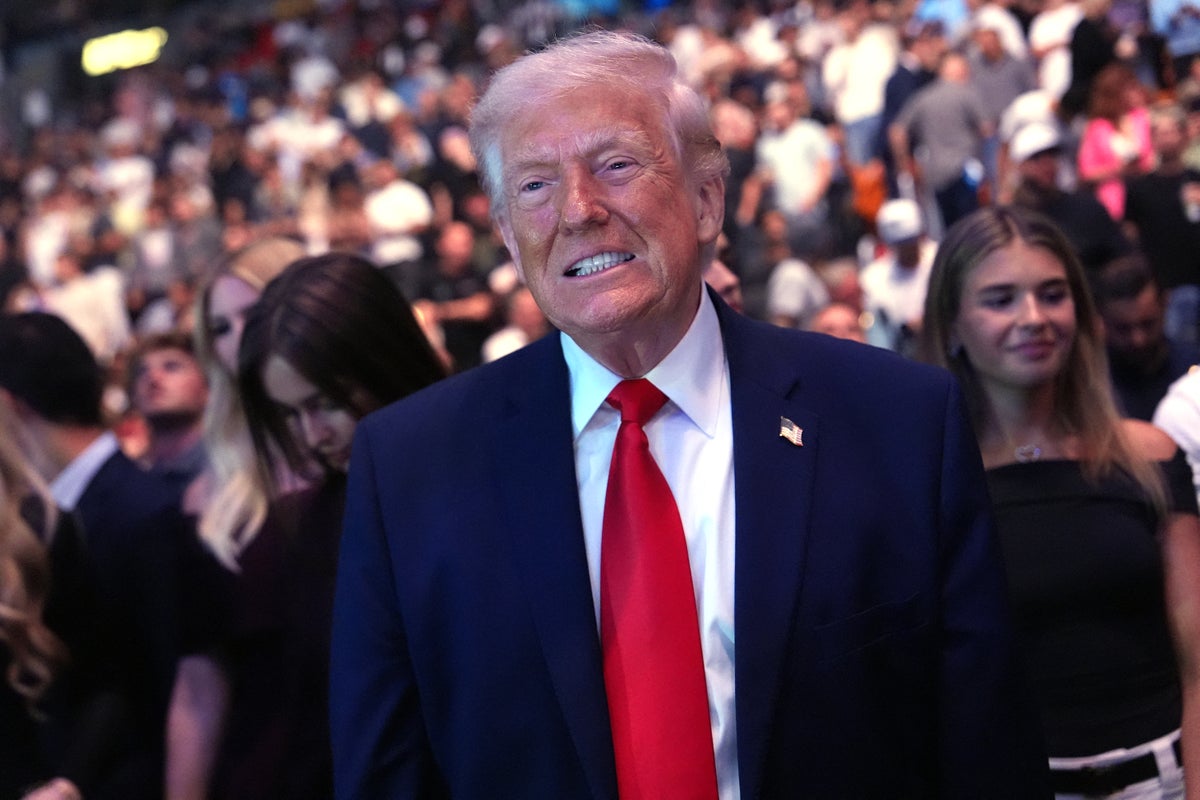
Heavy machinery is currently chewing up the South Lawn of the White House, erecting a six-foot wire-mesh octagon where the world's most violent sanctioned athletes will soon trade blood.
Billed as "UFC Freedom 250," the June 14, 2026 event is ostensibly a patriotic tribute to the semiquincentennial of the United States Declaration of Independence. The reality is far more transactional. This is a hyper-expensive, privately funded $60 million spectacle designed to fuse professional cage fighting with executive power, timed precisely to celebrate President Donald Trump’s 80th birthday. While corporate promotional copy paints this as a historic gift to the American public, the event exposes a stark collision of federal security, corporate ambition, and unprecedented regulatory gray areas.
The Millions Behind the Free Spectacle
On paper, the logistics look like an act of corporate charity. TKO Group Holdings, the parent company of the UFC, is absorbing the entire financial burden. The budget has ballooned from an initial $21 million projection—the cost of their groundbreaking production at Riyadh Season Noche UFC inside Las Vegas's Sphere—to a staggering $60 million.
Taxpayers are not footin the bill for the construction, nor will they pay the estimated $700,000 required just to re-sod and restore the torn-up executive grounds after the fighters pack up. But zero public funding does not mean public access.
The 4,300 seats surrounding the temporary outdoor arena are completely unavailable to the general public. Instead, a deeply exclusive gatekeeping process has taken hold. While roughly 1,000 seats are earmarked for active-duty military members, the remaining inventory is being tightly distributed.
President Trump is personally handpicking a significant portion of the guest list, turning ringside seating into the ultimate political currency. For high-rollers willing to spend money elsewhere, the UFC has reportedly packaged elite access to this crowd with $1.5 million VIP tickets that tie into separate high-profile fight cards later this summer.
The general public is being directed to The Ellipse, a park just south of the White House fence lines. The UFC plans to erect massive broadcast screens there, issuing up to 85,000 free tickets for a glorified viewing party. It is a stark spatial divide: the powerful and the deeply connected sit inside the security perimeter watching live skin hit canvas, while the masses watch a television feed from a park down the street.
A Shadow Commission on Federal Land
The most glaring anomaly of UFC Freedom 250 is not the location, but the complete absence of state legal oversight.
Professional combat sports in the United States survive on a strict foundation of state regulation. When a fight occurs in Las Vegas, the Nevada State Athletic Commission oversees drug testing, medical clearances, fighter payouts, and official matchmaking. In New York, the NYSAC holds total dominion.
The White House sits on federal land. Because of this unique jurisdictional status, no state athletic commission possesses the legal authority to sanction, referee, or judge the event.
Without a regulatory body, a professional fight card is technically an exhibition. The results cannot legally impact the professional win-loss records of the athletes involved. For a card featuring two major world championship fights, this created an immediate existential crisis for the promotion.
To bypass this legal vacuum, the UFC had to engineer a workaround. The promotion has requested that the Association of Boxing Commissions (ABC) step in as an independent third party to assemble an ad-hoc panel of judges, referees, and inspectors. The UFC maintains that it will voluntarily comply with standard medical examinations, pre-bout physicals, and drug-testing protocols.
"The UFC has confirmed that it will abide by all applicable regulatory requirements in support of this event," the promotion stated in a compliance brief, emphasizing that all bouts will be treated as licensed contests.
Yet, voluntary compliance is a fragile substitute for independent statutory law. If a fighter tests positive for a banned substance or a judging controversy occurs, there is no state government entity to issue fines, suspensions, or overturned decisions. The promotion is essentially policing itself on the lawn of the commander-in-chief.
Chaos Under the Open Sky
Standard UFC events take place in climate-controlled arenas where every variable is meticulously engineered. Moving an elite pay-per-view production to an outdoor space in Washington, D.C., in mid-June introduces environmental variables that production crews cannot completely control.
The card has been scaled back to a lean seven-fight lineup, a decision driven by strict time constraints and shifting daylight. The physical build is massive: a towering patriotic arch featuring stars-and-stripes patterns, two massive video walls, and a dedicated ringside area for a full marching band.
But the outdoor setting has introduced bizarre complications. UFC Chief Executive Officer Dana White recently acknowledged an unexpected, frantic operational issue: seasonal insect swarms.
The massive, high-intensity lighting rigs required to broadcast a high-definition pay-per-view at night act as a beacon for local bugs. During a site visit, production staff noticed heavy swarms gathering around the Rose Garden and South Lawn lighting arrays.
In a sport where a fraction of a second dictates whether an athlete gets knocked unconscious, insects flying into a fighter’s eyes, nose, or mouth during a high-stakes exchange is a genuine competitive hazard. The promotion's current solution involves deploying industrial-grade wind fans around the cage perimeter to disrupt insect flight paths without interfering with the cameras or blowing sweat and blood into the front rows.
The Card the Fans Didn't Want
Despite the historic nature of the venue, hardcore MMA fans have panned the actual fight lineup as underwhelming.
| Weight Class | Matchup | Title Status |
|---|---|---|
| Lightweight | Ilia Topuria vs. Justin Gaethje | Undisputed Title Unification |
| Heavyweight | Alex Pereira vs. Ciryl Gane | Interim Title Championship |
| Bantamweight | Sean O'Malley vs. Aiemann Zahabi | Non-Title Bout |
| Lightweight | Maurício Ruffy vs. Michael Chandler | Non-Title Bout |
| Middleweight | Bo Nickal vs. Kyle Daukaus | Non-Title Bout |
| Heavyweight | Josh Hokit vs. Derrick Lewis | Non-Title Bout |
| Featherweight | Diego Lopes vs. Steve Garcia | Non-Title Bout |
The main event features featherweight champion Ilia Topuria moving up to lightweight to unify his status against interim champion Justin Gaethje. While highly competitive, it lacks the broader cultural gravity of a historic crossover fight.
The co-main event features Brazil's Alex Pereira making his heavyweight debut against France's Ciryl Gane for an interim belt—a title created primarily because undisputed heavyweight champion Jon Jones remains sidelined, and interim champion Tom Aspinall was bypassed for the booking.
Further down the card, matchups like prospect Bo Nickal facing Kyle Daukaus and Josh Hokit fighting Derrick Lewis have faced criticism for looking more like standard television showcase fights than a premium, multi-million dollar stadium event. Trump reportedly requested Lewis's presence on the card personally, illustrating how executive whim has directly shaped the athletic matchmaking.
Disrupting the Capital
The physical transformation of the executive mansion has caused immediate friction in the surrounding District. Construction cranes and staging equipment have taken over the local landscape, forcing the relocation of long-standing civic events.
The Scripps National Spelling Bee, which spent 15 years operating out of a dedicated convention space, was forced to relocate to Constitution Hall. Families and competitors staying at nearby hotels have found their traditional walking routes across the Ellipse completely blocked by security fencing and heavy transport trucks, forcing long detours around the perimeter.
Security for the double-header event—the fan festival on June 13 and the fight card on June 14—has been designated a Level 1 Special Event Assessment Rating (SEAR 1) by the Department of Homeland Security. This puts the cage match on the same operational security tier as a presidential inauguration or a Super Bowl. Secret Service snipers will overlook a fighting cage surrounded by military personnel, corporate executives, and political allies.
The South Lawn has hosted tennis matches, jazz festivals, and easter egg rolls. It has never hosted a sport where the explicit objective is to inflict enough physical trauma to force a submission or a neurological shutdown. As the wire mesh goes up outside the Oval Office, the line between state power and raw sports entertainment has completely dissolved.

.jpeg?width=1200&auto=webp&trim=36%2C17%2C386%2C16)