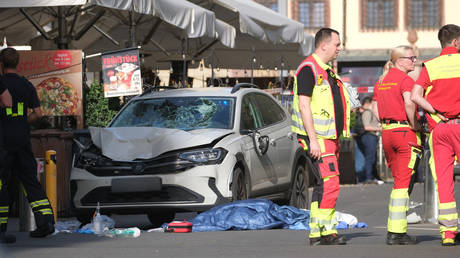
On a quiet spring Monday in Leipzig, the thin line between a bustling pedestrian thoroughfare and a scene of mass casualty evaporated in seconds. Two people are dead, and a score of others carry the physical and psychological scars of an afternoon shattered by an SUV accelerating through the Grimmaische Strasse. The suspect is in custody, but for the residents of Leipzig and policymakers across Germany, the primary question remains uncomfortably familiar: why does the heartbeat of a major city remain so profoundly exposed to a single vehicle?
The incident occurred at approximately 4:45 p.m. as the city center reached its late-afternoon density. Shoppers, families, and cafe patrons were caught in a trajectory that ended only when the vehicle struck a retractable bollard. That the bollard eventually stopped the carnage is a grim testament to the necessity of such infrastructure, yet it simultaneously highlights the agonizing gaps in our urban design. We are witnessing a cycle where public spaces are retrofitted with stopgap measures only after the tragedy has already occurred.
This is not the first time Germany has faced this specific nightmare. From the 2024 Magdeburg Christmas market attack to similar strikes in Berlin and Munich, the blueprint for these incidents is dangerously consistent. An individual utilizes a standard consumer vehicle, turns it into a kinetic projectile, and targets an area designed for human connection. The result is consistently devastating. The frequency of these events in recent years has shifted the conversation from theoretical risk management to a harsh, immediate requirement for defensive urban planning.
The central challenge lies in the fundamental nature of the German city. Pedestrian zones are the lungs of urban life, intended to be open, accessible, and inviting. The very characteristics that make these spaces successful—their lack of restrictive barriers and their integration with surrounding transit arteries—also render them uniquely susceptible to vehicular violence.
Engineers and security planners often point to the concept of Hostile Vehicle Mitigation (HVM) as the answer. This is not simply about dropping concrete blocks at every street corner. It involves a complex, tiered approach to risk reduction. True protection requires a blend of deterrence, traffic management, and incident response, all while maintaining the social function of the space.
Consider a hypothetical example of a modernized square. Instead of imposing, obtrusive steel barriers, designers can integrate security into the architecture itself. Reinforced benches, planters with deep-set foundations, and deliberate changes in street topography can subtly enforce speed limits and restrict vehicle access without turning a city center into a fortress. However, these solutions are costly and technically demanding to implement within historical old towns where digging into the bedrock can be archaeologically impossible or financially ruinous.
Furthermore, we must address the dynamic vehicle analysis that is too often ignored during urban development. A security assessment should calculate the maximum speed a vehicle can realistically reach before it hits a protected area. If a street is straight and wide, the kinetic energy at the point of impact is catastrophic. If the layout forces a vehicle to navigate tight, winding paths or sharp turns, the threat level decreases significantly. The failure to integrate these spatial limitations into city planning is a systemic oversight.
Local authorities often find themselves caught in a reactive loop. After an incident, public outcry demands immediate security, leading to the rapid deployment of temporary, often unsightly, barriers. These measures provide a sense of safety but frequently fail to address the broader, underlying risks. They are bandages on a structural wound. The shift toward a Vision Zero approach for road safety in Germany—which seeks to reduce fatalities across all road traffic—needs to broaden its definition of traffic violence to include these deliberate, weaponized acts.
Security, however, is never absolute. Even with perfect barriers, the unpredictability of human intent makes total prevention a fallacy. Experts acknowledge that if a determined actor is blocked from one entrance, they will simply look for a less protected one. This reality forces a difficult conversation about the extent to which we are willing to compromise the openness of our societies. Do we accept a higher level of risk as the price for a free, public life, or do we fundamentally alter how we interact with our cities?
There is also the matter of vehicle technology. Modern cars are increasingly connected and drive-by-wire, raising the specter of remote manipulation or the exploitation of automated safety systems. While this remains a niche concern compared to the blunt, manual use of a vehicle as a weapon, it represents an emerging frontier for law enforcement and cybersecurity agencies. The convergence of physical infrastructure failure and digital vulnerability is a problem that urban planners are not yet equipped to handle.
The families of those killed in Leipzig today are now living through the consequences of this systemic exposure. The Mayor of Leipzig, Burkhard Jung, has been forced to offer condolences for an incident that has again stripped away the illusion of safety in a routine shopping district. There is no political silver bullet, and there is no singular technical fix.
The path forward demands a departure from the current, reactive posture. It requires cities to move beyond temporary bollards and toward a permanent, architectural integration of safety that respects the purpose of public space. It demands that we treat the vulnerability of our city centers with the same urgency as we treat threats to national infrastructure. Until that shift occurs, the streets that host our most vital moments will continue to be potential corridors for the next catastrophe.
The bollards in Leipzig stopped the vehicle, but they did not stop the cycle. That will require a fundamental reassessment of what we are willing to do to keep a public square a place for people, and not a target for a motor vehicle. The work of redesigning these spaces is slow, expensive, and technically difficult, but the alternative is a continued, bloody series of lessons learned far too late.


