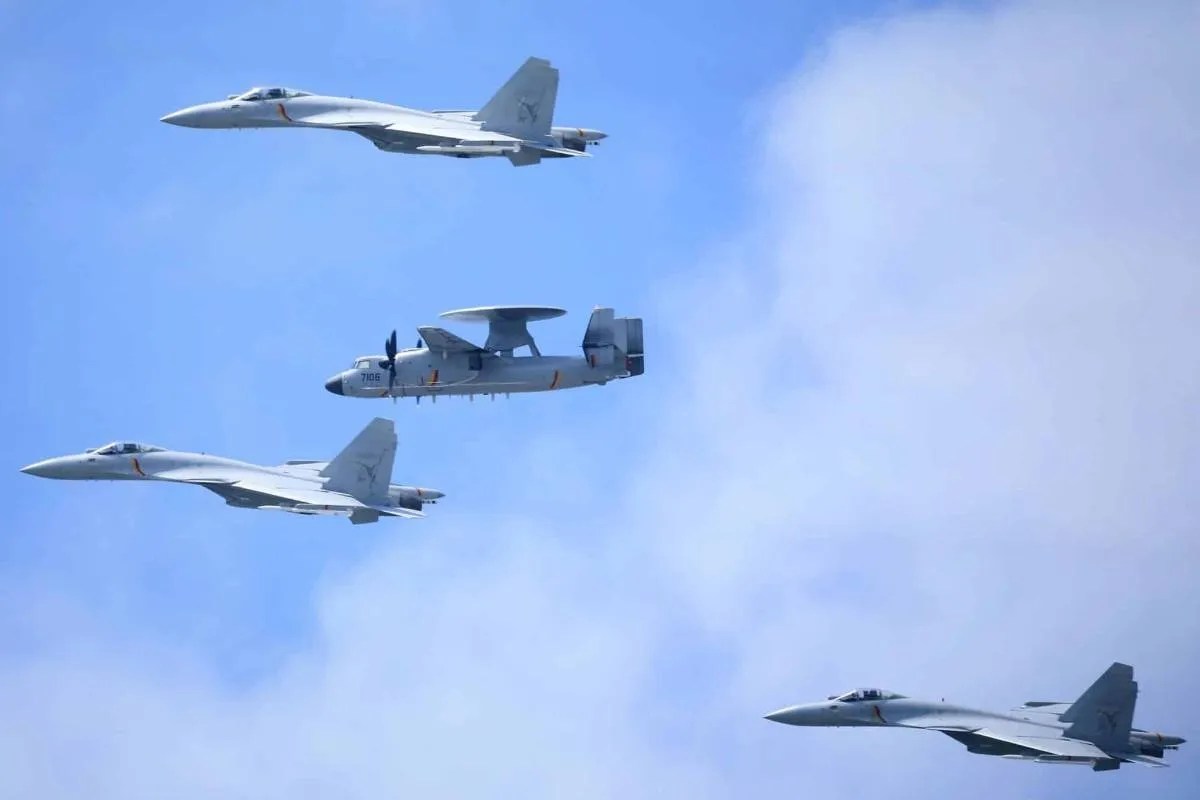
The media loves a predictable villain. Every time twenty-four Chinese aircraft and eight naval vessels drift across the median line in the Taiwan Strait, the headlines scream about an "imminent invasion" or a "tightening noose." They treat these maneuvers like a prelude to World War III. They are wrong.
This isn't a military buildup. It’s a theatrical production designed to drain the West’s coffers and mental bandwidth while China wins the actual war: the one being fought in silicon, not steel.
The Cost of Reactive Paranoia
Western analysts are obsessed with counting hulls and airframes. They see 24 planes and panic. What they fail to calculate is the asymmetry of exhaustion.
When China flies a sortie, they are using domestic fuel and pilots who are training in their own backyard. When the U.S. and its allies respond by surging carrier strike groups or placing regional forces on high alert, the cost is exponential. We are burning through flight hours on airframes that cost $100 million a pop to counter a Chinese show of force that costs them pennies on the dollar.
China isn't trying to land boots on the ground today. They are trying to make the status quo so expensive and psychologically taxing that the West eventually decides Taiwan isn't worth the bill.
The Myth of the D-Day Style Invasion
The "lazy consensus" suggests that China wants a kinetic, amphibious assault. This is a 1944 solution to a 2026 problem.
Amphibious invasions are the most difficult military maneuvers in existence. They require total air superiority, months of visible buildup, and a tolerance for casualties that would destabilize even the CCP. China knows this. They watched the logistics failures in Ukraine. They aren't going to repeat them.
Instead, they are perfecting the Gray Zone Blockade. Those 8 ships and 24 planes? They aren't an invasion force. They are a calibration exercise. They are testing how the global supply chain flinches. They are measuring the latency of the international response.
The real threat isn't a missile hitting Taipei; it’s a "regulatory inspection" of all merchant vessels entering the Strait that lasts for six months. By the time a single shot is fired, the Taiwanese economy would be hollowed out, and the global semiconductor market would be in a coma.
The Silicon Shield Is Actually a Target
Everyone talks about the "Silicon Shield"—the idea that China won't attack Taiwan because it needs TSMC’s chips.
That logic is decaying. China is currently pouring more capital into domestic legacy-node lithography and RISC-V architecture than any nation in history. They aren't trying to catch up to the 2nm process; they are trying to make the 2nm process irrelevant by dominating the 28nm and 14nm markets that actually run the world's cars, dishwashers, and medical equipment.
Once China achieves a threshold of "good enough" semiconductor independence, the Silicon Shield doesn't protect Taiwan—it marks Taiwan as a competitor that needs to be neutralized. The military drills are a smokescreen for this industrial decoupling. While we watch the radar screens, they are winning the fabrication war.
Deciphering the Theater of Escalation
Let’s talk about the numbers. 24 aircraft. 8 ships.
To the uninitiated, these numbers seem specific and threatening. To anyone who has spent time in a SCIF (Sensitive Compartmented Information Facility), these are budgetary signals.
- Domestic Signaling: The CCP needs to look strong during internal economic cooling. A fly-by is cheaper than a stimulus package.
- Normalization of Deviance: By making these incursions a daily occurrence, they desensitize the world. When they actually move to blockade, the first twelve hours will look exactly like just another Tuesday.
- Signal Intelligence Harvesting: Every time Taiwan scrambles its jets, China’s electronic warfare suites are recording the frequencies, the response times, and the radar signatures. We are giving them a free masterclass in our defensive posture every single day.
Stop Asking "When Will They Invade?"
That is the wrong question. It assumes a binary state of peace or war.
China has already moved past that. They are in a state of continuous competition. The ships and planes are just the kinetic layer of a multi-domain strategy that includes:
- Subsea Cable Interruption: Mapping the lines that carry the world's data.
- Cognitive Warfare: Flooding Taiwanese social media with defeatist narratives.
- Economic Coercion: Weaponizing trade long before the first drone launches.
If you are waiting for a "declaration of war," you’ve already lost. The war is happening now, and it’s being fought in the ports, the server farms, and the bank accounts.
The Uncomfortable Truth
The West is currently trapped in a reactive loop. We react to the planes. We react to the ships. We react to the rhetoric.
A superior strategy would be to ignore the theatrical sorties and focus on making the cost of a blockade unbearable—not through military might, but through total supply chain redundancy. If Taiwan’s importance to the global economy is decoupled from its physical geography, the "threat" of these 24 planes evaporates.
But that requires long-term industrial policy, which is far harder than moving a carrier around a map.
The next time you see a headline about Chinese ships near Taiwan, don't look at the map. Look at the chip production data. Look at the rare earth mineral flows. Look at the subsea cable maps.
That’s where the real blood is being drawn. The rest is just expensive noise.
Stop biting the bait.