The wind above 8,000 meters does not sound like wind. It sounds like a freight train screaming through a tunnel that never ends. Up there, in the Death Zone of Mount Everest, the air is so thin that your brain slowly starves for oxygen, tricking you into a soft, warm compliance. You stop feeling the frostbite eating your fingers. You stop caring about the summit. Eventually, you just want to sit down in the white powder and close your eyes.
When Kami Sherpa sat down, the mountain accepted his resignation.
His clients were gone, guided down by the remaining team. His oxygen tank was empty. To the human eye, and to the rigid metrics of high-altitude survival, Kami was no longer a person. He was a marker on the trail. His skin had turned the grey of glacial ice, his chest was still, and his pupils were fixed and dilated against the blinding glare of the snow. The expedition leaders made the call that every climber dreads but understands. They declared him dead.
In the valley below, the machinery of grief began to turn. Messages floated down via satellite phone, leaping from base camp to Kathmandu, and finally to a small, corrugated-roof house in a village tucked into the foothills of the Himalayas.
We treat death like a hard border. A line crossed. But sometimes, the line blurs.
The Geography of Ghostmaking
To understand how a man gets left behind, you have to understand the economy of the sky. Everest is no longer just a mountain; it is a vertical industry. Wealthy Westerners pay upwards of seventy thousand dollars to be ushered to the top of the world. The people who carry that industry on their backs are the Sherpas. They fix the ropes, carry the heavy nylon tents, cook the meals, and haul the heavy green oxygen cylinders up the treacherous Lhotse Face.
They are expected to be superhuman. But they are made of skin and bone.
Consider the physics of the Death Zone. At 29,029 feet, every breath you take yields only one-third of the oxygen you get at sea level. The human body is literally dying every second it spends there. If an amateur climber collapses, it takes four to six Sherpas to drag them down, risking their own lives in a brutal, slipping tug-of-war with gravity. If a Sherpa collapses, the math becomes devastatingly simple. There is often no one left with the strength to carry the carrier.
When the word reached Kami’s village, his family did not argue with the mountain. They knew the stakes. They gathered the community. The monks began to chant the traditional Tibetan Buddhist prayers for the dead, guiding his soul through the bardo—the transitional state between death and rebirth. The funeral pyre was being prepared. The scent of incense and burning juniper filled the courtyard of his home, a fragrant cloud meant to ease his spirit's departure from the earthly realm.
They were mourning a body that was still freezing on the upper slopes.
The Awakening
But Kami’s heart had not stopped. It had merely slowed to a microscopic rhythm, a biological hibernation triggered by the extreme cold. It is a phenomenon medical professionals sometimes describe with a grim adage: You aren’t dead until you are warm and dead.
He woke up alone.
Imagine opening your eyes to absolute silence, surrounded by nothing but towering walls of blue ice and the distant, mocking glitter of stars. His hands were frozen stiff, curled like claws inside his down mittens. His head throbbed with a blinding, agonizing pressure. The realization did not come all at once, but rather in a slow, terrifying trickle.
They were gone. He was dead to the world.
A lesser spirit would have closed their eyes again. The temptation to let go is immense when the alternative is a slow, agonizing crawl through the freezing dark. But Kami thought of his children. He thought of the smoke rising from his village. He did not have an oxygen mask. He did not have a radio.
He had only the instinct to move.
He began to slide. When he couldn't stand, he crawled on his knees, dragging his deadened limbs through the snow. Every few feet required a pause to catch a breath that offered no air. He fell down the steep incline of the Geneva Spur, his body bruising against the rock, but the pain was a luxury. Pain meant he was still alive.
The Return of the Ghost
At Camp IV, the highest camp on the mountain, a group of climbers was preparing their gear for a midnight summit push. The mood was somber, heavy with the knowledge that a Sherpa had been lost the day before.
Then, a figure appeared out of the whiteout.
It did not look human. It walked with a jagged, staggering gait, hunched over, a specter covered in rime and ice. Climbers scrambled backward into their tents, terrified. In the folklore of the high peaks, the spirits of lost climbers are said to wander the ridges, looking for warmth.
But this ghost was coughing. It was weeping.
When the camp guides realized it was Kami, the shock was total. It was as if a boulder had suddenly stood up and spoken. They dragged him into a tent, stripped off his frozen gear, and forced hot, sweet tea down his throat. His fingers were blackened by third-degree frostbite, but his pulse was thumping a furious, defiant rhythm against his chest.
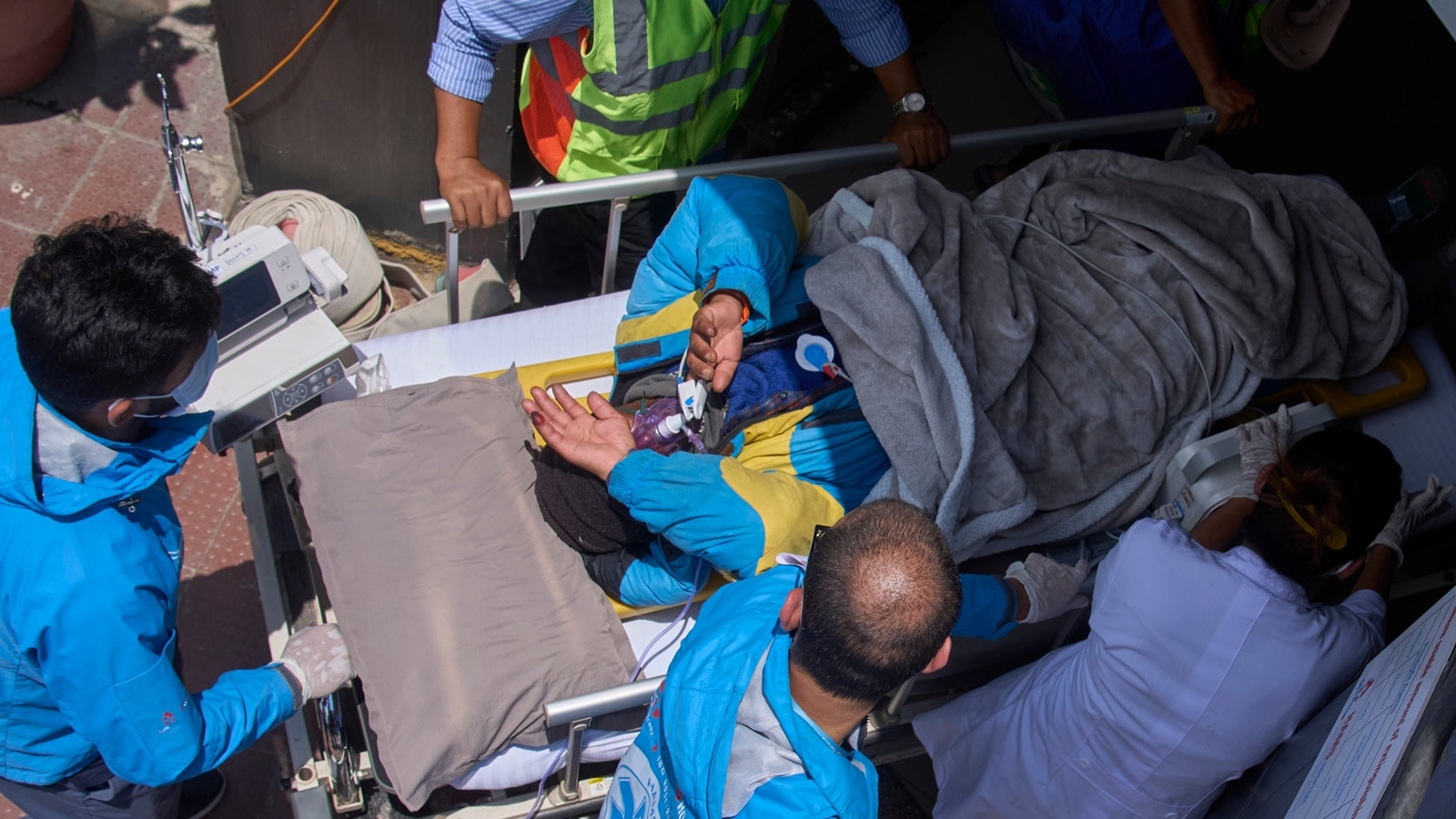
The journey down from Camp IV to Base Camp is a blur of agony and rescue sleds, but Kami survived it. He was flown by a high-altitude helicopter to a hospital in Kathmandu, his body battered but intact.
The Interrupted Ritual
The most surreal moment of a resurrection does not happen on the mountain. It happens at home.
In the village, the funeral rites were in their second day. The family had accepted the loss, their grief locked into the rhythmic, comforting cadences of the ancient prayers. Then, a mobile phone rang.
It was a call from the capital.
The voice on the other end was trembling. The funeral needed to stop. The man they were praying for was currently sitting in a sterile hospital room, drinking broth and complaining about the cold.
The transition from profound mourning to absolute disbelief is a violent one. For hours, the village hung in a strange limbo. Was it a cruel joke? A mistake? It was only when a cousin received a grainy photograph via WhatsApp showing Kami, alive and smiling despite his bandaged hands, that the truth settled in. The monks stopped their chanting. The funeral pyre was dismantled, its wood stacked away for another day, years in the future.
The incense was replaced by the smell of celebratory feasts.
The Permanent Scar
We love stories of survival because they promise us that the human spirit is indomitable. But survival is rarely clean. It comes at a cost that lingers long after the headlines fade.
Months after the incident, Kami sits in his home, far from the shadows of the big peaks. He survived the mountain, but he left pieces of himself up there. Several of his fingers had to be amputated. The simple acts of tying his shoes or holding a cup of tea are now daily struggles.
More than the physical toll, there is the psychological weight of having looked over the edge. Every night, when the wind rattles the corrugated iron roof of his house, he is back on the South Col. He is back in the dark, wondering if anyone is coming to look for him.
The commercialization of Everest will continue. Next season, hundreds of new climbers will arrive with fat wallets and grand dreams, and a new generation of Sherpas will risk everything to carry them to the top. The machinery will keep running, indifferent to the bodies it breaks.
But in one small village, a family looks at an ordinary man sitting by the fire, knowing that the ghost they almost buried is still warm, still breathing, and finally home.


:max_bytes(150000):strip_icc()/how-many-types-of-dwarfism-are-there-2860725-v1-8dae2c531b4b47d9ae36ae404d3308a0.png)