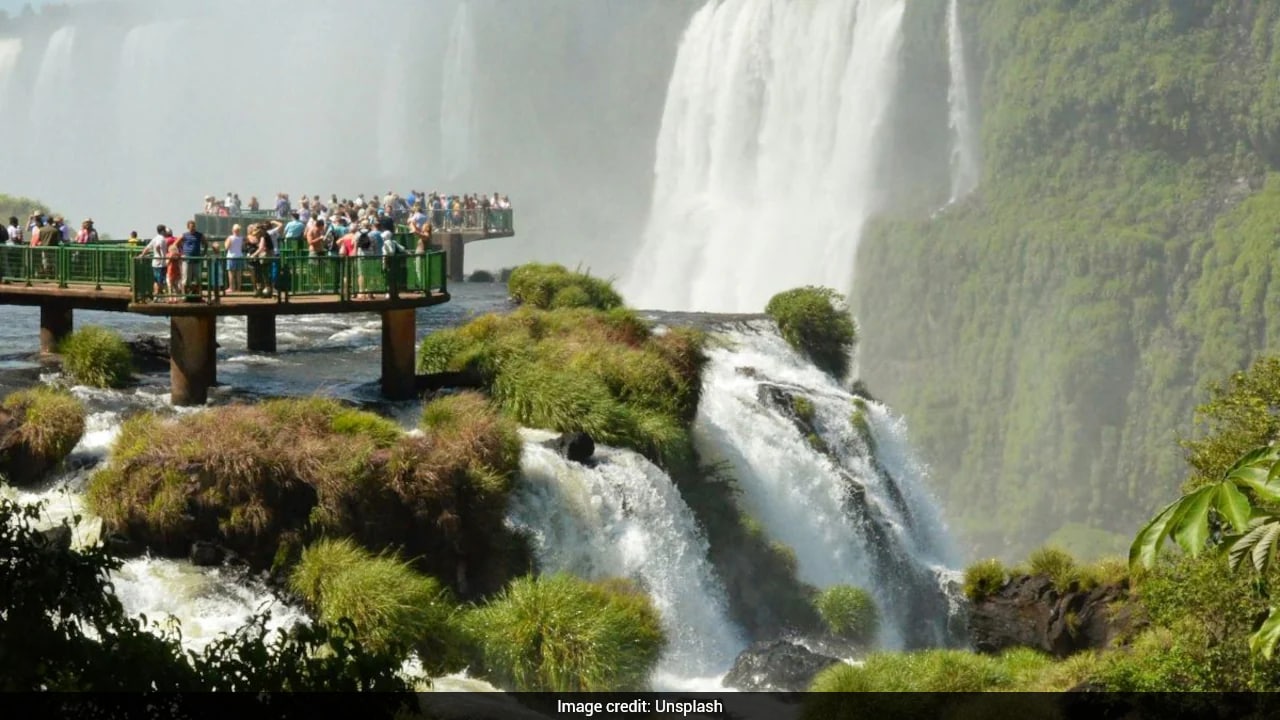
The roar of water at 262 feet is not just a sound. It is a physical weight. It vibrates in the marrow of your bones, a deafening, relentless reminder of gravity’s absolute power. Stand at the precipice of a waterfall that high, and your lizard brain screams a single, evolutionary command: Step back.
Yet, a tourist recently stood at the slick, mist-soaked edge of such a drop and made a different choice.
It started with a familiar, metallic clatter. A modern smartphone—carrying a lifetime of photos, banking apps, and unread emails—slipped from a pocket, skittered across the wet stone, and vanished over the rim. For a fraction of a second, time stopped. Then, ignoring the guardrails, the warning signs, and the basic human instinct for survival, the traveler went after it.
They scrambled down the treacherous, vertical rock face, chasing a piece of glass and aluminum into the blinding spray.
Witnesses gasped. Smartphones recorded the descent. The resulting footage went viral, packaged by news outlets as a shocking piece of internet trivia. Look at this crazy person risking their life for a phone. We watch these videos from the safety of our couches, shaking our heads at the sheer absurdity of it all. We call it foolishness. We call it clout-chasing.
But if we are entirely honest with ourselves, that tourist wasn’t just chasing a phone. They were chasing their identity. And their reckless descent reveals a terrifying truth about our relationship with modern technology: we no longer own our devices; they own our sense of reality.
The Illusion of Tangible Value
To understand why someone would gamble their life for a pocket-sized rectangle, we have to look past the physical object. A smartphone costs a thousand dollars. A human life is priceless. On paper, the math of that plunge makes absolutely no sense.
But money was never the driving force on that wet cliffside.
Consider what a smartphone actually represents in the modern era. It is not a tool, like a hammer or a fountain pen. It is an external hard drive for the human soul. Within that device lives the only copy of a child’s first steps, the final text messages from a deceased parent, the passwords to our financial survival, and the digital passports that tether us to our social networks.
When that phone slipped toward the 262-foot drop, the tourist didn’t see a financial loss. They saw an immediate, catastrophic erasure of their history and their connection to the world.
Psychologists call this the "extended self." It is a behavioral pattern where we subconsciously integrate external objects into our own identity. We don't just use our phones; we feel as though they are an extension of our physical and mental bodies. Losing a phone feels less like losing a wallet and more like suffering an sudden bout of amnesia. The panic that sets in is primal. It bypasses the rational cortex of the brain. It triggers the exact same fight-or-flight response that our ancestors felt when facing a predator.
On that waterfall, the tourist acted on pure, unadulterated panic. The brain, flooded with cortisol, made a instantaneous, deeply flawed calculation: Go get your life back.
The Siren Song of the Lens
There is a cruel irony embedded in this event. The tourist was likely at the waterfall to capture its beauty—to document an authentic, awe-inspiring natural wonder.
Travel used to be defined by presence. You packed a heavy backpack, boarded a train or a plane, and immersed yourself in the unfamiliar smell of a new city or the crisp air of a mountain peak. You took memories. If you were lucky, you had a film camera with twenty-four exposures, forcing you to choose your moments with deliberate care. You waited days or weeks to see if the photo even developed.
Today, the lens dictates the journey.
We no longer look at the waterfall; we look at the waterfall through a six-inch screen to ensure it is framing us correctly. The majesty of a 262-foot drop becomes a background asset, a scenic backdrop meant to validate our lifestyle to people we barely know on social media.
This shift alters our spatial awareness and our perception of risk. When you view the world through a camera app, a dangerous cliff edge loses its menace. It becomes a set piece. The digital interface acts as a psychological buffer, a literal screen that detaches us from the physical reality of the danger in front of us.
We see this manifested in tragic statistics worldwide. Selfie-related injuries and deaths have quietly spiked over the last decade. Travelers fall from historic battlements, get swept out by rogue waves, or step off ledges because their eyes were locked on a screen, trying to perfect a shot. The desire to document the experience completely hollows out the experience itself.
When the Screen Swallows the Scenery
Let us look closer at the mechanics of that moment on the rocks.
The stone near a waterfall is not normal rock. It is covered in a microscopic layer of algae and constantly lubricated by a fine, freezing mist. It is as slick as ice, but jagged. A single misstep doesn't result in a slide; it results in a tumble, a shattering of bone against granite before the final, unstoppable plunge into the churning pool below.
Imagine the sensation. The cold air rushing past. The terrifying realization that your shoes have zero traction. The spray blinding your eyes, making it impossible to see where the rock ends and the void begins.
Now, imagine doing all of that while keeping one eye on a piece of plastic wedged in a crevice.
It sounds insane because it is. But this insanity is cultivated daily by an industry designed to keep us perpetually hooked. The apps we use are engineered by the brilliant minds to trigger dopamine loops. Every notification, every like, every share is a micro-reward that trains our brains to prioritize the digital world over the physical one.
When we spend hours every day responding to these digital stimuli, our brains rewire themselves. We become conditioned to view the phone as the center of our universe. The actual universe—the trees, the sky, the thunderous waterfall—becomes secondary.
So, when the phone falls, the reaction is automatic. It is the muscle memory of an addict reaching for a dropped fix, completely oblivious to the fact that they are standing on the lip of a watery grave.
Reclaiming the Unplugged Edge
The tourist survived. By some miracle of friction and fortune, they retrieved the phone and scrambled back to safety, greeted by the bewildered stares of onlookers. They walked away with their device, and their life, intact.
But the victory is entirely hollow.
The video remains online, a permanent testament to a moment where a human being valued a mass-produced consumer product over their own breath. It stands as a warning sign for the rest of us, a stark mirror reflecting our collective digital dependency.
We have to learn to step back from the edge.
This doesn’t mean discarding technology or retreating to a cabin in the woods. It means establishing a conscious, ironclad boundary between the world we experience and the world we broadcast. It means training ourselves to put the device in a pocket, zip it shut, and look at the horizon with our own eyes.
True wealth in the modern world is not measured by the number of photos in your cloud storage or the followers on your feed. It is measured by your capacity to sit with a moment of pure grandeur, to feel the spray of a massive waterfall on your skin, and to be entirely, completely present.
The phone can be replaced. The memory, unblemished by panic and free from the tyranny of the screen, belongs to you forever.
Next time you find yourself standing at the edge of something beautiful, something immense, leave the camera in your pocket. Look down into the roaring dark. Listen to the thunder of the water. Let the awe wash over you, raw and unfiltered, and realize that the most valuable thing you possess is the heartbeat currently thumping against your ribs.