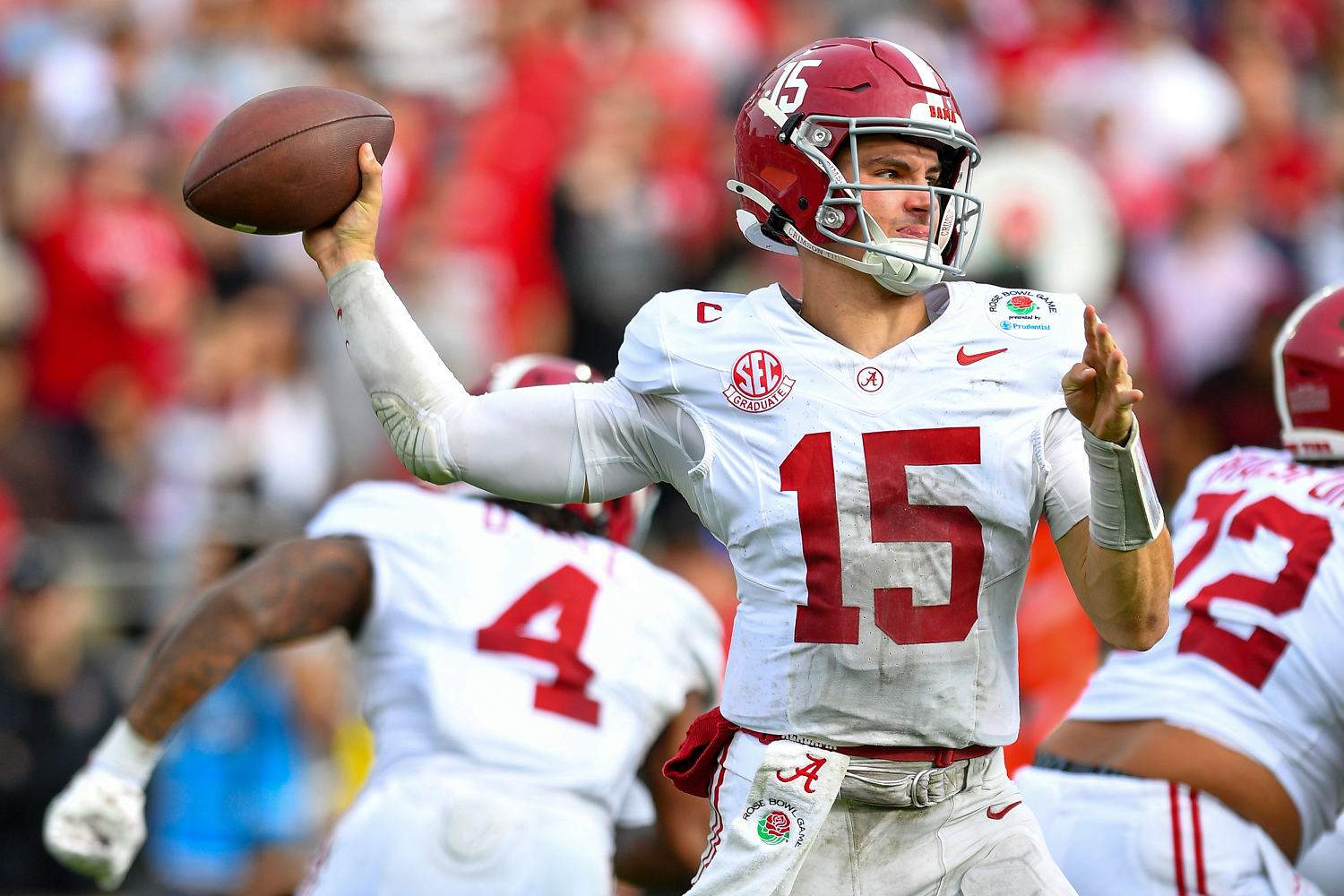
The NFL draft is a multi-billion dollar exercise in collective delusion. Every April, general managers with sweat-stained collars convince themselves that a 22-year-old kid with fifteen starts and a decent completion percentage is the messiah sent to save their failing stadium subsidies. The latest object of this irrational affection is Alabama’s Ty Simpson.
The consensus "experts" are currently debating whether Simpson is a mid-first-round lock or a late-first-round steal. They are asking the wrong question. The real question is why any serious organization would burn a premium asset on a quarterback who defines the word "projection" more than "production."
If you draft Ty Simpson in the first round, you aren’t just picking a player; you are drafting a pink slip for your entire coaching staff.
The Myth of the "Pedigree" Quarterback
Analysts love to mention that Simpson is a "coach's son." It’s the ultimate lazy scouting trope. It’s supposed to imply a high football IQ, a "student of the game" mentality that somehow compensates for a lack of elite physical traits. In reality, being a coach's son means you've been over-indexed on mechanics and under-tested on raw instinct.
I’ve watched front offices blow decades of relevance on the "pedigree" play. They see a 6-foot-1, 210-pound frame—which is generous, let’s be honest—and they see the Alabama jersey, and they assume the winning is baked into the DNA. It isn’t. Simpson didn’t "wait his turn" because of some noble commitment to the Crimson Tide; he stayed because the modern transfer portal market for a quarterback with three years of backup tape was surprisingly thin until he finally got the nod.
The Fifteen-Game Fallacy
The most dangerous stat in the 2026 draft is Simpson’s single season as a starter. Historically, the hit rate for quarterbacks with fewer than 20 college starts is abysmal. We are talking about a guy who threw for 3,567 yards in a system designed by Kalen DeBoer to make any semi-competent passer look like a Heisman finalist.
Look at the tape from the final stretch against Auburn, Georgia, and Oklahoma. When the windows tightened and the blue-chip talent gap narrowed, Simpson’s completion rate plummeted to 57%. That isn't "clutch" performance; it's a signal that when the play-calling isn't perfect, the player isn't either.
Teams like the Jets or the Rams—the supposed landing spots—are looking for a savior. But Simpson isn't a savior; he’s a developmental project with a first-round price tag.
The Opportunity Cost of Reaching
Drafting a quarterback in the first round is a binary event: they are either a franchise cornerstone or a catastrophic waste of resources. There is no middle ground. When you take Simpson at No. 16 or No. 20, you aren't just passing on the player; you are passing on the surplus value of a foundational Edge or a lockdown Cornerback.
Consider the financial mechanics. A first-round pick at Wide Receiver or Edge Rusher provides a massive discount relative to the veteran market, where those positions now command $30 million-plus in guarantees. If you draft a quarterback who isn't a Tier 1 talent, you're locked into a four-year window of mediocrity.
- The "Wait and See" Trap: You spend Year 1 "developing" him.
- The "Supporting Cast" Excuse: You spend Year 2 and 3 realizing the roster is too weak because you didn't draft linemen.
- The Extension Crisis: By Year 4, you have to decide whether to pay him $50 million a year for being "serviceable."
This is how franchises like the Raiders and the Jets stay in the basement. They chase the "potential" of a B-tier quarterback while ignoring the fact that the most successful "developmental" quarterbacks of the last decade—Patrick Mahomes and Jordan Love—joined rosters that were already playoff-caliber.
The Brock Purdy Comparison is Insulting
You’ll hear the "Shades of Brock Purdy" or "Jared Goff" comparisons in every draft room. This is a cognitive bias known as "availability heuristic." Scouts see a similar build and a similar pocket movement and assume the outcome will be the same.
Purdy succeeded because he had 48 starts at Iowa State and landed in the most quarterback-friendly ecosystem in NFL history. Goff was a No. 1 overall pick who nearly busted before Sean McVay rebuilt his brain. Ty Simpson is neither. He has the injury history of a veteran—fractured ribs, bulging discs, elbow bursitis—without the veteran experience to manage it.
Imagine a scenario where the Jets take Simpson. They are dropping a fragile, inexperienced quarterback into a high-pressure market with a porous offensive line. It’s not a "bold move." It’s a tragedy waiting to happen.
Stop Drafting for Hope
The "lazy consensus" says Ty Simpson is a first-rounder because the NFL is desperate for quarterbacks. Desperation is not a talent evaluation strategy.
The smart move? Let someone else take the risk. If you need a quarterback but your roster is a sieve, take the best Edge rusher on the board. Take the Offensive Tackle who will actually be on the field for 17 games. Use the second or third round to find your "developmental" guy.
If you take Ty Simpson in the first round, you are betting your job on a 15-game sample size and a "coach’s son" narrative. In a league where the difference between a "hit" and a "miss" is 63.9%, those are odds only a desperate man would take.
Don't be the GM who tries to justify this pick in a press conference three years from now while holding a box of your belongings. Simpson is a Day 2 talent with Day 1 hype. Let him be someone else’s problem.