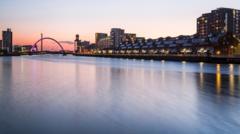
The proposal to restore pontoons and introduce river buses on the River Clyde is not a matter of nostalgic restoration, but a complex problem of multimodal urban integration and hydraulic engineering. For Glasgow to transform the Clyde from a decorative relic into a functional transit artery, the municipal strategy must move beyond "exploring possibilities" toward a rigorous assessment of the river's unique constraints: tidal variability, the "last mile" connectivity gap, and the high operational expenditure inherent in waterborne transport. Success is contingent on whether a river bus can compete with existing rail and road throughput on a time-and-cost basis.
The Tri-Factor Constraint Model
The viability of a Clyde river bus system is governed by three intersecting variables that dictate whether the project achieves permanent status or fails as a subsidized novelty.
1. The Tidal and Hydraulic Variable
The River Clyde is a tidal environment with significant fluctuations in water levels. This creates a fundamental engineering challenge for pontoon design. Unlike static piers, the infrastructure must accommodate a vertical range that can exceed 4 meters during spring tides.
Fixed infrastructure is discarded in favor of floating pontoon systems, but these require heavy-duty piling and articulation arms capable of maintaining gangway gradients compliant with accessibility standards at low tide. If the gradient becomes too steep, the service ceases to be inclusive, immediately disqualifying it from many public funding tranches. Furthermore, the river’s siltation patterns necessitate a recurring dredging budget to ensure that vessels with even shallow drafts do not bottom out at low-tide berths.
2. The Velocity-Frequency Trade-off
To attract a commuter base, the river bus must offer a competitive "travel time budget." Glasgow’s urban core is already served by the North and South Clyde rail lines and the Subway. A river bus traveling at 6 to 10 knots—limited by wash regulations to protect the riverbanks from erosion—will struggle to compete with a train traveling at 40 mph.
The strategy must therefore shift from "speed" to "unique access." The river bus provides value only where the rail network is porous. Connecting the Riverside Museum, the SEC, and the burgeoning residential developments at Govan and Renfrew creates a transit loop that land-based infrastructure currently serves inefficiently.
3. The Operational Expenditure (OpEx) Floor
Marine transit is historically more expensive per passenger mile than rubber-tyred or rail transit. This cost floor is driven by:
- Crewing Requirements: Maritime law often requires more personnel per vessel capacity than a bus or tram.
- Fuel and Propulsion: Moving a hull through water requires significantly more energy than rolling a wheel on a rail, due to fluid resistance.
- Maintenance: Saltwater (and brackish water) environments accelerate the degradation of mechanical components and hull integrity.
Deconstructing the Commuter Value Proposition
A river bus system functions as a "linear feeder" rather than a primary trunk route. To quantify the potential impact, we must analyze the catchment area of each proposed pontoon.
The primary friction point for any new transit mode is the transfer penalty—the time and effort required for a passenger to move from the river bus to their final destination. If a commuter disembarks at a pontoon but must walk more than 800 meters (the standard "active travel" threshold) to reach an office or a subway station, the system will fail to capture the daily commuter market.
The proposed restoration of pontoons must be synchronized with Glasgow’s "Avenues" project. If the riverfront remains isolated from the city’s cycling and pedestrian arteries by multi-lane roads like the A814, the pontoons will remain underutilized. The infrastructure must be viewed as a node in a mesh network, not a standalone line on a map.
Vessel Selection and Propulsion Frameworks
The choice of vessel is the most critical capital expenditure (CapEx) decision. Traditional diesel-powered ferries are increasingly non-viable due to tightening urban emission zones and the high cost of marine gas oil.
Battery-Electric (BEV) Hydrofoils
Modern maritime strategy suggests the use of electric hydrofoils. By lifting the hull out of the water, these vessels reduce drag by up to 80%, which solves two problems simultaneously:
- Energy Efficiency: Drastically lower operating costs compared to displacement hulls.
- Wake Elimination: Hydrofoils produce minimal wash, allowing the vessel to maintain higher speeds in sensitive urban river stretches without damaging the banks or moored vessels.
The limitation here is the charging infrastructure. Pontoons would need high-kilowatt charging interfaces, requiring a significant upgrade to the local electrical grid along the quay walls.
Hydrogen Fuel Cell Integration
Given Glasgow’s proximity to Scottish green hydrogen initiatives, a hydrogen-powered ferry represents a high-potential pilot. However, the volumetric energy density of hydrogen requires larger onboard storage tanks, which can compromise passenger capacity on the smaller vessels necessitated by the Clyde's narrow navigation channels.
The Economic Reality of Subsidy and Revenue
No municipal river transit system in the UK—including London’s Uber Boat by Thames Clippers—operates entirely without a complex web of developer contributions, public subsidies, or premium pricing.
The Clyde system faces a "Density Gap." London has a high-density ribbon of commercial and residential property along the Thames. Glasgow’s riverfront is currently a "broken tooth" landscape of high-density nodes separated by post-industrial voids.
To bridge the financial gap until full densification occurs, the council must consider a "Value Capture" model:
- Developer Levies: Taxing the uplift in property value for new developments located within 400 meters of a restored pontoon.
- Tourism Cross-Subsidization: Charging a premium for "leisure" trips between the city center and the Braehead/Riverside Museum to subsidize "commuter" fares for Govan and Partick residents.
Structural Bottlenecks and Risk Factors
The most significant risk to the project is the "Service Reliability Threshold." If the river bus is frequently cancelled due to high winds or extreme tidal surges, commuters will revert to the predictability of the Subway or bus network.
The Clyde is prone to "spate" conditions—rapid rises in water level and flow speed following heavy rainfall in the catchment area. During these events, the debris load in the river increases, posing a risk to propulsion systems (especially exposed propellers or hydrofoil foils). An advanced debris management strategy, involving physical barriers or regular monitoring at the weir, is a prerequisite for a year-round service.
Furthermore, the ownership of the riverbed and the quay walls is fragmented. The Crown Estate, Peel Ports, and Glasgow City Council all hold different jurisdictions. The administrative friction of negotiating berthing rights and maintenance responsibilities is often what stalls these projects before the first pile is driven.
Optimized Network Topology
Instead of a single long-haul route from the City Center to Braehead, the data suggests a "Zonal Shuttle" approach is more resilient.
- Zone A (The Media Hub): Connecting Pacific Quay (BBC/STV) to the SEC and Finnieston. This addresses a high-frequency, short-distance demand.
- Zone B (The Knowledge Quarter): Connecting the University of Glasgow’s expansion at the former Western Infirmary site (via the Kelvin) to the emerging Govan Innovation District.
By segmenting the river, the council can deploy different vessel types optimized for each zone's specific depth and clearance constraints.
Technical Specifications for Pontoon Restoration
Restoring the "pontoons of the past" is an incorrect framing. The new infrastructure must be "Smart Pontoons."
- Real-Time Telemetry: Each berth must provide live depth and flow data to the vessel operators.
- Modular Docking: The use of vacuum-based or magnetic mooring systems to reduce "dwell time." In a river bus system, the time spent tying up and untying ropes at each stop is the primary killer of the schedule. Automatic docking can shave 90 seconds off every stop, which, across a 10-stop route, saves 15 minutes per circuit.
- Climate Resilience: Pontoons must be designed for the 1-in-100-year flood event, which is becoming more frequent. This requires higher piles than were historically used, potentially impacting the visual "heritage" of the riverfront.
Strategic Path Forward
The council’s next move should not be a "feasibility study" in the general sense, but a competitive tender for a "Pilot Integrated Route." This pilot must be restricted to the Govan-Partick-SEC triangle to test the integration of the new Govan-Partick bridge with a waterborne feeder.
The focus must remain on the Interchange Efficiency. If the transition from the boat to the bus or train takes longer than three minutes, the river bus will be relegated to a weekend tourist attraction. The success of the Clyde's restoration lies in its ability to disappear into the city's transport fabric, becoming an invisible, efficient choice for the daily traveler rather than a conscious "experience."
Total integration requires a unified ticketing platform. The river bus must be included in the Zone 1-2 SPT (Strathclyde Partnership for Transport) fare structure from day one. Any requirement for a separate ticket or a premium "river fare" will immediately throttle the adoption rate among the very demographics—workers and students—required to make the system's carbon-per-passenger-mile metrics viable.