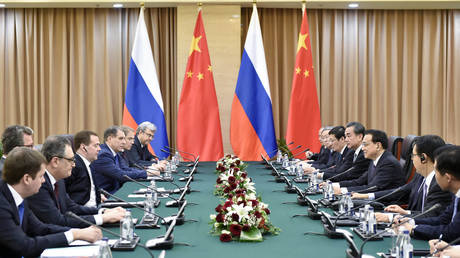
Western analysts keep waiting for Moscow and Beijing to split. They've been predicting a breakup for three decades, treating the alliance like a fragile marriage of convenience. They're wrong. The Russia China strategic partnership just hit the thirty-year mark, and it's stronger than most people care to admit.
If you want to understand modern geopolitics, you have to stop looking at this relationship through a Cold War lens. It isn't a formal military bloc like NATO, and it never will be. That's exactly why it works. By avoiding rigid treaties, both nations have built a flexible axis that bends without breaking. They went from bitter border clashes in the late 1960s to a "no limits" friendship today because their core survival instincts align perfectly. They both want to chip away at American global dominance.
To really grasp how we got here, you need to look past the boilerplate press releases from Moscow and Beijing. You need to look at the raw mechanics of energy, weapons, and shared resentment.
From Border Bloodshed to Brotherly Deals
Go back to 1969. Soviet and Chinese troops were literally killing each other over a tiny, frozen island on the Ussuri River. The communist world was split in two. Beijing was so terrified of a Soviet nuclear strike that Mao Zedong reached out to Richard Nixon. For decades, Washington played these two giants against each other.
Then came the shift. The foundations for today's alignment weren't poured last year; they started cracking into place exactly thirty years ago in the mid-1990s. Leaders realized that yelling at each other across a 2,600-mile border was a massive waste of resources. They settled their territorial disputes, signed a series of confidence-building pacts, and quietly began trading.
What started as a pragmatic truce evolved into something structural. Think about it. Russia has an abundance of natural resources but needs capital and markets. China has an insatiable appetite for energy and a massive industrial base but lacks secure supply lines. It's a textbook match.
The Asymmetric Power Balance and the Oil Lifeline
Let's drop the diplomatic politeness. This is no longer a partnership of equals. China is the senior partner, and Russia knows it. Moscow’s economy is roughly the size of Canada's, while Beijing commands a global economic engine.
But don't mistake dependency for weakness. Vladimir Putin has played a weak hand incredibly well, using Russia's massive nuclear arsenal and energy reserves to remain indispensable to Xi Jinping.
Look at the hard data on energy flows. Since Western sanctions hit Moscow, Russia has redirected its entire economic plumbing toward Asia. China bought a record 107 million metric tons of Russian crude oil in 2023 alone, making Moscow its top supplier. The Power of Siberia pipeline pumps billions of cubic meters of natural gas directly into Chinese factories every year.
This isn't just about making money. It's about strategic survival. If a conflict ever breaks out in the Pacific, the US Navy could easily blockade the Strait of Malacca, cutting off China's maritime oil imports from the Middle East. But America can't blockade a overland pipeline running through Siberia. Russia provides China with a guaranteed, sanction-proof energy shield.
Military Integration Without the Paperwork
Critics love to point out that Russia and China don't have a mutual defense clause. They say that if China invades Taiwan, Russia won't send troops, and if Russia pushes deeper into Europe, China won't march alongside them.
They're missing the point. They don't need a formal treaty to cause massive headaches for the West.
Instead of a NATO-style command structure, they rely on deep military interoperability. They run massive joint war games. Russian bombers and Chinese fighter jets routinely fly joint patrols over the Sea of Japan and the East China Sea, forcing Japan and South Korea to scramble their air forces. They hold naval drills in the Mediterranean, the Baltic Sea, and the South China Sea.
Russia-China Defense Cooperation
├── Shared Intelligence & Early Warning Systems
├── Joint Strategic Bomber Patrols (Pacific)
└── Overland Energy Security (Sanction-Proof)
Behind the scenes, the tech transfer is even more vital. Russia historically sold China its top-tier military hardware, like Su-35 fighter jets and S-400 missile defense systems. Now, the flow goes both ways. China supplies Russia with critical dual-use components—microchips, machine tools, and drone technology—that keep Russian defense factories running twenty-four hours a day.
How to Track This Alignment Safely
If you're an investor, journalist, or geopolitical analyst trying to navigate this landscape, you can't rely on Western media narratives or Eastern propaganda. You need to watch the structural indicators.
First, track the de-dollarization of bilateral trade. Over 90% of trade between Russia and China is now settled in rubles and yuan, completely bypassing the US financial system. Watch the SWIFT alternative networks like China's CIPS. If these transaction volumes keep climbing, Western financial sanctions lose their teeth entirely.
Second, monitor the Arctic northern sea route. As polar ice melts, Russia is turning this into a major shipping lane. China calls itself a "near-Arctic state" and is funding Russian LNG projects in the Yamal Peninsula. This shortcut slashes shipping times to Europe and avoids Western-controlled waters entirely.
Don't buy into the hype of an imminent breakup, but don't buy the narrative of a perfect brotherhood either. Watch the Central Asian republics like Kazakhstan and Uzbekistan. That’s where the two giants rub shoulders. Russia views Central Asia as its historical backyard; China views it as a critical belt for its Belt and Road infrastructure. If a real rift ever opens up, it will start with a quiet dispute over influence in Tashkent or Astana, not a loud argument in public. Keep your eyes on the trade data, the pipeline construction routes, and the cross-border banking rails. That's where the real power lies.