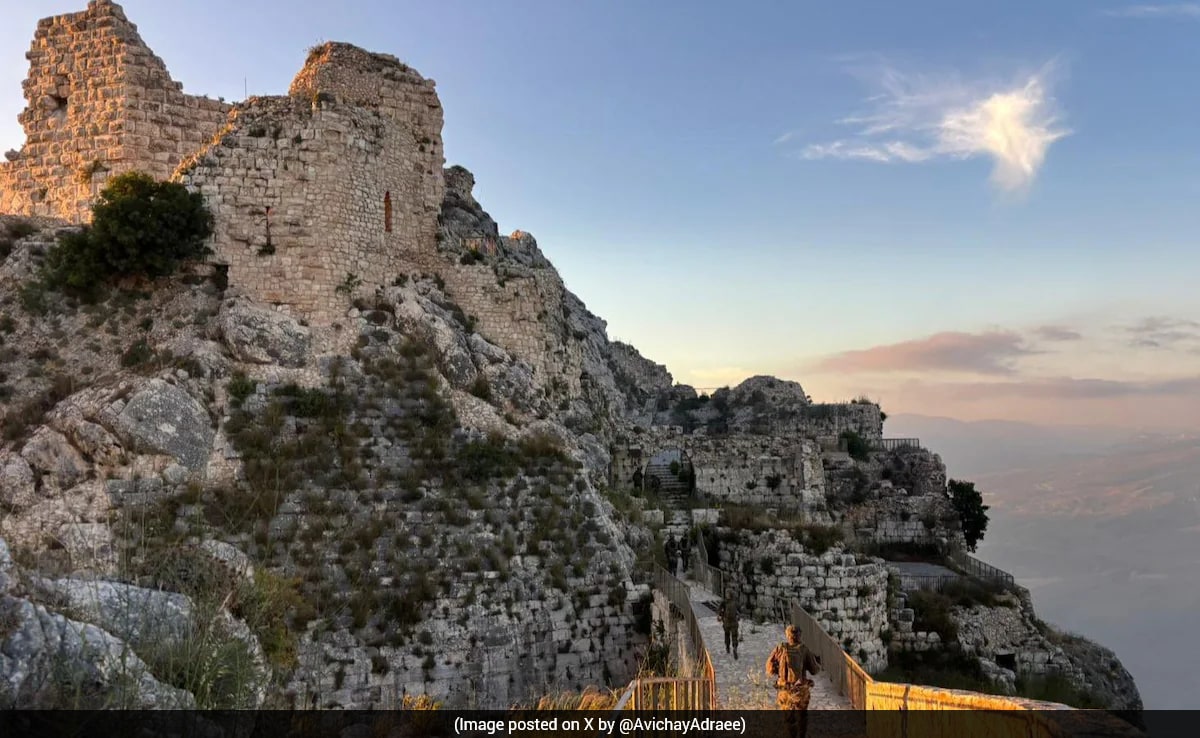
History repeats itself, but rarely with this kind of cinematic precision. On May 31, 2026, the Israeli military pushed deeper into Lebanese territory than it has in over a quarter-century. They didn't just take another border village. They seized Beaufort Castle.
If you're tracking the current conflict between Israel and Hezbollah, you know things are escalating rapidly despite the nominal ceasefire brokered back in April. But looking at a map doesn't give you the full story. Raising the Israeli flag and the Golani Brigade banner over a 900-year-old Crusader fortress isn't just a tactical win. It's a massive psychological sledgehammer with deep historic roots.
The Absolute Power of the Beaufort Ridge
To understand why Israeli Defense Minister Israel Katz went straight to social media to celebrate this capture, you have to look at the geography. Beaufort Castle sits on a jagged, razor-sharp rocky crest nearly 2,300 feet above the Litani River. The old Syriac name for it is Qalaat al-Shakif, which translates roughly to the fortress of the high rock.
From this single point, anyone holding the ruins can see for miles into northern Israel's Galilee region and across the rolling hills of southern Lebanon. It is the ultimate high ground. For Hezbollah, losing control of this ridge means losing their premier observation and launch position overlooking Israeli border towns.
The capture happened after days of brutal airstrikes and heavy ground fighting in nearby villages like Arnoun, Zawtar al-Sharqiyah, and Yohmor. Israeli forces didn't just stroll up the mountain. They pushed through a meat grinder, crossing the Litani River to establish what Prime Minister Benjamin Netanyahu calls an expanded security zone.
A Ghostly Echo of 1982
For Israelis, Beaufort carries an intense, almost haunting emotional weight. This isn't the first time the Israel Defense Forces have fought a bloody battle for these exact stone walls.
Back in 1982, during the First Lebanon War, the military took the castle from Yasser Arafat's Palestine Liberation Organization. That assault became a foundational, highly controversial moment in Israeli military history. It was led by then-Defense Minister Ariel Sharon, and the heavy casualties suffered on that hill left deep scars on the Israeli public consciousness. The army ended up staying there for 18 years, turning the ancient site into a heavily fortified bunker before finally withdrawing in 2000.
Seeing the flag go back up on that specific summit 44 years later is a deliberate message to both the Israeli public and Hezbollah. It signals that Israel is willing to return to its old playground, regardless of the long-term occupation risks.
Displacements and Deadlocks
While Israeli officials celebrate the capture as a strategic masterpiece to defend the Galilee, the human cost on the Lebanese side is exploding. Lebanon's Prime Minister Nawaf Salam didn't mince words, accusing Israel of running a scorched-earth policy and executing collective punishment.
The numbers back up the severity of the push. Over 1.2 million Lebanese people have been displaced since the broader conflict reignited on March 2. Following the fall of the castle, the Israeli military expanded its evacuation orders, telling everyone south of the Zahrani River to pack up and head north. That puts the front line roughly 40 kilometers deep into Lebanon, pushing dangerously close to Nabatiyeh, a massive regional hub just five kilometers away from the advancing troops.
Over 3,350 people have died in Lebanon since March, and Hezbollah has retaliated by using hard-to-detect fiber optic drones to strike back, killing at least 25 Israeli soldiers and defense contractors.
What makes this push incredibly messy is the timing. This massive offensive is happening while diplomatic delegations from both nations are actively sitting down in Washington for direct talks. The formal ceasefire that started on April 17 is essentially dead in the water, even if politicians refuse to admit it out loud. Far-right members of Netanyahu's cabinet are pushing for a total assault, meaning these peace talks at the State Department face a nearly impossible uphill battle.
Your Next Steps for Tracking the Conflict
Don't expect the fighting to stop at the castle walls. If you want to understand where this conflict goes next, stop looking at the diplomacy and start looking at these specific indicators on the ground.
First, watch the Zahrani River line. If Israeli ground forces start consolidating positions north of this boundary, it means they aren't looking for a temporary buffer zone. They're digging in for a long-term occupation reminiscent of the pre-2000 era.
Second, keep a close eye on the drone war. Hezbollah's shift to fiber optic drone technology has neutralized a lot of traditional electronic jamming, causing the bulk of recent Israeli casualties. If Israel manages to adapt its air defenses to stop these specific low-altitude threats, Hezbollah loses its most effective asymmetric weapon, likely forcing them into conventional, close-quarters infantry battles around major hubs like Nabatiyeh and Tyre. Monitor local independent military telegram channels and satellite tracking accounts to see if Israel's construction units begin building semi-permanent dirt berms and paved supply routes up to the Beaufort Ridge. That will tell you exactly how long they plan to stay.
Israeli Troops Claim Strategic Castle Overlooking Hezbollah Operating Zones In Southern Lebanon this video provides early footage and a visual breakdown of the strategic ridge and castle captured by Israeli forces.