A high-stress foot chase down a dark hallway. A chaotic struggle with an armed suspect in a cramped apartment. A sudden, deafening gunshot.
When a police officer gets shot, the public immediately assumes a criminal pulled the trigger. But law enforcement insiders know a darker, deeply tragic reality. Sometimes, the bullet comes from the person standing right next to you.
The recent fatal shooting of Chicago Police Officer Krystal Rivera is a brutal reminder of this hidden crisis. Rivera, a 36-year-old mother and tactical team veteran, was killed during a foot pursuit on the city's South Side. The initial headlines hinted at a violent shootout with an armed suspect. The truth that emerged 24 hours later was much worse. Her own partner accidentally fired the fatal round into her back while confronting a suspect holding a rifle.
This isn't an isolated tragedy. It's a systemic vulnerability that puts every cop on the street at risk.
The Anatomy of Blue on Blue Shootings
The term "friendly fire" belongs in military history books. In policing, these incidents are known as "blue-on-blue" shootings or unintentional discharges. They happen fast, usually in seconds, and leave a trail of ruined lives.
To understand why this keeps happening, you have to look at the psychological mechanics of extreme stress. Dr. Carrie Steiner, a former Chicago cop who works as a public service psychologist, notes that high-stakes encounters completely hijack the human brain. You aren't using your frontal lobe—the part responsible for logic, deliberation, and careful decision-making. Your limbic system takes over. It's pure fight, flight, or freeze.
Under that kind of intense pressure, physiological changes happen instantly.
- Tunnel vision kicks in, narrowing your visual field by up to 70%.
- Auditory exclusion blocks out the sound of your partner yelling commands.
- Sympathetic stress reflex causes involuntary muscle contractions.
If an officer has their finger resting on the trigger instead of indexed safely along the frame of the weapon, a sudden stumble, a loud noise, or a physical bump can cause a sympathetic squeeze. That's all it takes for a duty weapon to discharge.
When Negligence Disguises Itself as an Accident
Not every accidental shooting happens in the heat of a tactical pursuit. Some occur in environments that should be completely safe, born out of pure complacency.
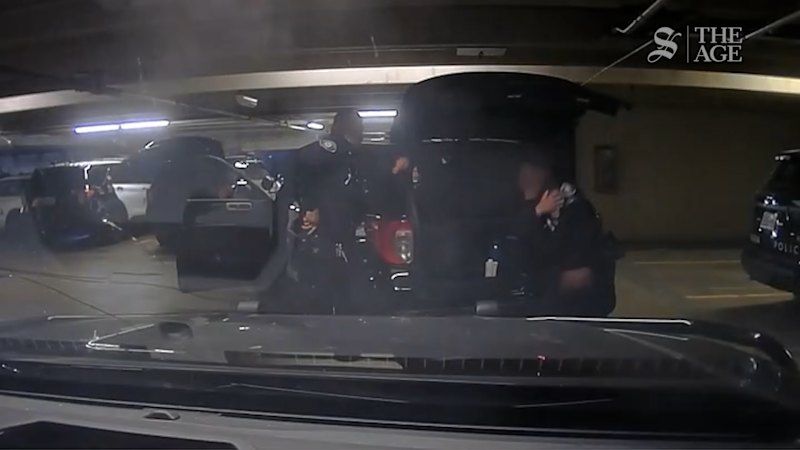
Take the Pasadena Police Department incident, where dashcam footage captured an officer shooting his colleague inside the department's parking garage. The police chief openly labeled it a "horseplay" incident. One officer drew his weapon and pointed it at another who was sitting in a patrol car. The officer in the vehicle drew his own gun in response. It went off, sending a bullet through the windshield and into his colleague's shoulder.
Then there's the 2019 bodycam footage out of Lafayette, Indiana. Officers Lane Butler and Aaron Wright were clearing an apartment for a volatile fugitive. As they rushed out of the home, Wright bumped into a closing door. His gun discharged, striking Butler in the back. While the review board ruled it an accident rather than gross negligence, it highlighted how easily basic firearm safety rules break down under movement.
Every recruit learns the four cardinal rules of gun safety in the academy. Never point a weapon at anything you don't intend to destroy. Keep your finger off the trigger until your sights are on the target. Yet, administrative data shows that familiarity breeds complacency. Weapons clearing, cleaning, and casual handling inside precinct walls account for a massive percentage of non-tactical accidental discharges.
How Law Enforcement Must Fix the Problem
We can't keep chalking these tragedies up to bad luck or high-stress environments. Departments need to completely overhaul how they train officers to handle weapons under duress.
First, reality-based training has to replace static shooting ranges. Standing still and shooting at paper targets doesn't prepare an officer for the chaos of a chaotic room clearing. Training must incorporate force-on-force scenarios using non-lethal training ammunition. Officers need to practice moving around colleagues with drawn weapons until muzzle discipline becomes absolute muscle memory, even when the heart rate hits 180 beats per minute.
Second, departments must enforce strict indexing protocols. The trigger finger should never enter the trigger guard unless the decision to use deadly force has already been made. Modern polymer pistols, which are standard issue for most American police forces, lack manual external safeties. They rely entirely on proper finger placement to prevent disasters.
Finally, we need to strip away the stigma of discussing these incidents. When a department covers up a friendly fire event or uses vague language to protect its public image, nobody learns. Airing the footage, breaking down the tactical errors, and forcing officers to analyze exactly where the breakdown occurred is the only way to prevent the next tragedy.
If you are in law enforcement, take a hard look at your own habits. Check your muzzle direction when you're clearing a house with your team. Pay attention to where your finger rests when you're running. Complacency kills, and the life you save might be the partner who has your back.