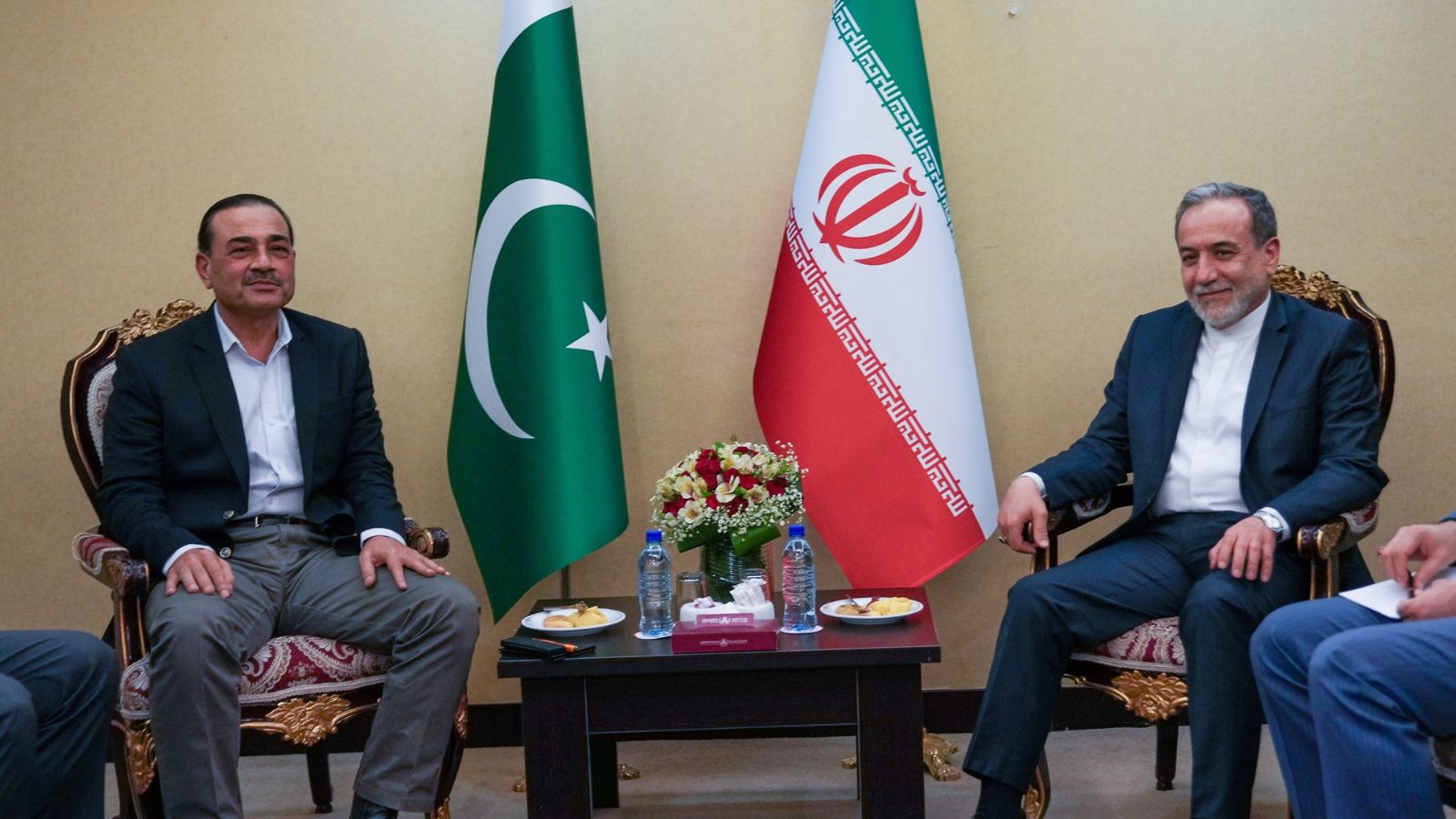
Rain doesn’t fall in the dusty corridors of power between Islamabad and Tehran, but the air feels heavy nonetheless. It is the weight of a silence that has lasted decades. When General Asim Munir, the chief of Pakistan’s army, stepped off a plane into the dry heat of the Iranian capital, he wasn't just carrying a briefcase of diplomatic protocols. He was carrying the anxiety of a billion people.
To understand why a military man is acting as a postman for peace, you have to look past the maps. Forget the colored lines marking borders for a moment. Instead, look at the flickering lights of a small grocery store in a border town like Taftan. The shopkeeper there doesn't care about "geopolitical shifts." He cares that his electricity comes from an Iranian grid and his flour comes from a Pakistani mill. If the tension between Washington and Tehran snaps, his lights go out. His children eat less. This is the human currency of high-stakes diplomacy.
The news cycle will tell you this is a "strategic meeting." That is a sanitized lie. It is a desperate gamble.
Pakistan finds itself in a position that would make a tightrope walker dizzy. On one side, the United States remains its most significant military benefactor and a massive trading partner. On the other, Iran is a neighbor you cannot move away from, a source of much-needed energy, and a fellow traveler in a region that has seen too much fire. For years, these two powers have stared at each other through the sights of long-range missiles and the harsh language of sanctions. Now, the man in the olive-drab uniform is trying to find the "off" switch.
Consider the hypothetical life of a young diplomat in the Iranian Foreign Ministry, let's call her Samira. She grew up under the shadow of the "Maximum Pressure" campaign. She knows that every time a Western leader speaks of "options on the table," the price of medicine in her local pharmacy climbs. When she sees the Pakistani Army chief sitting across from her superiors, she isn't thinking about nuclear centrifuges. She is wondering if this is the moment the door finally cracks open enough for the world to let her country breathe again.
The mission is simple to state and agonizingly difficult to execute. Munir is acting as a bridge. Washington wants stability in the Middle East so it can pivot its gaze elsewhere. Tehran wants the strangling grip of economic isolation to loosen. Pakistan, staring down its own economic demons, needs both of them to stop fighting so it can focus on surviving.
Peace isn't a signature on a piece of parchment. It is the absence of fear.
The friction between the U.S. and Iran isn't just a disagreement over policy; it’s a collision of worldviews. The Americans see a revolutionary state bent on regional dominance. The Iranians see a neo-imperial power intent on regime change. In the middle sits the Pakistani establishment, which has learned the hard way that when giants fight, the grass gets trampled.
But why now?
The timing isn't accidental. The world is changing. The old certainties of the post-Cold War era have evaporated. Beijing is brokering deals between Saudis and Iranians. Moscow is preoccupied. The vacuum left behind is being filled by regional players who realize that if they don't fix their own neighborhoods, no one else will. Munir’s visit to Tehran is an admission: the old ways of picking a side and sticking to it are dead. Survival requires being a friend to enemies.
Think of the border. Three thousand kilometers of sun-scorched earth where smugglers, insurgents, and soldiers play a lethal game of hide-and-seek. For decades, this frontier has been a wound. By talking peace, the General is trying to suture it. If Iran and the U.S. can reach even a "cold peace"—a state where they don't necessarily like each other but agree not to burn the house down—the ripple effect is massive.
It means the pipeline that has been a ghost project for years might finally carry gas. It means the militant groups that hide in the mountains lose their reason to exist. It means the merchant in Taftan can stop wondering if his shop will be caught in a crossfire.
There is a specific kind of bravery in being the middleman. You are the first person both sides blame if things go wrong. If Munir leans too far toward Tehran, Washington bristles and the IMF loans that keep Pakistan’s economy on life support might suddenly face "technical delays." If he echoes the American line too loudly, Tehran sees a puppet, and the border skirmishes turn into a full-blown crisis.
He is walking a wire made of razor blades.
The technicalities of the talks involve security cooperation and border management, but those are just the labels on the boxes. Inside the boxes is the reality of regional integration. Pakistan is currently an economic island. To its east, the border with India is a wall of steel. To its west, Afghanistan is a chaotic enigma. Iran is the only logical gateway to Central Asia and Europe. But that gateway has a massive "DO NOT ENTER" sign hung on it by the U.S. Treasury Department.
The General is essentially trying to negotiate a permit.
We often talk about these events as if they are chess moves. They aren't. Chess is a game of logic played with wooden pieces. Diplomacy is a game of ego, trauma, and history played with human lives. The officials in Tehran remember the 1953 coup; the officials in Washington remember the 1979 hostage crisis. These aren't just facts in a history book; they are the lenses through which every handshake is viewed.
To bridge that gap, you need someone who speaks the language of security. In this part of the world, that language is spoken by the military.
Critics will say that a soldier has no business in the realm of high diplomacy. They will argue that this should be the work of elected officials. They aren't wrong in principle, but reality is a different beast. In the corridors of Tehran, the word of a General carries a different weight than the word of a politician whose term might end in a year. There is a brutal, pragmatic continuity to military-to-military contact. It is the "hard power" version of a heart-to-heart.
The stakes are invisible until they aren't. They are invisible when a drone doesn't fire a missile. They are invisible when a trade convoy passes through a checkpoint without being searched for weapons. They only become visible when they fail—when the sky turns orange with explosions and the refugees start moving in their thousands.
Munir's presence in Tehran is a signal that the region is tired of being a theater for other people's wars. There is a growing realization that the geography of the Middle East and South Asia is a shared destiny. You cannot be prosperous if your neighbor is on fire. You cannot have a stable currency if the sea lanes next to you are a war zone.
What does "success" look like? It doesn't look like a grand ceremony on the White House lawn. It looks like a series of small, boring concessions. It looks like a hotline between navies in the Persian Gulf. It looks like a joint committee to stop drug smuggling on the Baluchistan border. It looks like a quiet agreement to let certain trade deals slide under the radar.
It looks like Samira being able to buy her father’s heart medication without spending a month’s salary.
There is a fragility to this moment. One stray bullet, one overzealous commander, or one tweet from a disgruntled politician can shatter the progress. The shadows in this part of the world are long and they are filled with ghosts. But for a few days in Tehran, the talk wasn't about the past. It was about the terrifying, necessary business of the future.
As the General’s plane climbs into the sky, leaving the mountains of Iran behind, the map hasn't changed. The borders are still there. The sanctions are still in place. The warships are still in the water. But there is a crack in the silence. And in the world of high-stakes power, a crack is sometimes the only way the light gets in.
The grocery store in Taftan remains open. The lights are still on. For now, that is enough.