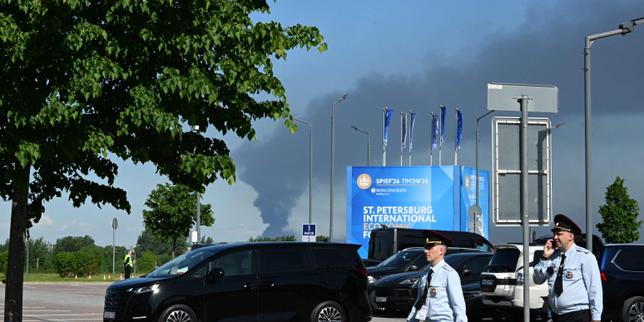
The champagne was supposed to be perfectly chilled. It was June in St. Petersburg, the season of White Nights, where the sun merely dips below the horizon before rising again, casting a surreal, perpetual twilight over the imperial canals. Inside the heavily guarded halls of the St. Petersburg International Economic Forum, Russia’s elite gathered to project an image of absolute permanence. Oligarchs in bespoke Italian suits rubbed shoulders with foreign delegates. Glossy digital displays trumpeted new trade alliances. Vladimir Putin’s flagship economic showcase was open for business, designed to prove to the world that western sanctions were a minor inconvenience, that the Russian economy was roaring, and that the war raging hundreds of miles to the south was a distant, managed abstraction.
Then the sky hummed.
Far from the air-conditioned opulence of the convention center, a low, lawnmower-like drone disrupted the northern twilight. It was a sound that has become the defining soundtrack of modern warfare, but one that the residents of Russia's cultural capital never expected to hear so close to home.
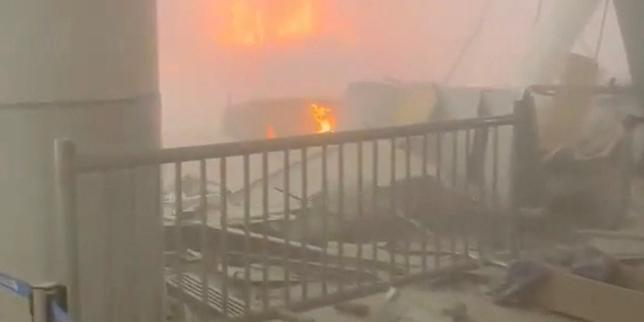
Ukraine had just sent a message. It bypassed layered air defenses, traveled over a thousand kilometers, and smashed into the reality St. Petersburg had spent over two years trying to ignore. The glass didn't just shatter at the targeted oil depot; it shattered the illusion of safety that the Kremlin had meticulously built for its oligarchs and citizens alike.
The Illusion of Distance
For a long time, the conflict was something that happened somewhere else. If you lived in Moscow or St. Petersburg, the war was a television broadcast. It was a series of maps on a screen, a collection of aggressive talking heads, a sacrifice made by men recruited from impoverished provinces thousands of miles away. The wealthy elite continued to dine in fine restaurants. The tech workers continued to sip oat milk lattes.
But geography is no longer a shield.
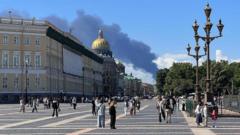
Consider a hypothetical resident of St. Petersburg named Mikhail. He does not fight. He does not protest. He simply works in logistics, pays his mortgage, and hopes the world stops shaking. For Mikhail, the war was a background noise he tuned out. Until the morning the windows rattled. Until the smoke plume rose against the familiar skyline. When a weapon built for pennies in a Ukrainian garage can strike the crown jewel of Peter the Great’s empire, the distance between the frontline and the living room collapses to zero.
This is the psychological front of modern warfare. It is not about the physical destruction of a single fuel tank, though that hurts the war machine. It is about the complete eradication of predictability. When the state can no longer guarantee that its most prestigious city is safe during its most prestigious event, the social contract begins to fray at the edges.
A War of Asymmetry
How does a nation without a major surface navy or a traditional long-range strategic bomber fleet strike deep into the heart of a nuclear superpower? The answer lies in a terrifyingly simple calculation of math and metal.
To understand why these strikes are happening now, we have to look at the evolution of autonomous technology. Traditional air defense systems like the S-400 are engineering marvels. They are designed to track and destroy high-altitude, fast-moving targets like fighter jets and cruise missiles. They look for massive radar cross-sections.
A Ukrainian long-range drone is something else entirely. It is often made of wood, fiberglass, or cheap carbon fiber. It flies low, hugging the tree line, moving slow enough to be mistaken for a flock of birds by older radar algorithms. It costs less than a used car.
To shoot it down, a military must fire a missile that costs upwards of a million dollars.
Even when the air defenses work perfectly and intercept the threat, the math favors the attacker. If Ukraine launches twenty drones and nineteen are destroyed, the single drone that gets through can cause millions in damage to an oil refinery or an electrical substation. More importantly, the nineteen interceptions still force the defender to burn through dwindling stocks of highly sophisticated interceptor missiles. It is an economic bleeding out, hidden beneath the bravado of state press releases.
The economic forum was meant to showcase Russia’s pivot to the Global South and its resilience against Western restrictions. Instead, the narrative was hijacked by cheap components, lithium batteries, and small explosive payloads. While speakers on stage talked about banking independence and sovereign development, the attendees could not help but glance at their phones, watching verified video clips of anti-aircraft guns firing into the St. Petersburg sky.
The Fragile Core of Infrastructure
The choice of targets is never accidental. Ukraine is not striking random residential blocks; it is aiming at the literal nervous system of Russian commerce. Oil and gas are the lifeblood of the Kremlin's budget. They fund the factories turning out tanks; they pay the salaries of the soldiers; they underwrite the subsidies that keep the domestic population compliant.
St. Petersburg and its surrounding regions serve as the critical gateway for Russian energy exports to the rest of the world. The ports and refineries clustered along the Gulf of Finland are monumental engineering feats. They are also incredibly fragile.
An oil refinery is essentially a giant, highly pressurized chemistry set. It cannot be easily paused. If a critical distillation column is damaged, you cannot simply buy a replacement on the open market anymore—not with western technology sanctions firmly in place. Fixing it requires complex reverse-engineering, black-market smuggling, or relying on less advanced alternatives that slow down production.
When these facilities are hit, the ripple effects move fast. Fuel prices at domestic pumps tick upward. Insurance rates for maritime shipping skyrocket. Foreign cargo vessels become hesitant to dock in zones where drones regularly fall from the sky. The invisible stakes of these strikes are found in the ledgers of insurance companies and the disrupted schedules of oil tankers, far more than in the immediate casualty counts.
The Quiet Panic
It is a strange thing to watch a city try to pretend everything is normal when it palpably is not. Reports from inside the economic forum painted a picture of forced optimism. The presentations went on. The deals were signed with pens that bore the forum's logo. But the conversations in the hallways had shifted.
The real threat of these long-range strikes is not that they will destroy the Russian military overnight. They won't. The threat is the slow, corrosive drip of anxiety. It is the realization among the economic elite that their wealth cannot buy them immunity from the consequences of geopolitical choices.
Every time an air raid siren sounds or a drone defense system engages over a major Russian city, it chips away at the core promise of the current regime: Leave politics to us, and your daily life will remain undisturbed.
The war has broken that promise. It did so quietly, through the air, without a massive invading army, carried on wings of grey plastic.
The White Nights of St. Petersburg are famous for their beauty, a time when the darkness never fully takes hold. But this year, the twilight brought no peace. As the delegates headed back to their luxury hotels, escorted by heavily armed convoys through streets lined with imperial architecture, the sky above the Gulf of Finland remained wide open, vast, and suddenly, profoundly unpredictable.