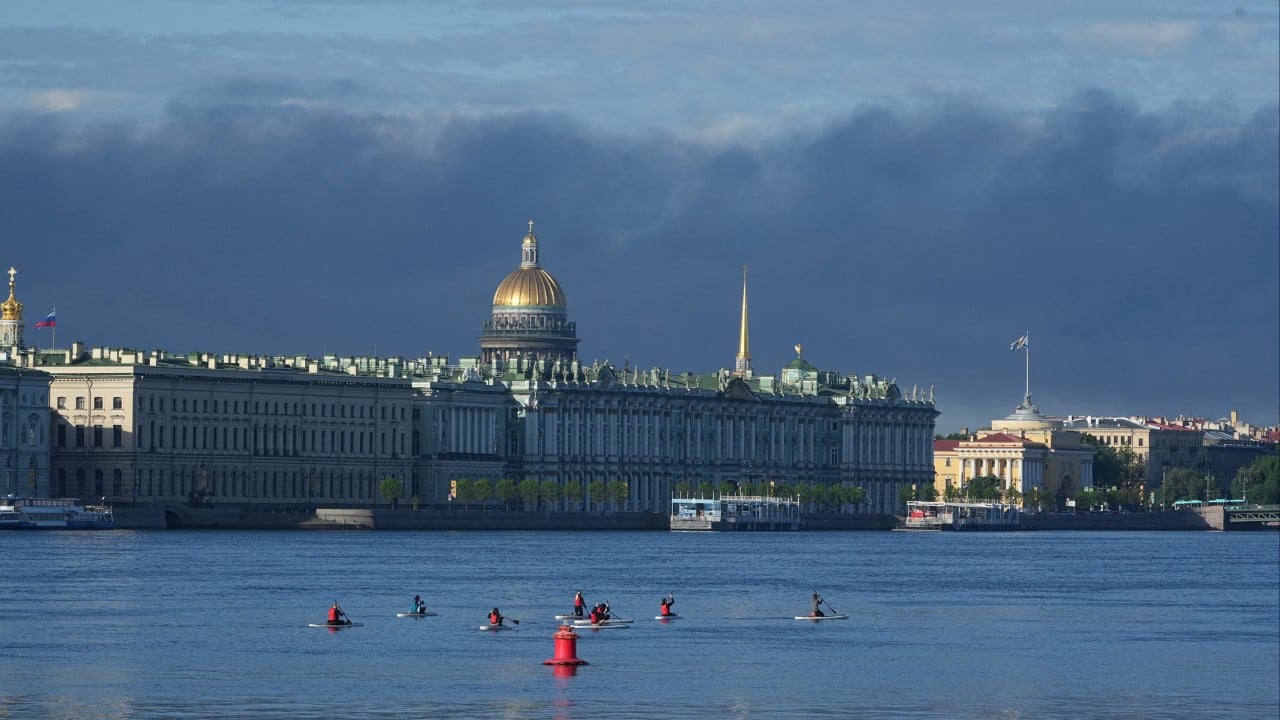
The champagne at the St. Petersburg International Economic Forum is always perfectly chilled. For decades, this event—often dubbed "Russia’s Davos"—has been the crown jewel of the Kremlin’s economic public relations. It is a world of marble floors, multi-billion-dollar deals, and hushed conversations between global executives and high-ranking officials. It is designed to project one specific illusion: absolute stability.
But stability is a fragile thing when it is made of glass.
A few hundred miles away, a technician launches a machine crafted from plywood, cheap electronics, and a lawnmower engine. It weighs less than a suitcase. It costs less than a single bottle of the vintage wine being poured at the forum’s opening gala. Yet, as this fragile contraption hums through the night sky toward Russia’s second-largest city, it carries enough explosive force to shatter the carefully curated illusion of safety.
The war in Ukraine is no longer a distant echo confined to the muddy trenches of the Donbas. It has arrived on the doorstep of Russia's elite, carried on the wings of low-cost, long-range drones.
The Sound of Two Worlds Colliding
To understand the sheer psychological weight of this moment, you have to look at the contrast.
Inside the ExpoForum convention center, the air is thick with the scent of expensive espresso and tailored wool. State officials speak confidently from podiums about "economic sovereignty" and new trade routes with Asia. Investors nod. PowerPoint slides flash statistics showing resilience in the face of Western sanctions. This is the version of reality Russia wishes to sell to the world.
Then comes the buzz.
It is a low, persistent sound, like an angry hornet trapped in a jar. Residents in the suburbs of St. Petersburg have grown to dread it. When a Ukrainian drone penetrates deep into Russian airspace, the response is loud, violent, and impossible to hide. Air defense systems fire into the darkness. Tracers illuminate the night sky above historical palaces and cutting-edge oil terminals.
Consider the logistical reality of what is happening here. Ukraine is successfully launching explosive payloads over distances exceeding 1,000 kilometers. They are bypassing some of the most sophisticated radar networks on earth. They are doing it by flying low, hugging the terrain, and utilizing autonomous guidance systems that defy traditional electronic jamming.
When these drones hit their targets—whether it is an oil refinery on the Baltic coast or an industrial warehouse—the explosion does more than destroy infrastructure. It breaks the unwritten social contract between the state and its citizenry. That contract was simple: the war stays on the television screen, and daily life in the major cities remains untouched.
That contract has expired.
The Microchip and the Lawn Mower
There is a profound irony in the technology redefining this conflict. For years, military theorists believed that the future of warfare belonged to exquisite, multi-million-dollar stealth jets and satellite-guided hypersonic missiles.
They were wrong.
The democratization of destruction is happening through off-the-shelf components. The drones targeting St. Petersburg are essentially flying lawnmowers guided by commercial GPS chips and basic artificial intelligence. They do not need to drop a massive bomb to be effective. A well-placed strike on a fractionating column at an oil refinery can halt production for months.
Think of a modern industrial economy as a giant, complex clock. You do not need a sledgehammer to stop the clock. You just need to drop a single grain of sand into the right gear.
Ukraine’s strategy is precisely that: systematic, low-cost disruption. By forcing Russia to defend every square mile of its vast airspace, Ukraine stretches the Kremlin’s air defense resources to a breaking point. Do you keep your Pantsir and S-400 missile systems at the front lines to protect marching troops, or do you bring them back to guard the billionaires drinking espresso in St. Petersburg?
It is a dilemma with no good answer. Every missile fired at a $10,000 drone costs upwards of a million dollars. The mathematics of this attrition are brutal, unforgiving, and entirely in Ukraine’s favor.
The Shifting Stakes for Global Business
For the international executives attending "Russia’s Davos," the threat is not necessarily physical danger. The ExpoForum itself is heavily guarded, surrounded by layers of military security and electronic countermeasures that jam cellular signals for miles around.
The real danger is financial and reputational.
Investing in an economy that is actively under bombardment requires a tolerance for risk that few modern boards of directors possess. When a drone strikes an oil depot near the port of Ust-Luga, it directly impacts global energy supply chains. Insurance premiums for shipping vessels in the Baltic Sea skyrocket overnight. Foreign partners who were once willing to look the other way regarding sanctions must now calculate the literal physical security of their investments.
The narrative of normalization that the forum tries so hard to foster is unraveling. You cannot convincingly argue that your economy is a safe haven when your guests can hear the air defense batteries working from their hotel room windows.
But the true impact of these strikes is felt by the ordinary people who inhabit these spaces when the dignitaries leave.
The View from the Ground
Imagine an engineer working the night shift at a Baltic fuel terminal. For decades, this was a prestigious, safe, well-paying job. St. Petersburg was always considered safe, insulated by history, geography, and political importance.
Now, the engineer spends their shift listening to the sky.
Every glance at the radar, every unfamiliar rumble from the harbor brings a spike of adrenaline. They know that they are standing next to thousands of tons of highly flammable fuel, and that the sky above them is no longer secure. They watch as makeshift anti-drone cages are welded onto storage tanks—a desperate, low-tech solution to a high-tech problem.
This is the psychological tax of modern warfare. It turns the mundane infrastructure of civilian life into a frontline combat zone. Power plants, ports, and factories become targets. The people who run them become reluctant participants in a war they thought was happening thousands of miles away.
The Kremlin’s response has been predictable: a tightening of information controls, a ban on filming drone strikes, and official statements claiming that all incoming targets were successfully intercepted by electronic warfare. But smoke cannot be classified. The pillars of black soot rising from the edges of the city tell a story that state media cannot erase.
The Architecture of Illusion
Wars usually end when one side can no longer sustain the cost of fighting. Historically, that meant running out of men or money. Today, it means running out of certainty.
The economic forum in St. Petersburg was built to showcase an empire of certainty. It was designed to prove that geopolitical isolation is a myth, that sanctions are toothless, and that the status quo remains unshakable.
But the sky above the Gulf of Finland is empty, vast, and impossible to police completely. As long as cheap, autonomous machines can traverse that emptiness, the glass towers of Russia's economic capital will remain vulnerable.
The conference will end, the delegates will fly home, and the champagne flutes will be packed away. But the hum in the night sky will remain, a quiet, persistent reminder that the distance between a luxury suite and a war zone is shrinking every single day.