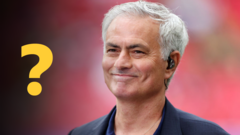
The rain in London doesn't just fall; it judges. It slicks the pavement outside Stamford Bridge, turning the world into a mirror of neon blue and cold steel. If you stand there long enough, you can almost hear the echo of a sharp, Portuguese accent cutting through the fog, declaring himself special before he had even won a single point.
Most people look at a list of football clubs and see a resume. They see a sequence of dates, a collection of trophies, and a win-loss percentage that fits neatly into a spreadsheet. But for the man who wore the gray cashmere coat like armor, these aren't just entries in a database. They are scenes of a crime. They are frantic love affairs that started with a kiss and ended with a burning house.
To recall the path of Jose Mourinho is to trace the history of modern ambition. It is a journey that began not under the bright lights of the San Siro or the Bernabéu, but in the quiet, dusty corners of Portugal where a translator decided he was actually a king.
The Birth of the Insurgent
In the beginning, there was Benfica. It lasted nine games.
Think about that. Nine games to realize you are too big for the room. Most managers spend decades begging for a seat at the table of a titan like Benfica. Mourinho took the seat, flipped the table, and walked out because the president wouldn't give him a contract extension after a 3-0 win over Sporting CP. It was the first sign of the pattern. The arrogance wasn't a flaw; it was the engine.
He moved to União de Leiria. It was a small pond, a blip on the map that shouldn't have mattered. But Mourinho turned them into a ghost ship, a team that haunted the bigger clubs until Porto came calling in 2002. This is where the myth hardened into reality.
At Porto, he didn't just win; he colonized the psyche of European football. He took a group of hungry, overlooked players and convinced them they were invincible. When he ran down the touchline at Old Trafford in 2004, arms flailing, coat flapping in the wind, he wasn't just celebrating a goal. He was announcing the death of the old guard. He won the Champions League and, before the confetti had even settled, he was gone. He didn't want to stay and build a legacy; he wanted to go where the stakes were high enough to break a man.
The Blue Revolution and the Italian Job
London was waiting. Chelsea was a club with money but no soul, a blank check looking for a signature. Mourinho provided the ink. He arrived and told the English press he was a "Special One." They laughed. Then they watched as he built a defensive wall so impenetrable it felt like playing against a mountain range.
He didn't just manage Chelsea; he owned it. He turned John Terry, Frank Lampard, and Didier Drogba into disciples. They would have run through a brick wall if he told them there was a trophy on the other side. He delivered the first league title in 50 years. Then he did it again. But the fire that warms the house eventually burns it down. By 2007, the relationship with Roman Abramovich had frayed. The divorce was messy, sudden, and left a void that the Premier League didn't know how to fill.
So, he went to Milan.
Inter Milan was a sleeping giant that had forgotten how to win the big one. Mourinho walked into the San Siro and spoke Italian better than the locals within months. He found a group of aging warriors—Zanetti, Eto’o, Sneijder—and whispered in their ears that the world hated them. He thrived on the siege mentality.
The 2010 season remains his masterpiece. It wasn't just about the Treble; it was about the semi-final against Barcelona. It was the ultimate clash of philosophies: the beauty of Pep Guardiola versus the brutal, organized defiance of Mourinho. When Inter won, Jose ran onto the Camp Nou pitch, finger pointed at the sky, a villain basking in the boos of 90,000 people. He loved the hate. It made him feel alive.
The White Heat of Madrid
If Inter was a romance, Real Madrid was a war.
Madrid is a club that demands grace. Mourinho gave them a fistfight. He was hired for one reason: to stop the Barcelona hegemony. To do it, he turned El Clásico into a scorched-earth campaign. The tension was suffocating. Friendships between Spanish national teammates were ruined in the tunnel. Press conferences became performance art.
He won La Liga with a record-breaking 100 points, but the cost was astronomical. He fought with the legends—Casillas, Ramos. He poked assistants in the eye. He became a caricature of his own intensity. When he left in 2013, he looked older. The gray in his hair wasn't just distinguished anymore; it looked like ash.
He retreated to the only place that ever truly loved him. He went back to Chelsea.
The "Happy One," he called himself. It was a lie, of course. He won another league title in 2015, proving he still had the magic, but the second act ended even more violently than the first. A collapse so sudden and so complete that it felt like a structural failure. The players stopped running. The fans were confused. The "Special One" was fired while his team sat hovering above the relegation zone.
The Manchester Mistake and the North London Gamble
For years, the Manchester United job was the one he coveted. It was the biggest stage, the legacy of Alex Ferguson, the theater of dreams. But when he finally got it in 2016, the dream felt more like a chore.
He won the Europa League and the League Cup. He finished second and called it one of his greatest achievements because he knew, deep down, the squad was broken. But the football was joyless. It was a chore to watch and, seemingly, a chore to play. The spark was gone. He spent his days living in a hotel, a nomad in a suit, never truly moving in. He was a man waiting for the inevitable axe.
When he popped up at Tottenham Hotspur in 2019, the world gasped. It was like seeing a refined wine connoisseur drinking a cheap beer. He was hired to bring a "winning mentality" to a club famous for "Spurring it up." He took them to a cup final and was sacked six days before the game. It was the ultimate indignity. The man who lived for finals was denied his stage.
The Roman Resurrection
Many thought he was finished. The game had passed him by, they said. High-pressing, data-driven, soft-spoken coaches were the new era. Mourinho was a dinosaur.
Then he went to Roma.
In the Eternal City, he found a fan base as emotional and volatile as he is. He didn't promise them the world; he promised them his heart. He cried when they reached the Europa Conference League final. He cried when they won it. It was the first time in years we saw Jose the human, rather than Jose the brand.
He lasted until early 2024. The ending was familiar—tears, anger, a sense of being betrayed by the board—but the connection he forged with the Romanisti was real. He gave a city that had been starved of glory a reason to scream again.
Now, he sits in Istanbul with Fenerbahçe. Another country, another language, another set of fans to radicalize.
The List of the Damned and the Devoted
To truly know the man, you have to say the names like a litany. Each one represents a different version of Jose.
- Benfica (The Audacious)
- União de Leiria (The Architect)
- Porto (The Conqueror)
- Chelsea (The Special One)
- Inter Milan (The Immortal)
- Real Madrid (The Antagonist)
- Chelsea (The Return)
- Manchester United (The Grump)
- Tottenham Hotspur (The Outsider)
- Roma (The Emotional)
- Fenerbahçe (The Legend)
We obsess over these clubs because Mourinho turns football into something more than a game. He turns it into a psychological thriller. He makes you pick a side. You either love him for his loyalty to his "soldiers," or you loathe him for his arrogance and his defensive "parking of the bus."
But there is a loneliness in his journey. To manage eleven clubs is to have eleven homes and belong to none of them. He is a man who builds cathedrals and then watches them burn from the rearview mirror of a departing car.
He once said that he prefers the taste of victory to the taste of food. You can see it in his eyes during the 89th minute of a 1-0 win. The jaw is set. The eyes are scanning for a threat that only he can see. He isn't just trying to win a match; he's trying to justify his existence. He's trying to prove that the translator from Setubal was right all along, that the world is a cruel place, and only those with the sharpest knives and the thickest skin survive.
The gray coat is gone now, replaced by designer tracksuits and sponsor-heavy gear. The hair is white. The outbursts are perhaps a little more predictable. But the ghost of that man who ran down the Old Trafford touchline still lingers in every stadium he enters.
He is the manager of your favorite team’s nightmares. He is the man who wins the trophy you want, in a way you hate, while insulting your traditions. And when he eventually leaves Fenerbahçe—and he will, likely in a cloud of controversy and expensive severance pay—he will leave behind a group of players who would still die for him and a boardroom that never wants to hear his name again.
That is the Mourinho cycle. It is exhausting. It is toxic. It is brilliant.
And we will miss it when it’s gone. Every time we see a list of his former clubs, we aren't just looking at a career. We are looking at a map of a man who traveled the world looking for a fight he couldn't win, only to realize the fight was the only thing he ever wanted.
The rain continues to fall on the touchline, but Jose doesn't seek shelter. He just waits for the next whistle, ready to tell the world exactly who he is, one more time.