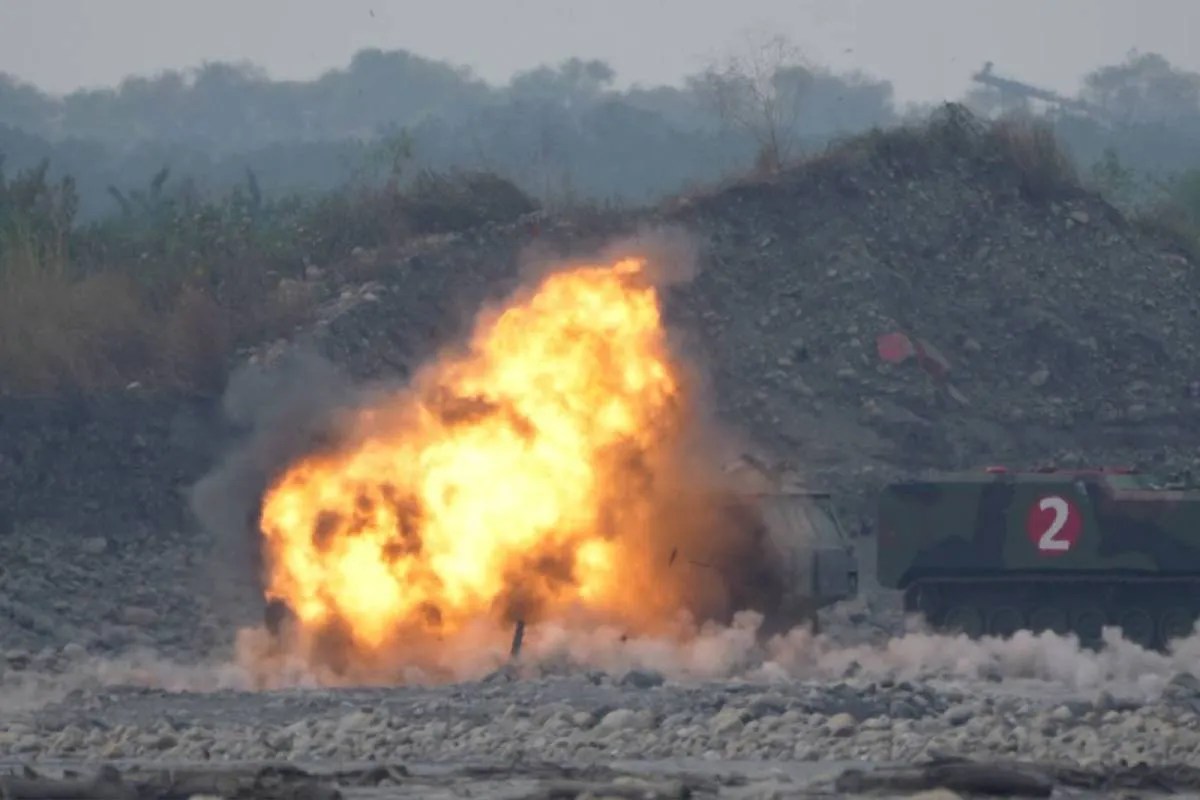
The detection of seven Chinese naval vessels and the persistent hovering of a singular asset within Taiwan’s contiguous zone marks a shift from occasional posturing to a deliberate strategy of operational normalization. This is not merely a series of isolated maritime sightings but a structured application of "Gray Zone" warfare designed to degrade Taiwan’s naval readiness and psychological sovereignty without crossing the threshold of kinetic conflict. By maintaining a constant, fluctuating presence of People’s Liberation Army Navy (PLAN) assets, Beijing is effectively recalibrating the baseline of "normal" military activity in the Strait, forcing the Republic of China (ROC) Armed Forces into a reactive cycle of high-tempo deployments that accelerate platform fatigue and deplete personnel reserves.
The Triad of Operational Attrition
The presence of multiple vessels surrounding a specific geography operates on three distinct levels of strategic utility. Understanding these levels reveals why a "discovery" of seven ships is a calculated signal rather than a random patrol.
- Resource Exhaustion (The Fiscal Lever): For every PLAN vessel idling near the median line or entering the contiguous zone, the ROC Navy must decide whether to shadow, intercept, or monitor via coastal radar. Shadowing requires a near 1:1 ratio of asset deployment. Given the PLAN’s superior hull count and industrial capacity, they can sustain a high operational tempo ($OPTEMPO$) at a fraction of the relative cost to Taiwan. This creates a fiscal bottleneck where Taiwan spends a disproportionate amount of its defense budget on reactive fuel and maintenance rather than long-term modernization.
- Sensor Saturation (The Intelligence Lever): Deploying seven vessels simultaneously allows for a distributed sensor network. One ship may act as a signal intelligence (SIGINT) collector, while others test the response times of specific Taiwanese coastal defense batteries. By "hovering," as reported with the singular vessel, the PLAN gathers high-fidelity data on how Taiwan’s command and control (C2) structures prioritize threats when multiple targets are active.
- Psychological Normalization (The Sovereignty Lever): Constant proximity erodes the significance of the 24-nautical-mile contiguous zone. When incursions become daily occurrences, the international community’s "outrage fatigue" sets in, and the domestic population’s sense of urgency may diminish, providing the PLAN with the tactical surprise necessary should they choose to escalate.
The Mechanics of Persistent Presence
The specific mention of one vessel "hovering" suggests a shift toward loitering munitions or electronic warfare platforms. In modern naval doctrine, a loitering vessel serves as a node in a larger kill-web.
Data Linkage and Target Acquisition
A ship that remains stationary or circles a specific coordinate is often performing bathymetric surveys or calibrating underwater acoustic sensors. These activities are foundational for anti-submarine warfare (ASW) and for mapping safe corridors for amphibious landing craft. If the vessel is equipped with advanced electronic support measures (ESM), its "hovering" allows it to map the electromagnetic spectrum of Taiwan’s northern or southern ports with surgical precision. This data is then fed back to mainland bases via satellite links, creating a real-time digital twin of the Strait’s defensive posture.
The Problem of Proximity and Reaction Time
The compressed geography of the Taiwan Strait means that a vessel within 24 nautical miles reduces the decision-making window for ROC commanders to mere minutes. The kinetic energy required to transition from a "patrol" to an "engagement" is minimal. This creates a permanent state of high-alert stress for Taiwanese crews, which is a known variable in human-factor engineering for military decline. Performance degradation in high-stress environments follows a non-linear path; once a crew reaches a tipping point of exhaustion, the probability of tactical error increases exponentially.
Strategic Constraints and Asymmetric Responses
While the PLAN holds the advantage in mass, their strategy is constrained by the very visibility they seek to exploit. Every movement is a data point for global intelligence agencies. However, relying solely on international condemnation has proven an insufficient deterrent against incremental territorial encroachment.
The Limitation of Conventional Monitoring
The current Taiwanese response relies heavily on aging destroyers and frigates. This creates a mismatch in the "Cycle of Attrition." Taiwan’s platforms are often older and more expensive to maintain than the PLAN’s Type 054A or Type 056A corvettes, which are specifically designed for these high-frequency, low-intensity missions. The structural integrity of a fleet is compromised when blue-water vessels are used for "constabulary" duties—essentially using a scalpel where a blunt instrument is required.
Integrated Coastal Defense Systems (ICDS)
The counter-move to naval encirclement is not necessarily more ships, but a dense, land-based network of anti-ship missiles (ASCMs) and unmanned surface vessels (USVs). By pivoting to an asymmetric posture, Taiwan can monitor PLAN vessels using low-cost drones and shore-based radar, reserving its expensive naval assets for high-threat scenarios. This "Porcupine Strategy" shifts the cost-exchange ratio back in favor of the defender. If the PLAN must account for thousands of mobile, land-based launchers, the tactical value of "hovering" seven ships diminishes, as those ships become highly vulnerable targets in the opening minutes of a conflict.
Quantitative Analysis of Naval Encirclement
To quantify the threat, one must look at the "Incursion Density." If the number of vessels increases from a weekly average of three to a daily average of seven, the surface area that Taiwan’s radar must track expands by over 100%. This is not a linear increase in workload; it is a geometric expansion of the data processing requirements for the ROC’s Maritime Tactical Command and Control System.
- Direct Observation: 7 vessels.
- Inferred Capability: Surface-to-air coverage, electronic jamming, and potentially sub-surface monitoring.
- Tactical Result: The creation of a "partial blockade" environment that tests the shipping lanes’ resilience and the insurance markets' risk appetite for the region.
The Strategic Pivot to Unmanned Defenses
The logical conclusion of this persistent naval pressure is the eventual exhaustion of the ROC Navy’s traditional fleet. To negate the PLAN’s "Seven Ship" tactic, Taiwan’s defense procurement must prioritize autonomous systems. Unmanned Surface Vehicles (USVs) can shadow PLAN vessels at a fraction of the cost, eliminating the human fatigue factor and preserving the life of the main fleet.
Furthermore, the integration of AI-driven predictive analytics can help ROC commanders distinguish between routine "Gray Zone" harassment and actual mobilization. By analyzing the historical movement patterns of these seven-ship clusters, algorithms can identify anomalies in fuel consumption, communication spikes, or formation changes that human observers might miss under the fog of daily operations.
The current trajectory indicates that China will continue to increase the frequency and complexity of these patrols. The objective is to create a "sealed" environment where the movement of PLAN assets is so ubiquitous that a transition to a full blockade or invasion is indistinguishable from a routine Tuesday exercise. The defense must therefore move away from matching hull-for-hull and toward a distributed, lethal, and autonomous sensor-shooter grid that makes the cost of persistent presence too high for the PLAN to ignore.
The primary strategic move now is the immediate acceleration of domestic USV production and the deployment of mobile, land-based Harpoon and Hsiung Feng missile batteries to the outer islands. This creates a cross-strait "no-go" zone for PLAN vessels, effectively neutering the psychological impact of their presence by ensuring that every ship "hovering" near the coast is pre-targeted by multiple, redundant systems.