The marble of the West Wing does not change, but the temperature inside does. It fluctuates based on a glance, a casual aside over a dinner of well-done steak, or an offhand comment made to a donor on a golf course. For two men in Washington, the humidity of that environment is everything. They are breathing the same air, yet navigating entirely different climates.
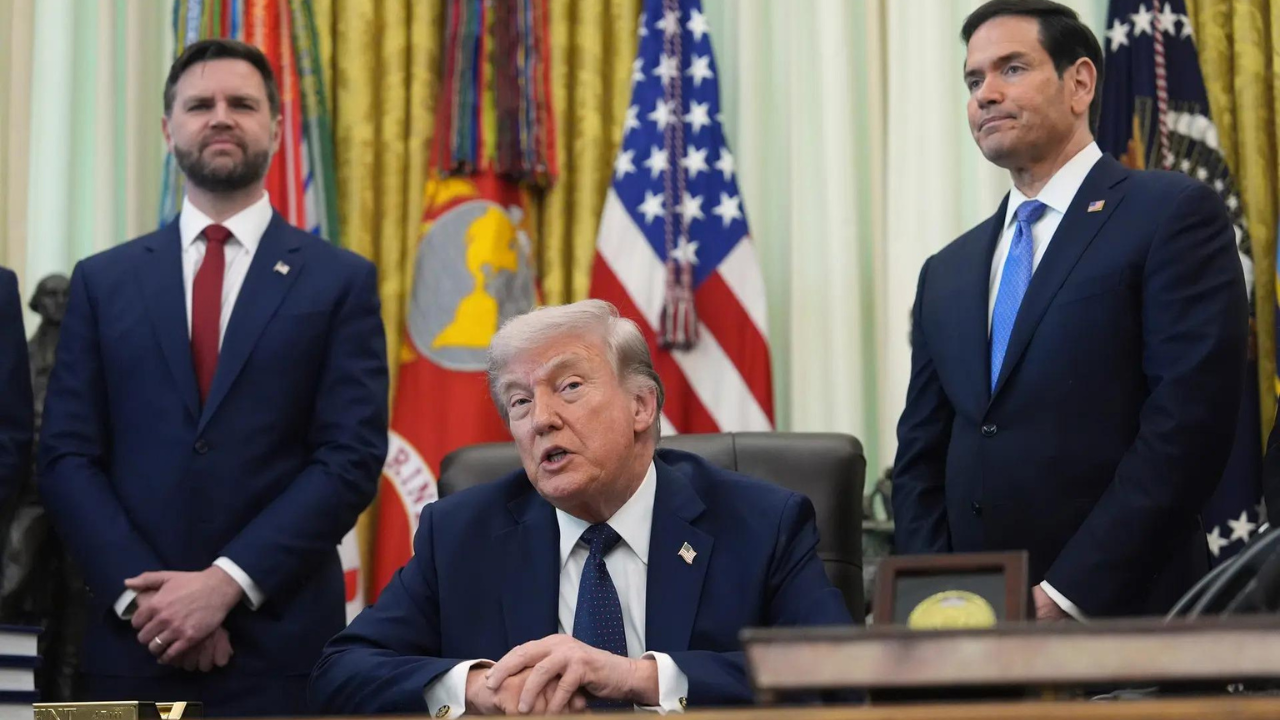
Step inside a closed-door Cabinet meeting. To the left sits the Vice President, a man whose life story was famously sold to Hollywood before he ever cast a vote in Congress. To the right sits the Secretary of State, the son of Cuban immigrants who has spent decades studying the precise placement of commas in international treaties.
Between them sits the President. He is already looking at the clock, not of his term, but of history. Behind closed doors, he has begun asking an agonizingly simple question to his inner circle: Vance or Rubio?
This is not a policy debate. It is a battle for the soul of what comes next.
The Two Wests
The fracture became visible on the grand, cold stage of the Munich Security Conference.
Imagine the contrast of consecutive winters. One year, the Vice President takes the podium and delivers a speech that functions as a blunt-force trauma to European diplomatic sensibilities. He does not talk about traditional adversaries. He tells Europe that its greatest threat is internal—an erosion of its own identity. It is raw, populist, and intentionally disruptive.
The next winter, the Secretary of State arrives to clean up the glass. He steps to the same microphone. His words are carefully calibrated, wrapped in the traditional language of the West, of shared history and enduring alliances.
The policy on paper is identical. The execution is worlds apart.
This is the fundamental tension of the post-Trump era, playing out in real-time before a single primary vote has been cast for 2028. It is a collision between two distinct philosophies of power.
The first philosophy, embodied by the Vice President, views global institutions with deep skepticism. It treats international agreements not as sacred bonds, but as bad business deals that need renegotiation. It speaks for the factory floor.
The second philosophy, carried by the Secretary of State, understands that empire requires a softer vocabulary. It uses the language of institutions to achieve populist ends. It speaks for the boardroom that finances the factory.
The Crucible of Crisis
Nowhere is this tension more agonizing than in the current standoff with Iran.
When the administration engaged in high-stakes diplomacy in Pakistan and Switzerland, it was the Vice President who flew into the eye of the storm. He returned with a fragile truce, a document tested daily by live ammunition. The President publicly remarked, with characteristic theater, that if the talks failed, the blame would fall squarely on his number two.
It was a classic trap. A high-wire act with no safety net.
Meanwhile, the Secretary of State chose to watch from a deliberate distance, skeptical of the regime's sincerity, preferring to focus on building concrete frameworks with traditional regional allies.
Consider the body language during a recent presentation on the conflict. The Secretary of State defended the military posture with absolute, unwavering certainty, framing it as a necessary defense of the free world. The Vice President sat beside him, sedate, almost detached. When it was his turn to speak, he gave a brief, restrained nod to security options before pivoting entirely to wish the assembled troops a happy Easter.
One man wants to fight the war of ideas. The other wants to avoid the abstractions of foreign entanglements altogether.
The Echo Chamber of the Faithful
To understand how this plays out across the country, look at the people standing in line in the rain at political rallies. They are not reading policy briefs. They are reading energy.
At a recent gathering in North Carolina, an attendee named Alice summed up the confusion that many voters feel. She wanted both men on the ticket. But when forced to choose, she leaned toward the Vice President. Why? Because he felt more like the disruption she had voted for. When asked about his shifting positions over the years, she brushed it off. They all change, she said.
A few days later, at a conservative conference in Washington, a voter named Joe expressed the exact opposite view. For him, the Secretary of State's unyielding, hawkish stance on Iran was the deciding factor. It felt like strength. It felt like traditional American power, retrofitted for a new age.
This is the dilemma for the men vying for the inheritance.
- To win the future, the Vice President must remain the ultimate loyalist while carrying the scars of every failed negotiation.
- To win the future, the Secretary of State must prove he belongs to the new populist order without completely abandoning the establishment that raised him.
The Unwritten Script
They are public friends and private rivals. They deny any rift. They praise each other in front of the cameras, using the rehearsed vocabulary of modern politics. "I love Marco," the Vice President says. "We work very well together," the Secretary replies.
But history is an unmerciful author.
The President loves the theater of the competition. He stirs the pot because the friction keeps both men sharp, and more importantly, it keeps them both loyal. But a shadow primary cannot remain in the shadows forever.
Eventually, the truce will break. The fragile agreements abroad will either hold or shatter, and the blame will be assigned.
The true test of the 2028 succession will not be found in who has the most policy successes. It will be found in who survives the proximity to the throne.
As the sun sets over the Potomac, the lights remain on in two specific offices in the capital. Two men are drafting two entirely different versions of the American future. Only one version can be printed.