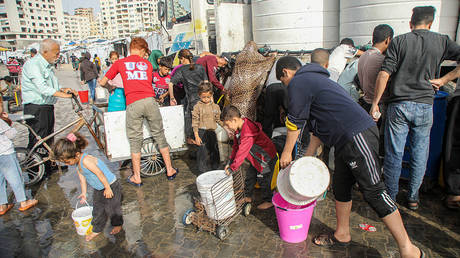
The viability of any urban population center rests on a singular, non-negotiable metric: the per-capita availability of potable water. In the current conflict environment of Gaza, water is no longer a neutral utility; it has been integrated into a broader strategy of urban exhaustion. International medical organizations, including Médecins Sans Frontières (MSF), characterize this as the "weaponization" of water. This is not merely a rhetorical flourish but a description of a systematic dismantling of the hydraulic lifecycle. By controlling the three primary nodes of water access—external supply lines, internal desalination capacity, and fuel-dependent distribution—a state actor can induce a population-wide health crisis without firing a single kinetic round.
The Tri-Node Control Framework
The Gaza Strip’s water security is defined by a precarious dependency on infrastructure that exists both within and outside its borders. To understand the current crisis, one must map the three nodes of supply that have been systematically throttled.
- Direct Pipeline Transfer: Israel manages three primary pipelines (Mekorot) that provide a significant percentage of Gaza’s drinking water. These lines can be—and have been—deactivated via remote valving, creating an immediate and absolute deficit in high-quality potable water.
- Energy-Dependent Desalination: Gaza operates several small-scale and three large-scale desalination plants. These facilities require consistent electrical power or high volumes of diesel fuel. When the sole power plant is incapacitated and fuel entry is restricted, these plants enter a state of mechanical stasis.
- Aquifer Extraction and Salinity: The Coastal Aquifer is the only natural source of water within Gaza. Over-extraction, exacerbated by the failure of external supply nodes, leads to seawater intrusion. This renders the remaining groundwater chemically unfit for consumption, even before biological contamination is factored in.
Mechanical Degradation and the Failure of Sanitation
The crisis is not limited to the absence of water; it is compounded by the destruction of the systems that remove it. In a dense urban environment, the hydraulic cycle is a closed loop. When the input (potable water) vanishes, the output (wastewater) stagnates.
Strategic strikes on power infrastructure and direct damage to sewage pumping stations have resulted in the discharge of raw effluent into the streets and the Mediterranean Sea. This creates a feedback loop of biological hazards. The lack of water for hygiene prevents the containment of fecal-oral pathogens, while the accumulation of standing wastewater provides a breeding ground for vectors. The MSF reports emphasize that medical teams are seeing a surge in hepatitis A and diarrheal diseases, which, in a caloric-deficit population, move from manageable illnesses to primary causes of mortality.
The Bio-Political Cost Function
The degradation of water infrastructure operates on a cost function that disproportionately targets the most vulnerable demographics. The "cost" here is measured in Disability-Adjusted Life Years (DALYs) and immediate mortality rates.
- Renal Failure and Chronic Condition Management: Hospitals require massive amounts of purified water for dialysis and sterilization. Without it, these departments cease to function, effectively issuing a death sentence to patients with kidney disease.
- Maternal and Neonatal Risk: Dehydration in lactating mothers leads to a failure in breast milk production. In an environment where clean water for formula is unavailable, the infant mortality rate climbs sharply.
- Wound Care and Sepsis: In a conflict zone with high trauma rates, water is the primary tool for wound debridement. When surgeons are forced to use non-sterile water or saline substitutes, the probability of postoperative sepsis approaches 100%.
The logic of this degradation is cumulative. It is a slow-motion catastrophe where the initial "strike" is the closing of a valve, and the "impact" is an outbreak of cholera or dysentery weeks later.
Logistical Bottlenecks and the "Dual-Use" Barrier
A critical barrier to restoring water security is the "dual-use" classification of repair materials. Pipes, pumps, solar panels, and chlorine for water purification are frequently blocked at border crossings under the justification that they could be repurposed for military engineering.
This creates a permanent state of infrastructure decay. Even when temporary "humanitarian pauses" allow for some aid entry, the structural components required to fix a shattered water main or a bombed pump station are excluded. The result is a patchwork of "jerry-rigged" systems that are prone to leakage and cross-contamination with sewage lines. The efficiency of the Gaza water network has dropped below 30%, meaning even when water is pumped, the majority of it is lost to the soil or contaminated before it reaches a tap.
The Strategy of Hydraulic Denial
The systematic restriction of water serves a specific tactical purpose: it forces the concentration of populations into "safe zones" that lack the infrastructure to support them. When water is available only at specific distribution points, it becomes a tool for population movement and control.
This is the definition of hydro-tactical asymmetry. One side maintains the ability to restore or deny life-sustaining resources with minimal risk to its own personnel. For the medical NGOs on the ground, the challenge shifts from treating war wounds to managing the fallout of a medieval-style siege updated for the 21st century.
Tactical Necessity of Infrastructure Neutrality
To prevent the total collapse of the Gaza healthcare system, the strategy must shift from sporadic aid delivery to the restoration of infrastructure autonomy.
- Immediate De-classification: International pressure must be applied to remove basic water-repair components (PVC piping, submersible pumps, and chlorine) from dual-use restriction lists.
- Decentralized Desalination: Priority must be given to small-scale, solar-powered desalination units that do not rely on a centralized power grid or vulnerable fuel supply lines.
- Hydraulic Sanctity: Water production and sewage treatment facilities must be recognized as protected zones under international law, with the same status as hospitals.
The current trajectory points toward a permanent ecological and health collapse. Without the immediate restoration of the hydraulic cycle, the mortality from water-borne illness will inevitably surpass the mortality from kinetic conflict. The strategic play is no longer about "managing" the crisis through bottled water deliveries; it is about the re-engineering of survival through the restoration of the grid.