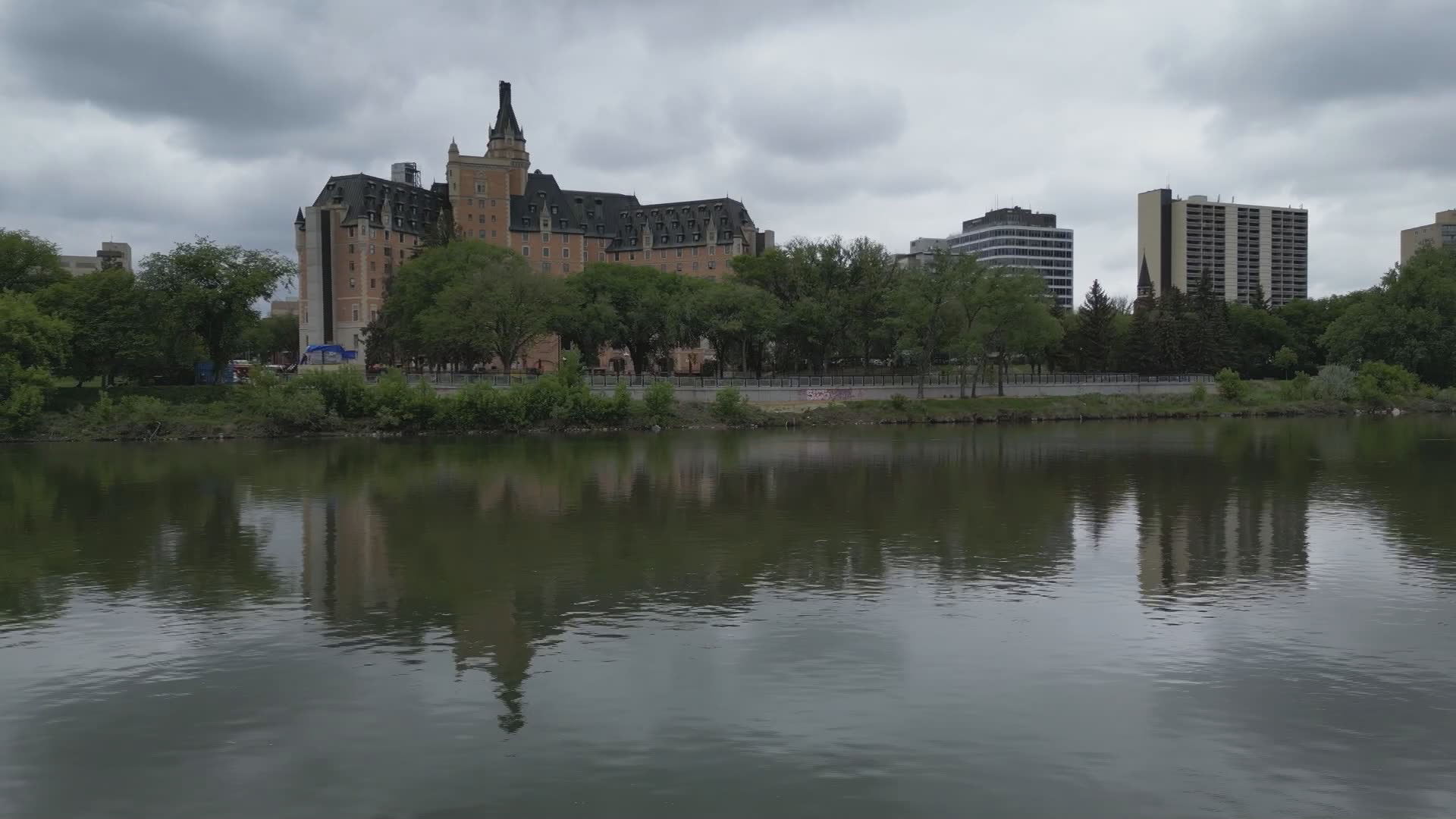
The South Saskatchewan River Basin operates as a highly coupled managed hydrological system, meaning that a half-meter rise in the Saskatoon waterline is never an isolated event. It is the physical manifestation of upstream volumetric discharge decisions and climate inputs colliding with rigid urban infrastructure. When upstream reservoirs, specifically the Gardiner Dam at Lake Diefenbaker, alter their release rates to accommodate mountain snowmelt and heavy rainfall, the downstream effects on Saskatoon are immediate, measurable, and structurally demanding. Understanding this event requires moving past superficial water-level observations and deconstructing the specific mechanics of river hydraulics, infrastructure vulnerability, and municipal risk mitigation.
The core challenge for municipal engineering and emergency planning is not the volume of water itself, but the velocity and surface elevation profile of the river as it passes through the urban core. A 50-centimeter elevation increase fundamentally shifts the hydraulic pressure against bank stabilization infrastructure, alters the operational parameters of water intake plants, and activates localized flood-plain management protocols.
The Upstream Forcing Mechanisms Driving Waterline Elevation
The South Saskatchewan River's flow rate through Saskatoon is primarily dictated by a three-tiered systemic framework: alpine snowpack depletion, regional precipitation events, and the operational storage capacity of upstream reservoirs.
[Alpine Snowmelt + Regional Rainfall] -> [Lake Diefenbaker Storage Buffer] -> [Gardiner Dam Release Rate] -> [Saskatoon Waterline Elevation]
1. Cumulative Basin Inflow
The headwaters of the South Saskatchewan River system rely heavily on the eastern slopes of the Rocky Mountains. Late-spring warming accelerated by heavy rain-on-snow events in Alberta creates a rapid surge of meltwater into the Bow, Oldman, and Red Deer rivers. When these tributaries converge, they deliver a massive volumetric influx into Lake Diefenbaker.
2. Reservoir Regulation Constraints
The Water Security Agency (WSA) manages Lake Diefenbaker via the Gardiner and Qu'Appelle River dams. The primary operational mandate during a high-water event is balancing flood control downstream with reservoir structural integrity and power generation efficiency. When the reservoir reaches its maximum desirable seasonal level, the WSA must match inflow with outflow. A sudden shift to high-volume spillway releases triggers the rapid escalation of downstream water levels.
3. Channel Morphodynamics and Hydrology
As the increased discharge volume moves toward Saskatoon, the physical constraints of the river channel dictate the localized water surface elevation. The riverbed configuration, channel width, and presence of islands or sandbars dictate the hydraulic roughness. In narrow or shallow sections of the Saskatoon river valley, the channel cross-section cannot expand laterally, forcing the water level upward to accommodate the increased volumetric flow rate, measured in cubic meters per second ($m^3/s$).
Dual-Vector Vulnerability Assessment of Urban Infrastructure
A half-meter increase in river elevation creates distinct structural challenges across two primary vectors: subterranean utility backpressure and surface-level hydraulic erosion. Municipalities frequently miscalculate total risk by focusing solely on overland flooding, ignoring the hydrostatic pressure exerted on underground systems.
Subterranean Utility Backpressure and Stormwater Inversion
The storm sewer system in Saskatoon relies largely on gravity-fed outfalls that discharge directly into the South Saskatchewan River. When the river level rises by 0.5 meters, it creates a hydraulic head that counters the outward flow of stormwater.
The mechanism of failure in this scenario follows a specific sequence:
- Outfall Submergence: The river level rises above the crown of the storm outfall pipes.
- Hydraulic Backwater Effect: Water backs up into the storm network, reducing the system's capacity to handle localized rainfall within the city.
- Surcharge and Inversion: If localized heavy rainfall occurs simultaneously with high river levels, the water cannot escape. The storm network surcharges, causing water to push upward through manholes and catch basins, flooding streets from the inside out.
To counter this, the city utilizes gate valves and inline backflow preventers. However, these mechanisms isolate the storm system from the river, meaning any rain falling within the city must be mechanically pumped over the barrier, shifting the vulnerability from gravity drainage to electrical and mechanical pump capacity.
Surface-Level Hydraulic Shear Stress and Bank Stabilization
Riverbanks are subject to continuous erosive forces, but a sudden increase in water velocity and depth alters the shear stress equation along the shoreline.
$$ \tau = \rho \cdot g \cdot R \cdot S $$
Where $\tau$ represents the fluid shear stress, $\rho$ is the water density, $g$ is the gravitational constant, $R$ is the hydraulic radius of the channel, and $S$ is the energy slope of the flow.
As the water level rises by half a meter, both the hydraulic radius ($R$) and the flow velocity increase, exponentially raising the shear stress exerted on the riverbanks. The vulnerability is concentrated in three zones:
- The Meewasin Trail Network: Expansive segments of the pedestrian trail run parallel to the riverbanks at low elevations. Increased water levels submerge trail foundations, saturating the sub-grade material and leading to structural failure, slumping, and washouts.
- Bridge Piers and Abutments: Saskatoon’s historic and modern bridges experience increased hydrodynamic drag and localized scour around their foundations. The increased velocity accelerates the removal of bed material from around the base of the piers, threatening structural equilibrium if left unmonitored.
- Water Treatment Plant Intakes: The city's potable water supply depends on river water intakes. High water levels bring elevated turbidity—increased loads of suspended solids, silt, and organic debris swept from upstream banks. This strains the filtration and chemical treatment processes at the water treatment plants, requiring real-time adjustments to coagulant dosages to maintain drinking water safety standards.
Operational Risk Mitigation Framework for High-Water Events
Managing a 0.5-meter surge demands a coordinated operational response that transitions from passive monitoring to active structural intervention. The municipal playbook breaks down into three distinct phases based on river discharge thresholds.
Phase A: Tactical Monitoring and Ingress Restriction
This phase initiates as river flow rates approach thresholds that elevate the waterline toward the 0.5-meter mark above seasonal averages. The priority is public safety and data collection.
- Asset Isolation: Physical closure of low-lying sections of the Meewasin Trail, boat launches, and park spaces adjacent to the riverbank to prevent pedestrian entrapment.
- Telemetry Calibration: Deployment of real-time hydrometric gauges to track water surface elevation, velocity, and turbidity changes hourly.
- Debris Management: Deployment of floating boom systems upstream of critical infrastructure, such as the water intake plants and bridge piers, to deflect large logs and debris carried by the fast-moving current.
Phase B: Hydraulic Isolation and Pumping Operations
This phase activates when the river level submerges storm outfalls, necessitating the isolation of the city's internal drainage network from the river's hydrostatic pressure.
- Sluice Gate Activation: Closing mechanical gates at storm sewer outfalls to prevent the South Saskatchewan River from backing up into urban neighborhoods.
- Lift Station Deployment: Activating high-capacity stormwater lift stations to pump internal runoff out into the river against the hydraulic head.
- Turbidity Management: Shifting water treatment plant operations to utilization of secondary settling basins or adjusting flocculation parameters to handle the intense sediment load without dropping system-wide water pressure.
Phase C: Post-Crest Structural Audit and Remediation
Once the river crests and levels begin to recede, the hidden damage must be quantified before infrastructure can return to normal operational status.
- Bathymetric Scour Surveys: Utilizing sonar technology to inspect the riverbed around bridge piers, ensuring that high-velocity currents did not compromise foundation stability through scour hole formation.
- Slope Stability Analysis: Geotechnical assessments of the river valley walls along Saskatchewan Crescent and other critical slopes to check for signs of deep-seated rotational slumps or accelerated erosion caused by groundwater saturation.
- Sub-grade Void Detection: Employing ground-penetrating radar along submerged trail systems and roadways to check for internal erosion or voids created by water piping beneath the asphalt.
Long-Term Capital Planning Under Hydrological Volatility
Relying entirely on reactive operational playbooks exposes structural limitations as climate variability increases the frequency and intensity of upstream weather events. Long-term municipal resilience requires structural adaptation embedded directly into Saskatoon's capital expenditure plans.
The first strategic priority must be the systematic retrofitting of all low-lying storm outfalls with mechanical duckbill check valves or automated knife-gate valves. These systems reduce the reliance on manual intervention during rapid rise events, mitigating human-error risks during crisis windows.
The second priority involves the implementation of green infrastructure and naturalized shorelines rather than relying solely on rigid concrete riprap. Utilizing engineered bio-retention cells, deep-rooted native vegetation, and articulated concrete block mats allows the riverbank to absorb kinetic energy and fluctuate naturally without experiencing catastrophic structural failures.
Finally, municipal planning authorities must update local zoning bylaws and flood-fringe definitions. Restricting permanent structural development within historical high-water marks and designing public park spaces to act as intentional, sacrificial flood reservoirs ensures that when the South Saskatchewan River claims its extra half-meter of space, the economic and structural impact to Saskatoon remains entirely negligible.