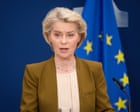
The European Union has unveiled a headline-grabbing plan to bar any Russian citizen who has served in the military since February 2022 from entering the bloc. Part of a sweeping 21st sanctions package announced by European Commission President Ursula von der Leyen, the proposed visa ban aims to ensure Europe remains off-limits to those participating in the invasion of Ukraine. However, while the political messaging is sharp, the practical enforcement mechanisms remain deeply fractured. Border security experts and diplomatic insiders quickly pointed out that the EU lacks a unified, centralized database capable of tracking millions of anonymous Russian conscripts and contract soldiers, meaning the burden of verification will fall entirely onto overstretched national intelligence agencies.
Beyond the symbolic battlefield of travel bans, the real weight of this fresh diplomatic offensive lies in a desperate bid to shore up Europe's crumbling economic defenses. Rising geopolitical friction in the Middle East has inadvertently thrown Moscow an economic lifeline by disrupting global logistics and driving up global oil benchmarks. To counter this, Brussels is attempting to freeze the Russian oil price cap mechanism at roughly $44 per barrel until January 2027 and blacklist 30 additional shadow fleet tankers. Yet, as long as third-party maritime hubs continue to facilitate illicit ship-to-ship transfers, the economic siege remains vastly incomplete.
The Data Gap Defeating the Military Entry Ban
Proposing a blanket ban on former combatants makes for excellent political theater in Brussels, but the bureaucratic machinery required to execute it does not exist. European consular offices globally do not have access to the internal personnel registries of the Russian Ministry of Defense.
When a Russian citizen applies for a Schengen visa, they submit standard employment records, bank statements, and biometric data. Under current protocols, identifying whether an applicant spent six months in a motorized rifle brigade near Avdiivka relies almost entirely on self-reporting or circumstantial paper trails, such as gaps in civilian employment history. Wealthier veterans or contract soldiers who have returned to civilian life can easily obscure their military past by obtaining new employment documentation from compliant domestic firms.
Western intelligence agencies possess high-level satellite imagery and intercept capabilities, but they do not maintain real-time biographical rosters of the hundreds of thousands of mobilized men moving through the Russian military apparatus. This leaves frontline EU border states like Finland, Estonia, and Latvia to bear the operational brunt of the policy, forcing border guards to conduct aggressive, manual interrogations based on loose intelligence indicators.
The Middle East Factor and the Shadow Fleet Cat-and-Mouse Game
While the diplomatic focus remains on infantrymen, the economic war is being fought on the high seas, where Europe is losing ground due to shifting global dynamics.
"The conflict in the Middle East and disruptions to global energy supply chains have eased some pressure on Russia," Von der Leyen admitted during her briefing.
💡 You might also like: Why the Ethnic Unity Law is Changing Tibet Forever
When geopolitical instability flares up in the Middle East, global energy markets tighten instinctively. For Moscow, this volatility has been a massive windfall, allowing its oil revenues to stabilize despite Western efforts. The EU response in this 21st package is an aggressive regulatory freeze, holding the Russian crude price cap firmly down to insulate the West from market spikes.
Expanding the Blacklist
To enforce this artificial ceiling, the European Commission is targeting the maritime logistics infrastructure that allows Russia to bypass Western insurance and shipping networks entirely.
- Thirty new vessels are being added to the EU blacklist, pushing the total number of explicitly sanctioned shadow fleet hulls past 660.
- Logistical service providers offering refueling, provisioning, and maintenance to these blacklisted tankers are facing outright bans.
- Physical infrastructure restrictions are being drafted to penalize international ports, airports, and refineries caught processing or trading oil moved via illicit channels.
The strategic flaw in this approach is the sheer adaptability of maritime asset ownership. The moment an oil tanker is blacklisted by Brussels, its ownership is routinely transferred to a newly registered shell company in Dubai, Monrovia, or Mumbai. The ship is renamed, re-flagged under a cooperative maritime authority, and sent right back to sea within weeks.
The Third-Party Crypto and Banking Crackdown
Recognizing that traditional financial sanctions have hit a wall of diminishing returns, Brussels is expanding its regulatory reach into the digital asset ecosystem and third-party financial institutions. The new package slaps transaction bans on 31 additional domestic Russian banks, but the more critical development is the explicit targeting of 20 financial entities, crypto platforms, and oil brokers operating entirely outside Russian borders.
For the first time, the EU is attempting to claim the legal authority to impose a total, blanket prohibition on crypto-asset service providers in third countries if they are found to be facilitating the movement of capital for sanctioned Russian entities.
| Target Sector | Proposed Action | Intended Strategic Impact |
|---|---|---|
| Third-Country Crypto Firms | Total EU transaction and operational prohibition | Cut off alternative capital flight corridors used to bypass SWIFT blocks. |
| Industrial Metals & Alloys | Strict export controls on aerospace-grade inputs | Starve Russian defense complexes of precision components for drone systems. |
| Seafood Industry | Complete import ban on specific products like cod | Deprive the Kremlin of non-energy commodity revenues worth millions. |
This financial escalation faces immense geopolitical friction. Unilateral European decrees carry little weight in jurisdictions like the United Arab Emirates, Kazakhstan, or India, where national governments view Western sanctions as a regional overreach rather than international law. If an overseas crypto exchange or secondary bank decides that its volume of Russian business is more profitable than its exposure to the European market, it will simply ignore the mandate, further fracturing the global financial system into isolated Western and non-Western alignment blocs.
The Looming Fight for Unanimity
Before any of these measures can take effect, the proposal must survive the volatile gauntlet of the European Council, where all 27 member states hold veto power. Getting every capital to sign off on a package that directly penalizes third-country corporations and bans cheap seafood imports will require months of intense backroom horse-trading. Frontline states will demand even harsher measures, while economically vulnerable members will quietly fight to insert carve-outs that protect their domestic industries from inflation. Brussels has drawn a line in the sand regarding who can step onto European soil, but enforcing that line requires structural capabilities that the bloc simply does not possess.



:max_bytes(150000):strip_icc():focal(665x0:667x2)/gettyimages-50733149-2000-8b129a2475974982a915418ce92a73d8.jpg)