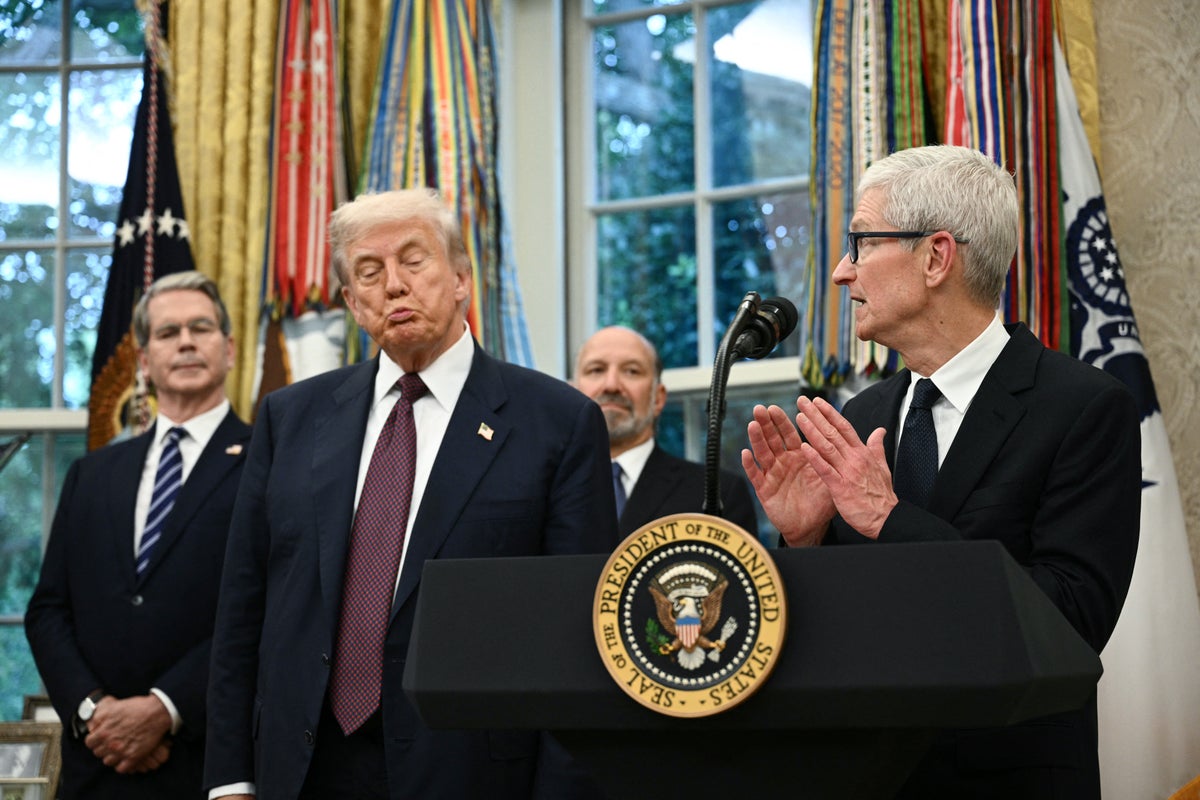
The premarket stock spike on Thursday morning told one story, but the reality inside Cupertino and Santa Clara tells a far more complicated one. When President Donald Trump announced on Truth Social that Apple had agreed to work with Intel to design and manufacture chips in the United States, it marked the climax of a year-long, high-pressure campaign by the federal government. For Apple, this is a forced diversification strategy driven by the threat of sweeping tariffs and the reality that Taiwan Semiconductor Manufacturing Company is increasingly prioritizing AI tech giants. For Intel, it is a desperate validation of its manufacturing turnaround, backed by a direct taxpayer equity stake.
This arrangement does not represent a voluntary corporate alliance born out of technical alignment. It is a shotgun wedding brokered by Washington interventionism, fundamentally altering how advanced semiconductors will be built, priced, and distributed in the coming decade.
The Strongarm Diplomacy of Howard Lutnick
Behind the sudden presidential social media post lies a multi-month campaign led by Commerce Secretary Howard Lutnick. For over a year, Lutnick repeatedly met with Apple leadership, delivering a simple message. The administration would use every economic lever at its disposal, including aggressive tariff structures on foreign-made electronics, to force major American tech firms to anchor their supply chains domestically.
Apple had comfortably spent the last six years relying almost exclusively on TSMC to fabricate its custom Apple Silicon. This reliance gave Apple unmatched yields and elite performance across iPhones, iPads, and MacBooks. However, that reliance became an extreme concentration risk as geopolitical tensions grew and TSMC found itself overwhelmed by demand for specialized artificial intelligence accelerators from firms like Nvidia and AMD.
The White House saw an opening. In August 2025, the federal government took a 9.9 percent equity stake in Intel, investing 8.9 billion dollars of capital directly into common stock, partially funded by money from the CHIPS Act and the Secure Enclave program. Suddenly, the U.S. government was not just a regulator or a provider of subsidies. It was Intel's most influential shareholder.
Lutnick used this position to push Apple into negotiations. The narrative presented to Cupertino was clear. If Apple wanted to protect its massive margins from incoming import taxes, it needed to buy American wafers. And the only American fab capable of eventually matching Apple's needs was Intel.
The Technical Reality of the 18A-P Node
While the political announcement focuses on immediate manufacturing independence, the actual production timeline reveals a massive lag between executive signatures and functional hardware. Apple is not shifting its flagship iPhone processors to Intel fabs tomorrow.
According to industry reports and preliminary engineering tests, Apple has only recently begun evaluating systems-on-chip built on Intel’s enhanced 18A-P process node. This specific node just entered risk production, as Intel announced at the VLSI Symposium in Honolulu earlier this week. Intel claims the 18A-P variation delivers a 9 percent performance boost at identical power levels, or an 18 percent power reduction at identical performance, compared to its standard 18A architecture.
The technical specifications of this process are highly specific.
- RibbonFET Transistors This architecture shifts from traditional FinFET structures to gate-all-around configurations, allowing tighter control over electrical currents.
- PowerVia Backside Power Delivery By moving power distribution lines to the reverse side of the silicon wafer, Intel decouples the power grid from signal routing, reducing resistance and saving physical space.
- Tighter Skew Corners The 18A-P node claims a 30 percent improvement in manufacturing consistency, which is vital for raising wafer yields to a level that Apple finds economically viable.
Despite these engineering milestones, risk production is merely the testing phase. Analyst data suggests that actual volume delivery of Intel-made Apple chips will not hit the market until at least the second or third quarter of 2027. Initial production runs will almost certainly be restricted to lower-stakes components, such as processors for entry-level MacBook Air models or standard iPads, rather than the high-volume, high-margin silicon that drives the flagship iPhone lineup.
TSMC AI Shift Created the Opening
To understand why Apple ultimately yielded to Washington's pressure, one must examine the shifting priorities inside TSMC itself. For over a decade, Apple was the uncontested king of TSMC’s client roster. It routinely bought out entire initial runs of next-generation nodes, effectively dictating the operational rhythm of the Taiwanese foundry.
That dynamic changed with the explosion of data-center artificial intelligence infrastructure. In early 2026, TSMC reported that high-performance computing, the segment tracking AI accelerators and data-center hardware, accounted for a staggering 61 percent of its total corporate revenue. Meanwhile, smartphone-related revenue plummeted by 11 percent.
Firms like Nvidia and AMD are buying advanced packaging and fabrication space at premiums that a consumer electronics brand cannot easily absorb without driving retail device prices to unsustainable levels. Apple’s leverage over TSMC has weakened. For the first time, Apple faced the reality that it might not always get first priority for advanced manufacturing capacity in Taiwan.
Diversifying to Intel is a logical corporate hedge, even if it was catalyzed by a political shove. By introducing Intel as a secondary foundry supplier, Apple creates a competitive counterweight to TSMC. It gives Apple an alternative manufacturing pipeline, breaking a long-running dependency and providing an internal buffer against supply-chain shocks in East Asia.
The Financial Stakes for Taxpayers
The federal government’s intervention in the semiconductor market has fundamentally changed the financial profile of domestic manufacturing. When the White House bought its 10 percent position in Intel in mid-2025, the chipmaker's total market value was hovering near 100 billion dollars. Following a string of earnings beats and the momentum generated by this Apple agreement, Intel’s valuation has swelled significantly.
From a purely financial perspective, the government's paper returns look spectacular. However, this creates a bizarre corporate governance dynamic. The line between state policy and corporate interests is blurring.
Critics point out that this interventionist strategy distorts standard market dynamics. By actively directing major domestic consumer electronics companies to use a specific manufacturer, the administration is effectively picking industrial winners and losers. If Intel fails to hit its yield targets on the 18A-P node throughout 2026, Apple will be trapped using a sub-par domestic supply chain, which could force consumer price increases that Apple’s leadership recently described as otherwise unavoidable.
Execution is the Only Metric That Matters
Wall Street celebrated the Truth Social announcement with a 9 percent premarket bump for Intel stock, but veteran observers know that press releases do not print functional silicon. Intel has historically struggled with its contract manufacturing division, frequently missing delivery timelines and failing to convince outside fabless designers that it can operate with the reliability of TSMC.
Landing Apple as a validation customer is an extraordinary marketing victory for Intel chief executive Pat Gelsinger. It proves to other skeptical chip designers that Intel’s open-foundry model can satisfy the most demanding quality control department in global tech. If Apple's engineers are working with Intel's tools, companies like Qualcomm or MediaTek may feel more comfortable booking future capacity in Chandler, Arizona or New Albany, Ohio.
But validation is not volume. The hard work of chip manufacturing happens at the factory floor level, where engineers must maintain near-perfect cleanroom environments and dial in extreme ultraviolet lithography machines to achieve acceptable yields. A 30 percent tighter process variation on paper means nothing if the actual wafers coming out of Fab 52 show high defect rates.
Apple has signed a preliminary commitment because the political and supply-chain pressures left it with no viable alternative. But if Intel’s 18A-P lines falter during the 2026 testing phase, no amount of White House pressure will force Apple to put defective processors into millions of consumer devices. The administration has successfully brought the horse to water, but Intel still has to prove it can actually manufacture the future of American computing.