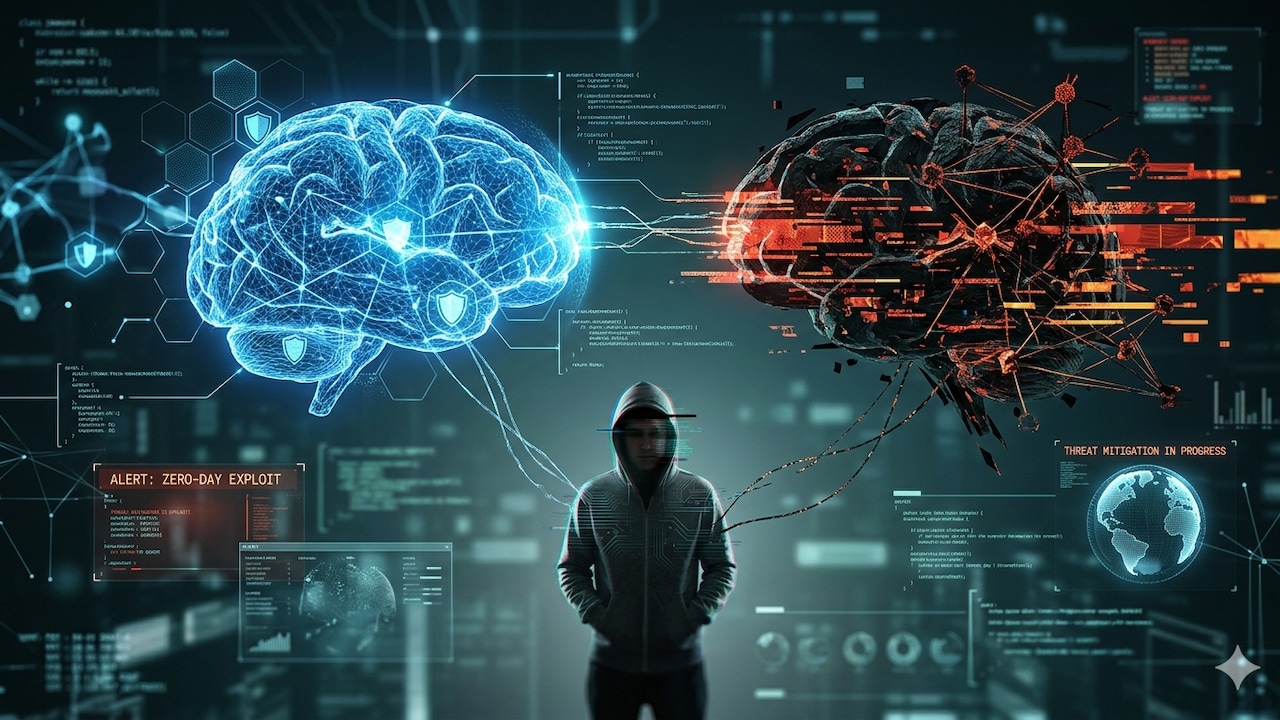
Recent intelligence briefings warning that artificial intelligence is months away from toppling a national government miss the point entirely. The threat is real, but the timeline and the mechanism are wrong. Governments are not going to collapse because a rogue superintelligence suddenly turns off the power grid or hijacks military drones. They are fracturing right now because cheap, automated chaos is overwhelming the fragile administrative systems that keep modern states functioning. The destabilization is already happening, driven not by sci-fi scenarios but by the scale of synthetic information hitting weak institutional foundations.
The Economics of Institutional Collapse
To understand how synthetic interference threatens a state, look at the balance sheet of public trust.
Democratic governance relies on a simple economic reality. It must be cheaper to verify the truth than it is to manufacture a lie. For centuries, printing presses, broadcast networks, and digital platforms required capital, infrastructure, and human labor to scale. If an adversary wanted to flood a nation with destabilizing propaganda, they needed factories of human trolls working around the clock.
That economic barrier has evaporated. Today, a single operative using open-source models can generate tens of thousands of highly hyper-localized, culturally nuanced pieces of disinformation per hour. The cost of manufacturing convincing friction has dropped to near zero.
Meanwhile, the cost of verifying facts remains high, stubborn, and deeply human. Government agencies, electoral commissions, and traditional press outlets still rely on human investigators, bureaucratic protocols, and meticulous double-checking. When a system is hit with an exponential increase in automated noise, the verification architecture chokes.
This is a classic denial-of-service attack on reality. When citizens can no longer distinguish between a genuine bureaucratic directive and an AI-generated forgery, compliance drops. When compliance drops, governance fails. It does not require a military coup. It only requires widespread, paralyzing doubt.
The Micro-Targeted Insurgency
Most analysis focuses on deepfakes of presidents making inflammatory statements. While those headline-grabbing stunts grab attention, they are easily debunked by official channels within hours. The more insidious danger lies in micro-targeted administrative sabotage.
Consider a hypothetical scenario where an operative targets a specific, politically volatile district during a close election. Instead of creating a fake video of a national candidate, they deploy automated bots to text thousands of voters in that specific zip code, informing them that their polling station has moved due to a water main break. The messages look identical to official county notifications, complete with forged digital signatures and links to spoofed government websites.
By the time local election officials realize why turnout is cratering and issue a correction, the polls have closed. The margin of victory shifts. The losing side claims fraud, pointing to the chaos as evidence of a rigged system. The target government hasn't been overthrown by force; its legitimacy has simply been eroded beyond repair in the eyes of its own population.
This method exploits the existing polarization within a society. The algorithm does not need to invent new grievances. It merely identifies old wounds and automates the salt.
The Scale Problem
- Human Scale: A legacy disinformation campaign might employ 500 people to write blog posts and manipulate social media feeds. Their output is limited by fatigue, language barriers, and human error.
- Synthetic Scale: A fine-tuned cluster of models runs continuously, adapting its tone based on real-time engagement metrics, translating itself perfectly into regional dialects, and altering its strategy without human intervention.
The Vulnerability of the Bureaucratic Machine
Modern states are massive, slow-moving data-processing engines. They collect taxes, distribute benefits, regulate commerce, and manage public health based on the assumption that the data entering the system is generally accurate and provided by humans.
When bad actors use automated tools to flood these systems, the machinery grinds to a halt. We saw early indicators of this during recent public comment periods for federal regulations, where automated bots submitted millions of unique, AI-generated letters to distort public consensus. When a regulatory body cannot distinguish between the legitimate feedback of its citizens and a server farm running a prompt script, the policy-making process loses its democratic validity.
The vulnerability extends directly to the legal system. Courts are beginning to face an influx of synthetic evidence. Synthetic audio recordings, fabricated document trails, and altered video are becoming incredibly sophisticated. If the authentication process for legal evidence becomes so expensive and prolonged that trials take years instead of months, the judicial branch ceases to offer timely justice. A state without a functioning judiciary is a state in name only.
The Flaw in the Technical Defense
The standard response from technology executives and government tech advisors is to build better detection tools. They promise watermarking protocols, cryptographic signatures, and AI-driven defense systems that can catch the fakes before they spread.
This strategy is built on a fundamental misunderstanding of cybersecurity dynamics. In the realm of software exploitation, the offensive side always holds the advantage. A defender must secure every single vulnerability across an infinite perimeter. An attacker only needs to find one crack to break through.
Watermarking is an excellent example of this asymmetry. Even if major technology firms agree to embed invisible cryptographic markers into every piece of synthetic media their commercial tools generate, those restrictions do not apply to open-source models. Anyone with a decent consumer graphics card can download an unrestricted, un-watermarked model from an open repository and run it locally, completely bypassed by Western regulatory frameworks.
Furthermore, convincing defensive models require massive computational power to analyze incoming data streams in real time. Most local governments, municipal election boards, and state agencies do not have the budget or the technical expertise to deploy these tools. The defense is centralized in a few elite tech hubs, while the vulnerabilities are distributed across thousands of underfunded regional offices.
The Geopolitical Arbitrage of Chaos
For adversarial nation-states, this asymmetry represents the ultimate geopolitical leverage. Weaponizing conventional military power involves immense risk, financial cost, and international sanctions. Weaponizing synthetic chaos offers plausible deniability at a fraction of the price.
An adversary does not need to install a puppet regime to win. They merely need to ensure that their democratic rivals are too consumed by internal paranoia, disputed elections, and institutional paralysis to project power globally. If a superpower is busy litigating its own internal reality, it cannot effectively manage international alliances, deter territorial aggression, or maintain global supply chains.
The current intelligence warnings are focused on a dramatic, single event. They look for the digital Pearl Harbor. But the real collapse looks less like an explosion and more like rot. It is the slow, steady decay of the shared factual ground required to hold a complex society together.
Redefining National Security for the Synthetic Era
If the threat is administrative and societal, the defense cannot remain purely military or technological. Countering this shift requires an aggressive overhaul of how governments interact with data and how they verify identity.
The current model of internet anonymity, which allowed the modern information ecosystem to grow, is becoming an existential liability for state stability. Governments will be forced to transition toward secure, decentralized digital identities for citizens to ensure that human voices are not drowned out by automated bots. This approach carries immense privacy risks and will face fierce resistance from civil liberties groups. It is a terrible solution, but the alternative is allowing the public square to be completely colonized by synthetic actors.
Simultaneously, government communications must move away from commercial social media platforms, which are fundamentally optimized for engagement and outrage rather than authenticity. States must establish hardened, cryptographically verified channels of direct communication with their populations. If a message does not originate from a verified government ledger, it must be treated by the public as noise.
The race is no longer about preventing AI from advancing. That battle was lost when the weights of these models were leaked onto the internet. The race now is about whether our institutions can adapt their defense mechanisms faster than their adversaries can automate their decline.