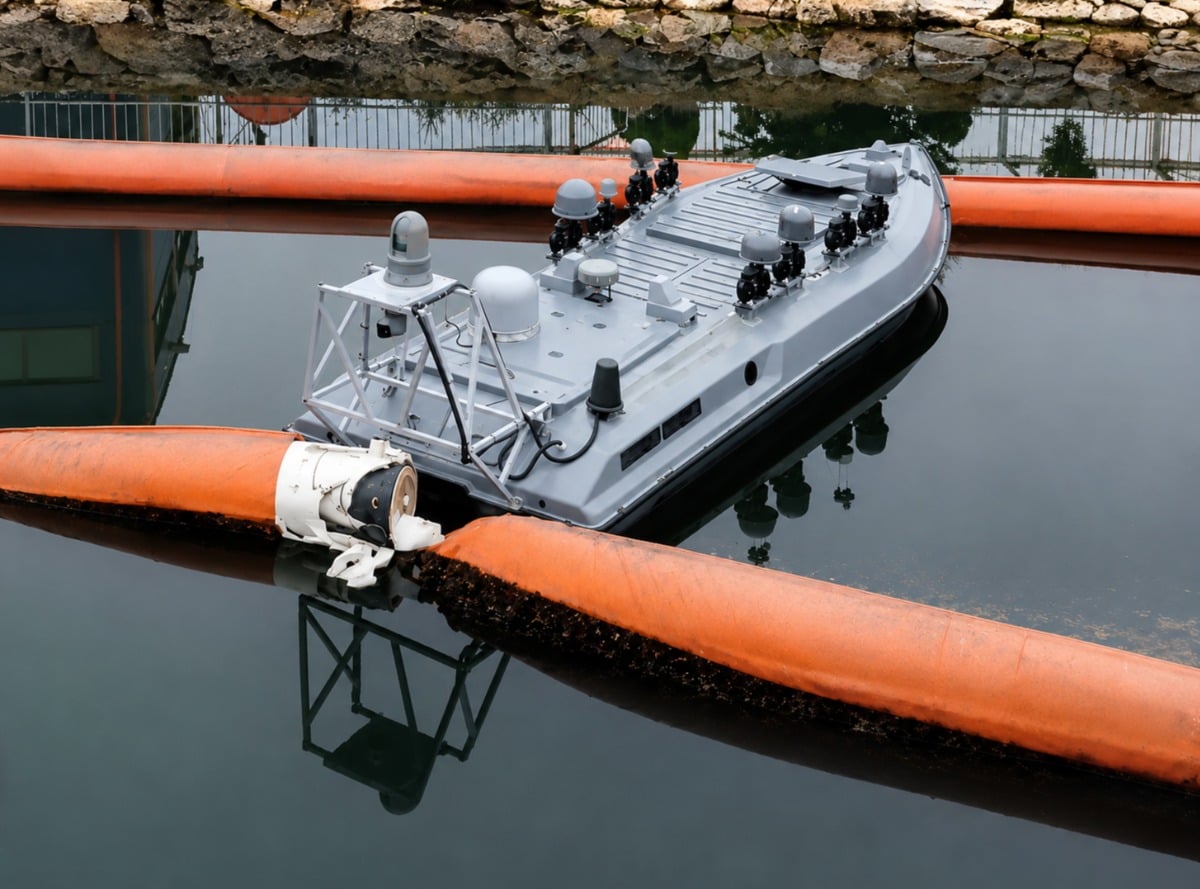
The explosion that rocked berths 77 and 78 at the Romanian port of Constanța on Friday morning was not an accident, nor was it a direct strike by Russian forces. A Ukrainian maritime drone, packed with dozens of kilograms of military-grade explosives, drifted helplessly into a pollution-control barrier just a few hundred meters from a major oil terminal before detonating. The Ukrainian Navy quickly confirmed it lost control of the vessel—and three others nearby—after heavy interference from Russian electronic warfare systems. While official channels paint this as a localized mishap with no civilian casualties, the reality is far more dangerous. The incident exposes an invisible, lawless electronic war turning the western Black Sea into a hazard zone where NATO boundaries offer zero protection against wandering hardware.
The detonation at 10:30 a.m. forced a mass evacuation of more than 1,300 people from nearby beaches and put the strategic port on a red alert. It marks the third major security breach on Romanian territory in recent weeks, trailing closely behind a Russian aerial drone strike on an apartment building in Galați that injured two civilians.
For two years, the public narrative focused on the brilliant success of Ukraine’s uncrewed surface vessels in forcing the Russian Black Sea Fleet into retreat. This incident reveals the messy, unscripted flip side of remote-controlled warfare. When the invisible strings of satellite navigation and radio telemetry are severed, these weaponized boats turn into blind, drifting mines.
The Mechanics of Drift
Navigating the Black Sea has always been treacherous, but the introduction of high-powered, broad-spectrum electronic jamming has fundamentally altered the environment. Russian electronic warfare units, stationed in occupied Crimea and on remaining naval platforms, project massive bubbles of signal interference designed to break the Global Positioning System coordinates and satellite uplinks that Ukrainian drones rely on.
When a maritime drone enters an electronic warfare dead zone, it loses its connection to operators in Kyiv or Odesa.
Standard operating procedures for these uncrewed vessels vary. Some are programmed to circle aimlessly until their fuel runs out. Others possess automated return-to-base protocols. However, under heavy, multi-layered jamming that alters sensor data, the internal guidance computers can become completely disoriented.
The drone that reached Constanța was one of four vessels operating in the same pack. While two detonated far out at sea and a third exploded just outside the harbor, the fourth rode the prevailing southern currents directly into Romania’s primary commercial gateway. It did not recognize the NATO border, nor did it recognize that it had transitioned from a military operations zone to a civilian harbor.
The Automated Threat to Energy Infrastructure
A more alarming factor is emerging from technical analyses of recent drone wreckage across Europe. Some European defense analysts suggest that Ukrainian maritime assets are increasingly reliant on automated backup targeting systems. If a drone loses its primary pilot uplink, the onboard software can switch to autonomous optical or radar-based targeting, searching for specific signatures like large metal structures or oil storage tanks to complete its mission.
When a rogue drone drifts into a civilian port like Constanța, an automated system cannot differentiate between a Russian oil tanker in Sevastopol and a commercial terminal in Romania. The fact that the drone became wedged in a pollution barrier just short of the oil terminal suggests a terrifying possibility. The vessel may have been drawn to the massive industrial footprint of the port facility itself.
This is not an isolated problem for Romania. Just last month, Greek authorities issued a sharp diplomatic protest to Kyiv after a stray Ukrainian naval drone laden with explosives drifted across the Mediterranean and was pulled ashore by fishermen on the island of Lefkada. The geographical spread of these incidents proves that current geo-fencing software and fallback protocols are insufficient against modern military jamming.
NATO's Invisible Border Problem
The political fallout from the Constanța blast is stretching the limits of alliance diplomacy. Romanian President Nicușor Dan was quick to blame Moscow, stating that the drone's incursion into sovereign Romanian space was a direct consequence of the war of aggression unleashed by Russia. Bucharest has reacted aggressively, expelling Russia's consul general and shuttering the consulate in Constanța following the previous week’s aerial strike in Galați.
Behind the unified public front, irritation with Kyiv’s western-drifting hardware is growing among regional partners. The Latvian government collapsed in May following fierce political infighting over how to handle stray Ukrainian aerial drones crashing near the Russian border. Neighbors are discovering that supporting Ukraine’s defense means accepting an erratic, explosive overflow into their own backyards.
The Russian Embassy in Bucharest has capitalized on the friction, immediately issuing statements accusing Ukraine of using unmanned vehicles to commit terrorist acts against civilian shipping. It is a cynical rhetorical line from a state running a brutal war, but it exploits a genuine grey area in international maritime law. When a state loses control of an explosive-laden asset that damages a neutral neighbor, liability becomes highly contentious.
The Limits of Port Defense
Europe is rushing funds into early-warning systems and anti-drone capabilities, but protecting thousands of miles of coastline from low-profile, composite-hull boats is an entirely different challenge than shooting down a slow-moving aerial drone.
| Country | Recent Maritime Incidents | Local Defense Response |
|---|---|---|
| Romania | 4 sea drones drifted near Constanța; 1 exploded in port | Deployed helicopters, issued text alerts, cleared beaches |
| Greece | Explosive naval drone recovered near Lefkada island | Formal diplomatic protest to Kyiv; increased coast guard patrols |
| Bulgaria | Multiple floating sea mines neutralized near shipping lanes | Routine naval sweeping operations; enhanced radar monitoring |
Traditional harbor defense relies on underwater netting, sonar, and visual scanning. A stealthy, wave-skipping maritime drone sitting inches above the water line has a minimal radar cross-section. In the Constanța incident, the harbor was only isolated after the drone had already drifted deep inside the civilian shipping sectors. If the vessel had detonated against a loaded cargo ship rather than a soft pollution barrier, the economic damage to the Black Sea's busiest grain and energy hub would have been catastrophic.
The war in Ukraine has proved that cheap, uncrewed tech can neutralize a legacy navy. The unintended lesson of the Constanța explosion is that the technology is still crude, vulnerable to electronic disruption, and indifferent to international borders. As electronic warfare tactics intensify, the western Black Sea will see more blind, unguided weapons floating southward toward civilian targets.
Relying on frantic beach evacuations and lucky entanglements in pollution booms is a unsustainable strategy for a frontline NATO state.
The immediate challenge rests on Ukrainian engineers to develop reliable, un-jammable self-destruct mechanisms that trigger the moment a vessel loses its command link, ensuring that a weapon designed to defend Odesa does not accidentally destroy the infrastructure of the allies keeping Ukraine alive.