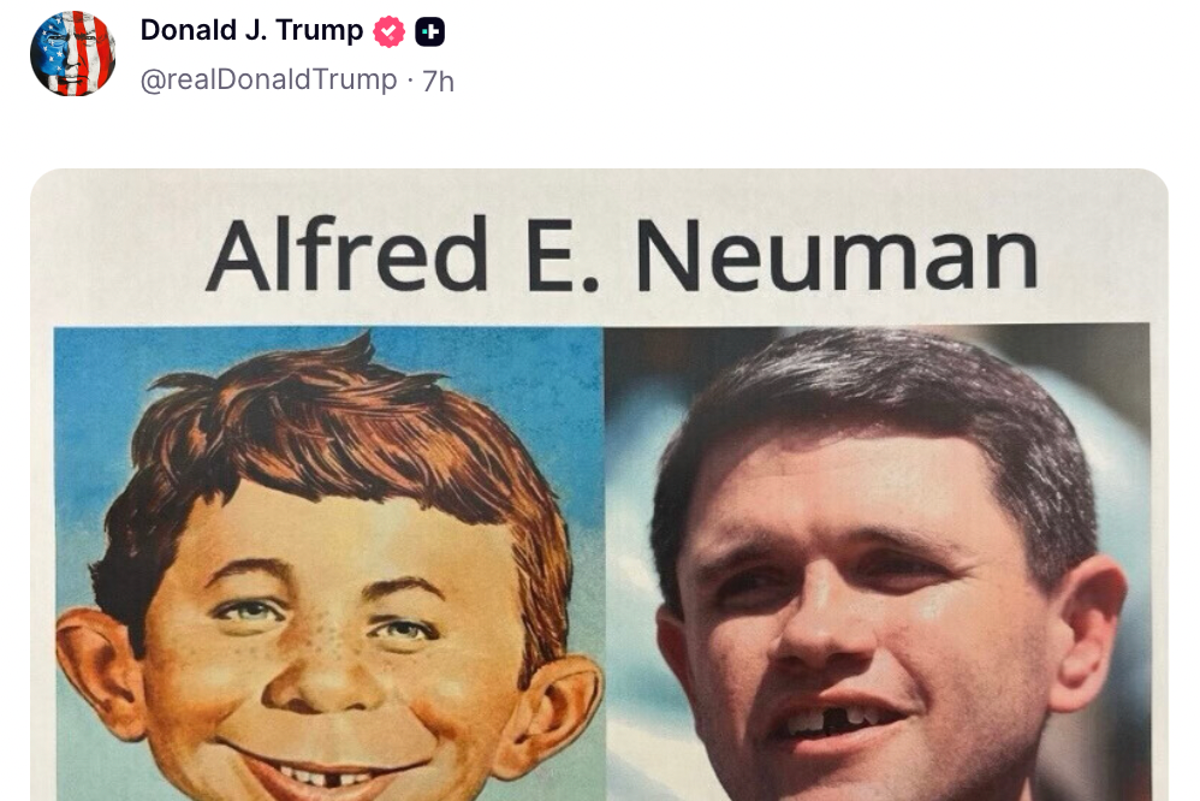
At 2:14 a.m. on the eve of America’s 250th anniversary, the digital apparatus of the executive branch bypassed formal history and returned to the gutter. Donald Trump did not post a solemn reflection on the Declaration of Independence or a call for national unity. Instead, his official channels launched a coordinated barrage of highly targeted memes, casting prominent political adversaries as Mad Magazine’s Alfred E. Neuman and Pee-wee Herman. This late-night offensive was not an erratic outburst, but rather the opening salvo of a deliberate effort to replace traditional national commemoration with a commercialized, grievance-driven rally that redefines the American story through factional dominance.
The initial public reaction followed a familiar, exhausted script. Critics decried the lack of presidential decorum on a milestone birthday, while supporters celebrated the trolling as a refreshing strike against elite pretense. Both reactions missed the deeper operational reality. Behind the seemingly crude graphics lies a sophisticated, well-funded propaganda machine designed to permanently hijack public attention and strip institutional bodies of their cultural authority.
The Industrialization of the Presidential Insult
To understand the mechanics of the midnight meme offensive, one must look past the iPhone screen and examine the modern campaign apparatus. The images distributed in the early hours of July 4 were not slapdash creations thrown together by a sleep-deprived politician. They were high-resolution, focus-tested digital assets generated by a specialized communications cell working alongside allied Super PACs.
For months, this digital machinery has operated parallel to the official federal agencies tasked with planning the Semiquincentennial. The original federal entity, the U.S. Semiquincentennial Commission—known to the public as America250—was designed to be a nonpartisan body that would orchestrate inclusive, historically grounded events across all fifty states. It focused on museum exhibits, educational curricula, and community service initiatives.
That infrastructure has been systematically sidelined. Through executive actions and strategic appointments, a parallel, highly ideological nonprofit named Freedom 250 took control of the narrative. Where the original commission sought broad historical consensus, the new management favored spectacle. The result has been a series of bizarre cultural collisions, including a live mixed martial arts event staged on the White House lawn and a poorly attended Great American State Fair on the National Mall that featured garish partisan video clips.
The midnight memes represent the ultimate execution of this strategy. By injecting vulgarity and hyper-partisan mockery into the exact moment designated for national reflection, the administration effectively crowded out any competing message. Serious historical evaluation cannot compete for clicks with a sitting president depicting a rival politician as a snickering 1980s television character. The media ecosystem spent the morning of the nation's 250th birthday explaining the cultural relevance of Pee-wee Herman rather than examining the state of American democracy.
Weaponizing Gen-X Nostalgia and Generational Grievance
The choice of caricatures reveals a precise demographic calculation. Alfred E. Neuman and Pee-wee Herman are not cultural touchstones for Gen Z or millennial voters. They are specific symbols of mid-to-late twentieth-century American satire and television, instantly recognizable to voters in their fifties, sixties, and seventies.
This is strategic targeting. The core political coalition supporting this administration relies heavily on older demographics who harbor deep nostalgia for a specific era of American history. By using these exact characters, the digital strategy taps directly into an existing reservoir of cultural memory. It contrasts a remembered era of simplicity and humor with what it portrays as the sterile, overly sensitive realities of contemporary political discourse.
Reducing political opponents to mid-century comic book characters accomplishes something far more insidious than simple insult. It completely infantilizes serious institutional critique. When a political adversary raises valid questions about economic policy, judicial independence, or constitutional norms, the administrative response is no longer an argument. It is a caricature. The message to the electorate is clear: do not take these people seriously, they are merely cartoons.
This technique effectively dismantles the possibility of substantive debate. It shifts the theater of political conflict from the realm of policy and law to the realm of schoolyard mockery, where the rules of engagement favor the loudest bully. For an administration that views institutional checks and balances as obstacles to be overcome, this degradation of public discourse is an asset, not a liability.
The Commercial Fusion of Patriotism and Private Profit
The timing of this digital campaign coincides with an unprecedented monetization of the American anniversary. The lines between state-sponsored commemoration, campaign fundraising, and private commercial enterprises have completely dissolved.
Within minutes of the memes appearing online, online merchandise vendors began offering t-shirts, hats, and digital tokens featuring the identical caricatures superimposed over the American flag. This immediate commercialization points to a highly integrated pipeline where political messaging is instantly converted into consumer goods. The celebration of the nation’s founding has been transformed into a marketplace of factional apparel.
This phenomenon extends deep into the unregulated corners of the financial markets. The lead-up to July 4 saw a massive surge in speculative digital assets, including a highly volatile "America 250" meme coin that grew rapidly in value through online communities before dropping sharply as the holiday arrived. These financial maneuvers demonstrate that the Semiquincentennial is no longer viewed as a civic milestone, but as a marketing hook designed to extract capital from a highly charged, emotionally invested base.
[Traditional vs. Monetized Anniversary Models]
Traditional Model (1976 Bicentennial):
Civic Subsidies -> Nonpartisan Commission -> Public Education -> Civic Pride

Monetized Model (2026 Semiquincentennial):
Private PACs -> Digital Mockery -> Viral Merchandise / Crypto -> Partisan Loyalty
The executive branch has actively encouraged this shift. By transforming the official July 4 concert on the National Mall into a political rally after several mainstream musical acts withdrew, the administration finalized the privatization of the national anniversary. The state no longer hosts a birthday party for the entire populace; it hosts a private celebration for its loyalists, financed by merchandising and validated by viral engagement metrics.
The Deliberate Rejection of Consensus
The 1976 Bicentennial, despite its flaws and the profound political cynicism of the post-Watergate era, attempted to construct a narrative of national healing. It sought a common denominator that could unite a fractured country around shared democratic principles. It was an exercise in civic cohesion.
The 250th anniversary celebration intentionally rejects that premise. The late-night meme offensive demonstrates a clear understanding that unity is politically unprofitable. In a highly polarized electorate, a message of broad consensus satisfies no one deeply, whereas a message of sharp, aggressive division energizes a dedicated core.
The strategy is one of pure factional dominance. By using the symbolic power of the presidency to mock fellow citizens on the national anniversary, the administration signals that half the country is excluded from the celebration. The founding narrative is no longer an open invitation; it is a proprietary asset owned by one specific political movement. Those who disagree are not merely political opponents; they are outcasts who deserve nothing more than public humiliation.
This approach creates a self-fulfilling prophecy of national decline. When the highest office in the land treats the country’s defining milestone as a platform for petty score-settling, it actively erodes the remaining institutional trust that holds a diverse, continental republic together. It leaves a vacuum where shared civic faith used to reside.
The Failure of Traditional Media Countermeasures
Mainstream journalistic institutions remain completely unequipped to handle this form of digital asymmetric warfare. The standard editorial response to a midnight meme barrage is to publish fact-checks, analyze the breach of decorum, or interview outraged historians who lament the decline of the presidency.
This play is obsolete. The communications strategists directing these campaigns anticipate this exact reaction. In fact, they rely on it. Media outrage is the primary mechanism through which these memes achieve maximum reach. Every critical article, every television panel discussing the appropriateness of Alfred E. Neuman references, serves to amplify the original insult and keep the focus squarely on the terms dictated by the White House.
By treating these incidents as isolated lapses in judgment or examples of personal eccentricities, traditional journalism fails to expose the structural reality. This is not a personal quirk of an individual politician. It is a highly rational, institutionalized system of media manipulation that exploits the structural vulnerabilities of attention-based algorithms. It turns the press into an involuntary megaphone for authoritarian style messaging.
To counter this effectively, reporting must shift its focus away from the content of the provocations and toward the machinery that profits from them. The story is not the meme itself, but the replacement of public infrastructure with private, ideological entities designed to monetize grievance.
The Long Road Beyond the Spectacle
The immediate impact of this digital warfare is an increasingly exhausted and cynical electorate. When the highest symbols of national heritage are degraded into disposable internet jokes, citizens naturally withdraw from the public square. They become numb to the constant noise, retreating into private life and leaving the governance of the nation to the most extreme elements of the political spectrum.
This exhaustion is a calculated objective of the strategy. A public that is tired, confused, and thoroughly disillusioned is a public that is unlikely to organize, resist, or demand institutional accountability. The endless cycle of outrage and mockery creates a state of permanent distraction, ensuring that complex structural changes to the economy, the judiciary, and the environment occur entirely outside the view of a captivated public.
Reclaiming the civic narrative requires more than simply ignoring the midnight posts or wishing for a return to an idealized past that never truly existed. It demands the painstaking work of rebuilding independent local institutions, reinvesting in rigorous historical education, and creating spaces for public life that are intentionally insulated from the toxic incentives of viral media. The American experiment has survived 250 years of internal conflict, foreign war, and profound social transformation. Surviving the era of algorithmic degradation will require an entirely new level of civic resilience.
The celebration on the National Mall will eventually conclude, the crowds will disperse, and the viral merchandise will end up in landfills. What remains will be the structural reality of a nation that has traded its shared democratic vocabulary for a collection of cheap, bitter caricatures. The midnight memes are not a joke. They are a ledger of what has been lost.