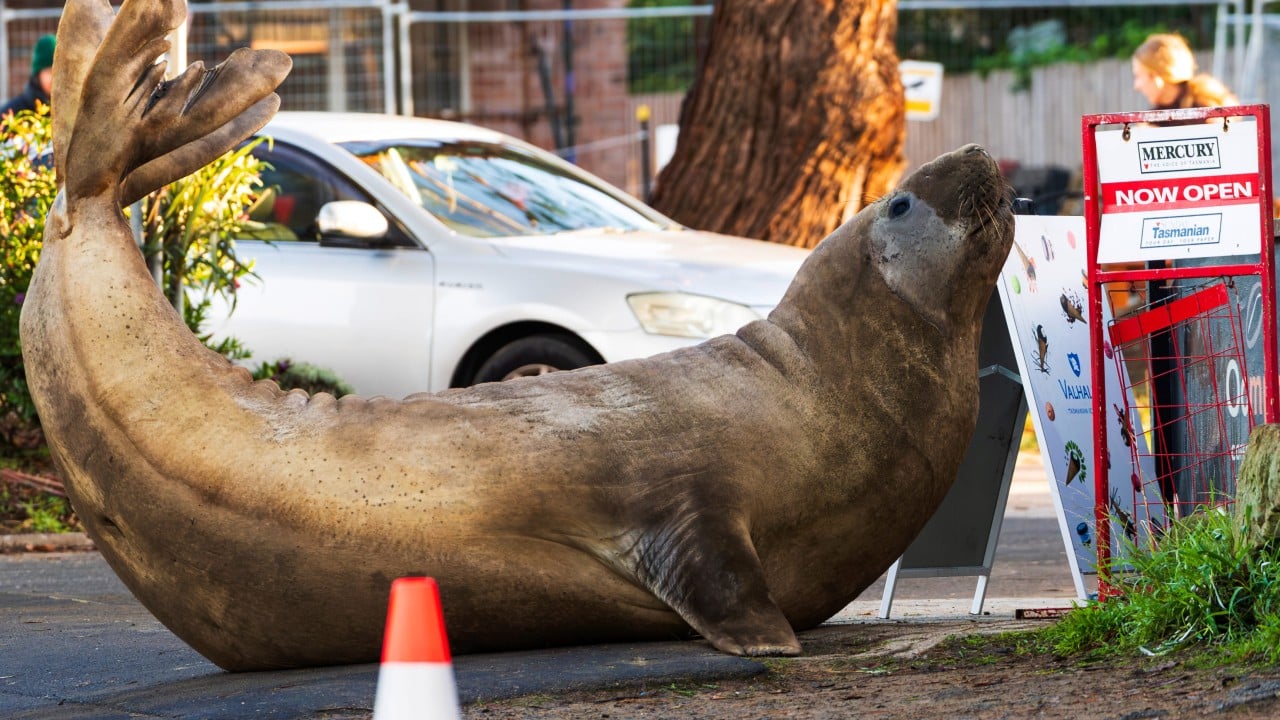
The asphalt on a southern Tasmanian coastal road is not built to withstand a resting, one-tonne monolith. Yet, there he sits, a colossal southern elephant seal known to 1.4 million TikTok followers simply as Neil.
He leans his massive, blubbery bulk against a dented suburban fence, completely indifferent to the traffic gridlock forming a few meters away. To the digital crowd scrolling through their feeds in London, New York, or Sydney, Neil is a brilliant piece of slapstick comedy. He is the bad boy of the marine world, a renegade who crushes traffic cones, battles parked Toyotas, and treats human infrastructure like a personal playground.
But on the ground, the air feels different. The sound of a 1,000-kilogram apex predator exhaling a wet, rattling breath on a public sidewalk carries a weight that a smartphone screen cannot communicate. It is the sound of an ancient, wild reality colliding directly with modern human obsession. And right now, that obsession is growing dangerous.
The Rehearsal of a Giant
To understand Neil, you have to understand the isolating tragedy of his upbringing. He was born in October 2020 on a lonely beach in southeast Tasmania. This was an anomaly. His species typically belongs thousands of kilometers south, thriving in massive, raucous colonies on the subantarctic Macquarie and Heard islands.
Biologists suspect Neil’s mother was young, inexperienced, and entirely off course. He was born without a colony, raised without peers. When he was just a forty-kilogram pup, wildlife rangers had to physically haul him off a treacherous sandbar to keep him from drowning. He survived, but his internal compass was permanently set. He is biologically programmed to return to the exact Tasmanian shores where he first drew breath.
Twice a year, Neil hauls his massive body out of the ocean to rest and shed his skin. He comes looking for companionship, or at least the sparring partners his biology demands.
Consider what happens when a juvenile male elephant seal grows up. In the subantarctic, he would spend his days play-fighting with other teenagers. They rear up, slam their massive chests together, and bite at each other's necks. It is a brutal, necessary rehearsal for the adult dominance battles that await them, where mature bulls weighing three tonnes fight for breeding rights.
Neil has no other seals. He has no peers to teach him the boundaries of his own strength.
So, he improvises. He finds a row of plastic bollards and flattens them. He spots a parked sedan and slams his chest against the bumper, practicing the violent choreography of his ancestors on a piece of manufactured steel. Online, commentators laugh. They call him a king. They call him an anti-authoritarian hero.
They do not see a lonely, confused juvenile trying to figure out how to be an elephant seal in a world made of concrete.
The 20-Meter Delusion
The real danger does not stem from Neil’s behavior. It stems from ours.
Wildlife officials are watching a terrifying pattern unfold along the Tasmanian coast. Armed with smartphones and a desire for digital validation, onlookers are erasing the boundary between humanity and the wild. Rangers have reported parents carrying their human babies within arm's reach of Neil, desperately trying to position the infant for a perfect Instagram photo. People offer him food. They treat him like a giant, plush mascot who stepped out of a theme park.
This is a profound, potentially fatal misunderstanding of nature.
Neil is currently five years old. He is fast, remarkably agile on land when motivated, and possesses the jaw pressure to crush bones. If a person encountered a polar bear or a North American bison on a suburban street, they would flee. They would lock their doors. But because Neil canoodles with an orange traffic cone and looks soft in a short video clip, the human instinct for survival is replaced by the urge to collect digital likes.
The state’s Department of Natural Resources and Environment has established a strict protocol: stay at least twenty meters away from Neil. If you have a dog, make it fifty meters. Do not block his path to the water. These are not arbitrary bureaucratic rules; they are life support systems for the animal. Violating them carries heavy fines of up to $16,000 and a potential twelve-month jail sentence.
But human behavior is notoriously difficult to police when a phenomenon goes viral.
The Ghost of Freya
Biologists have a haunting phrase for what is happening in Tasmania right now. They call it "loving an animal to death."
We have seen this script play out before, and it always ends in tragedy. In 2022, a companionable, 600-kilogram walrus named Freya captured the heart of the internet when she swam into the Oslo Fjord in Norway. Just like Neil, Freya became an overnight celebrity. She climbed onto small boats to sunbathe, sinking a few in the process. She was a viral sensation.
Officials pleaded with the public to give Freya space. They warned that the crowds gathering inches from her face were stressing the animal and creating a powder keg for a human tragedy. The warnings were ignored. People swarmed the docks with children in tow.
Eventually, Norwegian authorities concluded that human safety could no longer be guaranteed. The public refused to stay away, and the animal could not be controlled. They euthanized Freya.
That is the unvarnished, terrifying reality hanging over southeast Tasmania. If someone’s toddler is bitten, or if an eager tourist is crushed because they stepped into Neil’s blind spot for a selfie, the state will not blame the human. They will blame the predator.
Relocation is an incredibly stressful, logistically nightmarish option for a one-tonne marine mammal, and it rarely works permanently. Neil knows these roads. He knows these beaches. He will swim back. If human behavior cannot be managed, the ultimate, tragic fallback plan is euthanasia.
Finding a Way to Coexist
Historical records show that northwest Tasmania was once home to thriving elephant seal colonies, before commercial hunting completely wiped them out in the early 1800s. In a way, Neil’s persistent return to these shores is a beautiful, fragile sign of nature attempting to reclaim its lost territory. It is a living piece of history walking through a modern neighborhood.
But coexistence requires a maturity that the internet age actively discourages. It requires us to look at a magnificent creature and resist the urge to turn him into a prop for our own stories.
For now, Neil remains on his chosen stretch of Tasmanian sidewalk, a massive, breathing boulder surrounded by flat bollards and cautious rangers. He is waiting out his molt, preparing to return to the deep ocean where the human gaze cannot follow him. He does not know he is famous. He does not know his life depends entirely on our ability to look at him from a distance, put our phones away, and simply step back.