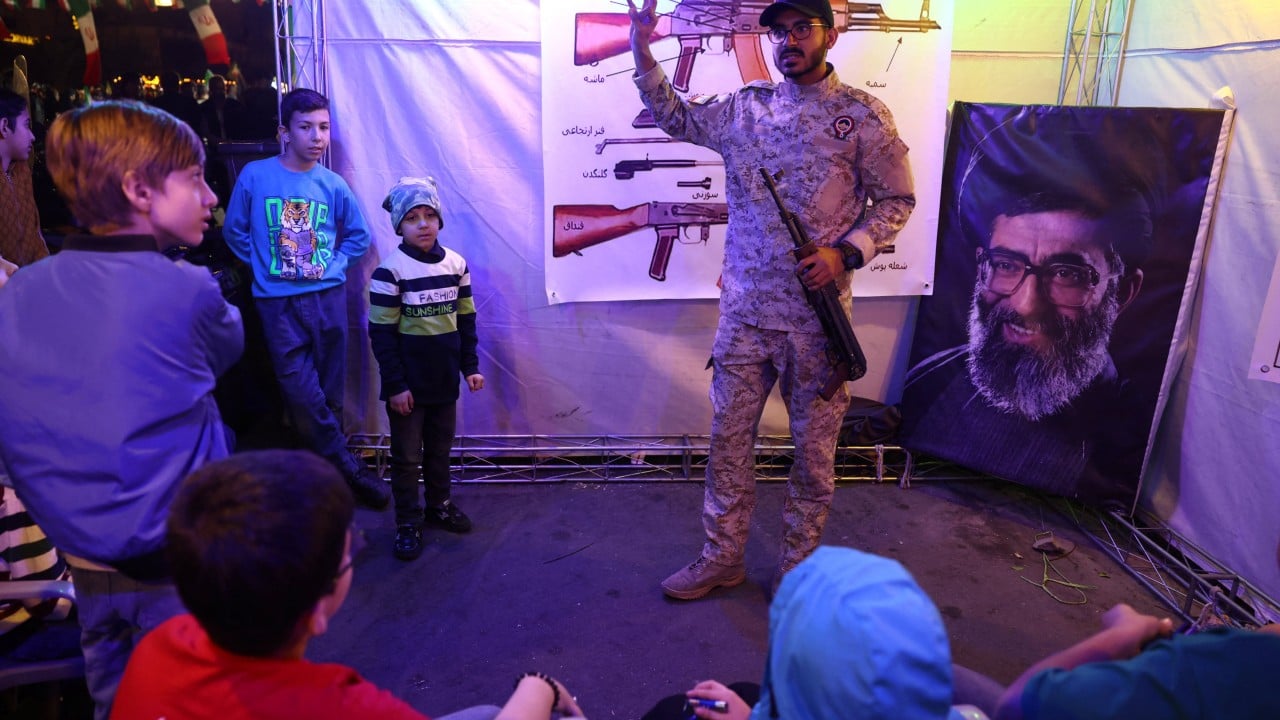
Walk through Tehran's Haft-e Tir Square right now, and you won't just see the usual chaotic traffic and street vendors. You'll see green-uniformed Islamic Revolutionary Guard Corps (IRGC) soldiers standing in makeshift booths, surrounded by illustrated boards, holding folding-stock Kalashnikov assault rifles. They aren't there for a security detail. They are running public workshops, teaching ordinary grandmothers, government office workers, and teenagers how to load magazines, chamber rounds, and clear malfunctions.
If you turn on Islamic Republic of Iran Broadcasting (IRIB), the state television network, the scene gets even more surreal. Studio anchors are literally handling live AK-47s on air. In one recent broadcast, a presenter stood by as a masked IRGC officer gave a quick tutorial, before the host racked the bolt and fired a round directly into the studio ceiling. Another segment showed an anchor aiming an unloaded rifle at a wall graphic of Israeli Prime Minister Benjamin Netanyahu, while wishing aloud that the bullets would soon find their target.
This isn't standard military bravado. It's the visible manifestation of a society on the edge, bracing for the fragile April 8 ceasefire to shatter completely. With U.S. President Donald Trump threatening to resume full-scale military action if negotiations over the Strait of Hormuz collapse, Tehran isn't just relying on its standing army anymore. They are trying to turn the entire civilian population into a permanent, armed militia.
The Strategy Behind the Public Weapon Booths
Tehran's sudden push for civilian weapon familiarity isn't an accidental stunt. It's a calculated psychological operation directed at two entirely different audiences: Washington and the local population.
On the global stage, the message is pure deterrence. By broadcasting footage of chador-clad mothers and middle-aged bureaucrats stripping down rifle components, the regime wants to project an image of total national mobilization. They want the White House to look at Iran and see a hornet's nest—a country where an occupying force would face a guerrilla fighter on every single corner, much like the citizen-led resistance seen in the early days of the 2022 Ukraine war.
But look closer at the domestic angle, and a darker motive appears. The Islamic Republic is coming off a brutal internal crisis. The massive nationwide protests in January met a ferocious government crackdown, resulting in the deaths of over 7,000 activists and thousands more detentions according to human rights organizations. By putting military weapons in public city squares and distributing "Janfada" (those who sacrifice their lives) certificates to loyalists, the state is effectively reinforcing its grip on the streets. Arming and organizing hard-line volunteers acts as an immediate deterrent against anyone thinking of starting a new domestic uprising while the regime is vulnerable.
Barely Functional Training and Public Fear
While state media claims their new mobilization campaign has attracted tens of millions of eager volunteers, the reality on the ground looks a lot less organized. The training offered at these public kiosks is basic at best, and dangerous at worst.
Observers at the Tehran booths have noted major safety violations. At a recent session, an elderly man struggled to click his magazine into place, accidentally swinging the muzzle of his weapon directly across the crowd of onlookers. Because the guns used in the public squares are mostly unloaded or deactivated for display, trainers frequently overlook fundamental firearms safety. It's a rushed, superficial crash course designed for photo opportunities rather than creating disciplined marksmen.
This chaotic militarization is sparking severe pushback from local Iranian media outlets and public figures who don't usually break rank. Independent and even some conservative commentators are openly questioning why the state is acting like the official military has already failed.
- The news site Rouydad24 published a scathing critique, asking why a country with a massive standing army, the IRGC, the Basij militia, and mandatory conscription needs to teach civilians how to fight in the streets. They warned that these broadcasts tell the public that official security forces are no longer enough, signaling a terrifying future where normal citizens have to defend their homes from total societal collapse.
- Khabar Online attacked the state broadcaster for bringing "barracks imagery" into regular living rooms, pointing out that seeing a nightly talk-show host wave an assault rifle causes widespread anxiety instead of making people feel safe.
- Iranian Nobel Peace Prize laureate Shirin Ebadi condemned the state-sponsored footage showing young boys holding heavy weaponry, comparing the visuals to the exploitation of child soldiers by militant groups in war zones like Congo or Sudan.
The Direct Cost of the Standoff
For the average family living in Tehran or Isfahan, the theoretical threat of American airstrikes is only half the problem. The immediate crisis is economic survival.
The current military standoff and the threat of renewed total war have completely crippled the local economy. Inflation is moving at a runaway pace. Everyday citizens face sudden, mass corporate layoffs, sudden business closures, and skyrocketing prices for basic food items and imported medicines.
Tehran Civilian Sentiment: A Divided Capital
┌───────────────────────────────────────────┬───────────────────────────────────────────┐
│ The Hard-Line / Voluneteer Stance         │ The Critical / Moderate Stance            │
├───────────────────────────────────────────┼───────────────────────────────────────────┤
│ • View weapons training as a human duty   │ • Worry that state TV is causing panic    │
│ • Driven by a desire for retaliation      │ • Fear the normalization of street violence│
│ • Highly responsive to regime rhetoric    │ • Focus on inflation and medicine shortages│
└───────────────────────────────────────────┴───────────────────────────────────────────┘
The regime relies heavily on ideological rhetoric to distract from these collapsing living standards. Loudspeakers near the training booths constantly blast state-approved eulogies for top military commanders, including the late Supreme Leader Ali Khamenei, who was killed during the devastating joint U.S.-Israeli opening strikes on February 28. For the hard-liners visiting these booths, learning to use an AK-47 isn't an option—it's a mandatory act of holy vengeance. For everyone else, it's a grim reminder that their currency is worthless, their future is uncertain, and their home could become a active battlefield before the month ends.
Reading Between the Lines
Don't buy into the state's narrative of a perfectly unified, hyper-prepared populace ready to march into battle. What's happening in Iran right now is a desperate gamble by a cornered leadership. They are weaponizing public spaces because their conventional military options are severely limited after weeks of intense strikes earlier this year.
If you want to track where this crisis goes next, stop looking at the formal diplomatic statements coming out of Washington or Geneva. Watch the streets of Tehran. Watch whether these weapon booths expand past the capital into the restive, rural provinces where anti-government sentiment runs deepest. If the regime starts distributing live ammunition to its newly minted "Janfada" cardholders in those regions, it means they aren't just preparing for a war with Donald Trump—they are preparing for a war against their own people.