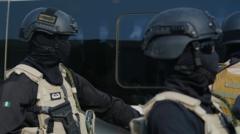
The persistent failure of Nigerian aerial operations to differentiate between insurgent targets and civilian population centers suggests a breakdown in the sensor-to-shooter loop that transcends simple mechanical error. When an airstrike strikes a marketplace, the failure occurs long before the ordnance is released. It represents a systemic collapse of "Target Intelligence" (TAI) and "Positive Identification" (PID) protocols. This analysis deconstructs the operational architecture of Nigerian counter-insurgency (COIN) to identify the specific failure points that transform tactical strikes into strategic liabilities.
The Triad of Operational Failure
Aerial strikes in dense, non-linear environments like the Nigerian North-east and North-west operate within three specific constraints. These constraints dictate the probability of "collateral damage"—a term often used to sanitize the death of civilians in high-density areas.
- Intelligence Decay: The time-sensitivity of human intelligence (HUMINT) often exceeds the deployment speed of kinetic assets. If a source reports insurgent activity in a market at 09:00, but the asset arrives at 11:00, the "intelligence shelf-life" has expired. The target is no longer a discrete military objective; it has reverted to a civilian social hub.
- Sensor Limitations vs. Atmospheric Friction: Nigerian forces often rely on aging platforms or unmanned aerial vehicles (UAVs) with optical sensors that struggle with "clutter." In a market setting, distinguishing a civilian vehicle from a technical (improvised fighting vehicle) requires high-fidelity thermographic imaging and multi-spectral analysis that the current fleet often lacks or fails to utilize effectively.
- Command and Control (C2) Latency: The authorization chain for a kinetic strike frequently suffers from a disconnect between the ground commander (who has eyes on the target) and the air component commander (who has the authority to fire). When communication breaks down, pilots often default to pre-briefed coordinates rather than real-time visual confirmation.
The Mechanics of PID Failure
In modern warfare, Positive Identification is the rigorous process of confirming that a target is a legitimate military objective. In the context of the recent market strikes, PID failure typically occurs through a process known as "Confirmation Bias."
Operational teams, under pressure to produce results against banditry or Boko Haram remnants, interpret ambiguous data as hostile. A group of men gathering in a rural market—historically a red flag for insurgent planning—is identified as a "Meeting of Leaders" without the granular verification needed to distinguish between a village elder and a militia commander.
The structural lack of Joint Terminal Attack Controllers (JTACs) on the ground is the primary technical bottleneck. Without a qualified operator embedded with ground forces to "paint" the target or provide terminal guidance, the aircrew relies on "Pattern of Life" (PoL) analysis. PoL analysis is notoriously fragile in Nigeria, where the movement patterns of nomadic herders, local traders, and insurgent scouts often overlap geographically and chronologically.
The Economic and Social Cost Function
Every civilian casualty in an airstrike functions as a force multiplier for the insurgency. This can be quantified through a simple feedback loop:
- Loss of Legitimacy: The state’s primary value proposition is the provision of security. When the state becomes the source of lethality, the local population shifts from neutral or cooperative to hostile.
- Recruitment Subsidies: Insurgent groups utilize footage and reports of market strikes as low-cost recruitment tools. A single misplaced 250lb bomb can generate more recruits than years of ideological indoctrination.
- Intelligence Blackouts: Following a strike on a civilian center, the flow of HUMINT—the most critical asset in COIN—evaporates. Villagers cease reporting insurgent movements to the military, fearing that doing so will invite an airstrike on their own homes.
The Urban-Rural Tactical Gap
The Nigerian Air Force (NAF) has demonstrated proficiency in "Deliberate Targeting"—planned strikes on fixed insurgent camps. However, "Dynamic Targeting"—responding to moving targets or emerging threats in populated areas—remains an unmastered discipline.
The shift of insurgent tactics toward "hiding in plain sight" within civilian markets is a deliberate exploitation of this tactical gap. By using civilians as human shields, insurgents create a "lose-lose" scenario for the state. If the military strikes, they lose hearts and minds. If they do not, the insurgents operate with impunity.
To break this cycle, the Nigerian military apparatus must transition from a "Kinetic-First" posture to an "Intelligence-Led Surveillance" model. This involves:
- Persistent Loiter Capability: Utilizing UAVs not for immediate strikes, but for long-duration surveillance to establish a baseline of "normalcy" versus "anomaly."
- Acoustic and SIGINT Integration: Combining visual data with signals intelligence (intercepting radio or cell traffic) to verify that the people in the market are indeed coordinating hostile actions.
- Collateral Damage Estimation (CDE) Rigor: Implementing a mandatory CDE methodology that halts any strike where the probability of non-combatant casualty exceeds a defined threshold, regardless of the target's value.
The current trajectory of Nigerian aerial operations suggests an over-reliance on the "Hard Power" of the airframe at the expense of the "Soft Power" of precision intelligence. Until the Nigerian defense establishment treats the death of a civilian with the same gravity as the loss of an aircraft, the tactical successes against insurgent groups will continue to be eroded by the strategic failures of their kinetic delivery.
The immediate requirement is the establishment of an independent, multi-agency after-action review (AAR) board. This board must be empowered to declassify flight data and sensor footage to determine exactly where the PID chain broke. Without this transparency, the "market strike" remains a recurring feature of the conflict, rather than an avoidable tragedy.
Military leadership must now weigh the marginal benefit of a single insurgent kill against the total collapse of regional trust. The strategic play is clear: prioritize the "Sensor" over the "Shooter." If the identification is not 100% certain, the mission must be aborted. In counter-insurgency, the target you don't hit is often more important than the one you do.