The wind in the Sahel does not just blow. It bites. It carries a fine, relentless grit that embeds itself into the back of your throat, under your fingernails, and into the very fabric of your memories. When you stand on the edge of the Sahara, you can actually smell the encroaching desert. It smells like baked earth, old dust, and the quiet panic of a family realizing their well has run completely dry.
For decades, the desert has been moving south. It is an invisible invasion, advancing yard by yard, swallowing grazing lands, choking out ancient baobab trees, and forcing entire villages to pack up what little they own and flee.
But if you travel to certain patches of Senegal, Chad, or Niger today, the air shifts. The smell of dust gives way to something almost forgotten in these parts. The scent of damp soil. The rustle of green leaves.
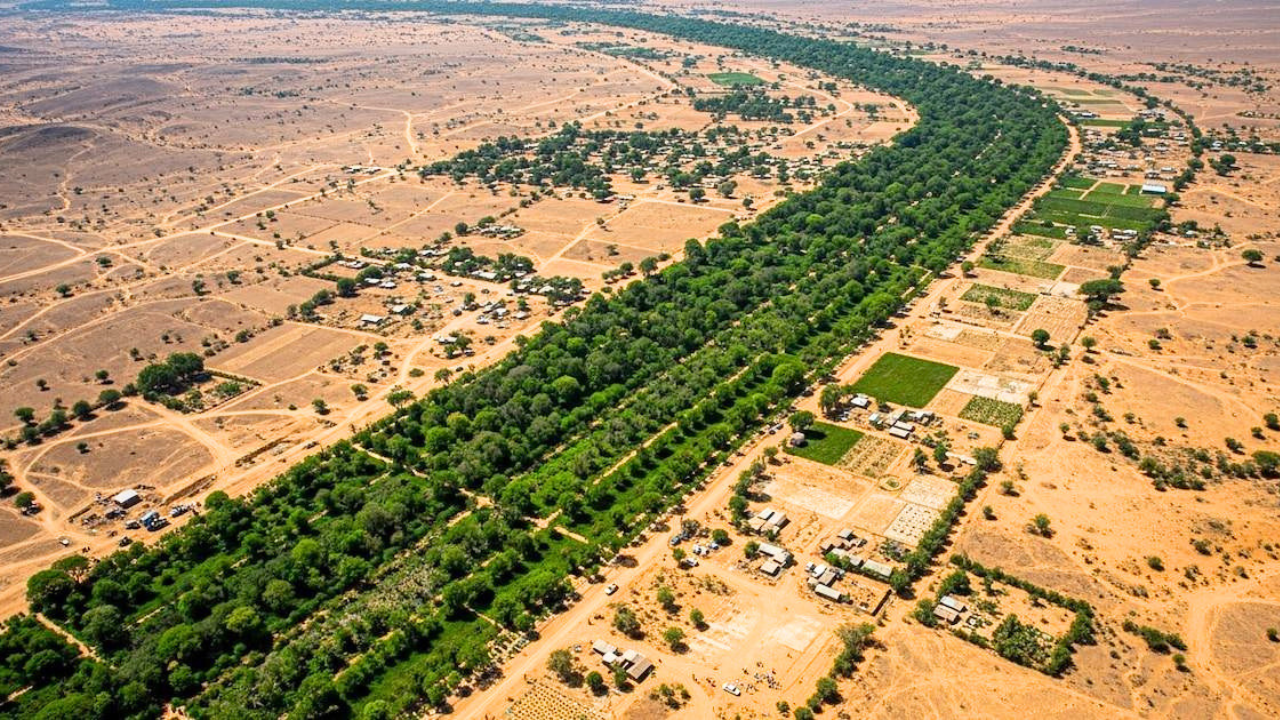
Africa is fighting back against the sand, not with concrete, steel, or weapons, but with a weapon far more radical. A wall of trees. Spanning the entire width of the continent, from the Atlantic coast of Senegal to the Red Sea shores of Djibouti, this is the story of the Great Green Wall. It is an audacious, multi-billion-dollar experiment in survival that is rewriting the future of an entire continent.
The Day the Dirt Died
To understand why eleven countries pledged to plant a forest across the widest part of Africa, you have to understand what it feels like when the land dies.
Let us look at a hypothetical farmer named Ibrahim. He lives in a small village in northern Nigeria, a place where his grandfather once herded cattle through shoulder-high grass. When Ibrahim was a boy, the rains were predictable. They came in June, soaked the earth, and left behind a vibrant ecosystem of millet, sorghum, and fat, healthy livestock.
Then, the rains began to stutter.
One year they arrived a month late. The next year, they lasted only a few weeks. The grass died first. Without roots to hold the soil in place, the dry harmattan winds from the north swept in and carried away the fertile topsoil. What remained was a hard, cracked crust that rejected water like stone. Ibrahim’s cows grew skeletal, their ribs mapping the tragedy of a changing climate.
This process is desertification. It sounds like a slow, academic term. In reality, it is a violent economic eviction.
When the land fails, everything else collapses. Food prices skyrocketing. Young men leaving their ancestral homes for crowded coastal cities or dangerous migrant routes across the Mediterranean, driven by the sheer lack of options. The creeping desert does not just destroy agriculture; it fuels conflict, instability, and deep, systemic poverty.
By the mid-2000s, the crisis had reached a tipping point. The Sahara was claiming roughly 1.5 million hectares of land every single year. Something massive had to be done.
A Blueprint Born in the Sand
The idea sounds like something out of a science fiction novel. Plant an unbroken band of trees 8,000 kilometers long and 15 kilometers wide. It would be three times longer than the Great Barrier Reef and would dwarf the Great Wall of China.
When the African Union officially launched the Great Green Wall initiative in 2007, the global community was skeptical. Cynics called it a pipe dream. Western experts questioned how some of the poorest nations on earth, many plagued by political turbulence and internal conflict, could coordinate a mega-project of this scale. They imagined millions of saplings being planted, only to die of thirst weeks later in the scorching 110-degree heat.
They were wrong because they misunderstood the strategy.
The early vision of a literal, unbroken line of trees planted in the sand was quickly abandoned. It was too rigid. Instead, the project evolved into something far more sophisticated: a mosaic of green interventions tailored to the specific needs of each region.
Instead of importing exotic, fast-growing trees that would drain the precious groundwater, local communities turned to ancestral knowledge. They selected native species like the Acacia senegal. This is a gnarled, thorny tree that looks unremarkable but possesses a superpower. It can thrive in areas with less than an inch of rain per year. Its deep root systems reach far underground, stabilizing the shifting sand dunes and bringing buried nutrients back to the surface.
Even better, the acacia produces gum arabic, a valuable commodity used worldwide in everything from soda to pharmaceuticals. The tree was not just a shield against the desert; it was a paycheck.
The Miracle of the Underground Forest
If you walk through the restoration zones of Niger today, you might not see massive plantations of newly planted trees. Instead, you see millions of low, bushy green shoots rising from the dirt.
This is the result of a technique known as Farmer-Managed Natural Regeneration, or FMNR. For generations, farmers clearing land for crops would chop down the stumps of wild trees, viewing them as weeds. But those stumps were not dead. Their vast, ancient root systems remained alive underground, dormant, waiting for a chance to grow.
By teaching communities to identify, protect, and prune these living stumps rather than clearing them, millions of trees have literally resurrected themselves from the dead earth.
Consider the sheer scale of what this shifts. It costs thousands of dollars per hectare to plant and maintain a traditional nursery forest. FMNR costs next to nothing. It relies on the earth's natural resilience and the watchful eyes of the people who live there.
The results are staggering. In Niger alone, farmers have restored over five million hectares of land using this method, bringing back more than 200 million trees. This is not a top-down government mandate. It is a grassroots revolution led by people who refused to let their homes become a wasteland.
The return of the trees changes the local macroclimate. Walk into an area restored by the Great Green Wall, and you will immediately notice the temperature drop. The canopy provides shade, reducing the evaporation of moisture from the soil. The roots act as a natural sponge, allowing the rare, torrential downpours to sink deep into the aquifers rather than washing away the remaining topsoil in destructive flash floods.
Birds have returned. Insects have returned. With them, the natural balance of the Sahel is slowly re-establishing itself.
The Human Return
The true metric of the Great Green Wall’s success cannot be measured by satellite imagery alone. It is measured in human footsteps.
In villages across Senegal, where the project has planted millions of trees and established organized agricultural cooperatives, a strange phenomenon is occurring. People are coming home.
Before the green wall arrived, the community of Widou Thiengoly was dying. The youth had abandoned the village, leaving only the elderly and young children behind. The local wells were pulling up muddy sludge.
Today, Widou Thiengoly is surrounded by a thriving multi-purpose garden. The women of the village manage hectares of vegetables, growing onions, tomatoes, and melons in the shade of the restored acacia trees. They have food security for the first time in a generation. They have an income. They have established a local market, trading with neighboring communities that once ignored them.
The young men who left for Dakar or Europe are starting to return, realizing that the land can finally sustain them again.
But let us be completely honest. The path forward is not a smooth, triumphant march. The Great Green Wall is facing massive, terrifying hurdles.
Funding is a constant, agonizing bottleneck. While billions have been pledged by international organizations like the World Bank and the European Union, getting those funds disbursed to remote, bureaucratic agencies across eleven different nations is a logistical nightmare.
Then there is the issue of security. Some of the most critical stretches of the wall run directly through the parts of Mali, Burkina Faso, and Nigeria that are currently destabilized by extremist groups. It is impossibly difficult to plant trees or monitor progress when a region is actively embroiled in conflict.
By some estimates, only about 15 to 20 percent of the original target area has been successfully restored. With the 2030 deadline looming, the project is running significantly behind schedule.
The Stakes We Choose to Ignore
It is easy for someone sitting in a climate-controlled office in New York, London, or Tokyo to view the Great Green Wall as a distant, localized African project. That view is a dangerous luxury.
The Sahel is the canary in the coal mine for global climate stability. If the desert completely swallows this region, the resulting mass migration will dwarf anything the world has seen in modern history. Tens of millions of people will be permanently displaced. The political and economic shockwaves will be felt across every continent.
Furthermore, the Great Green Wall is designed to sequester an estimated 250 million tons of carbon from our atmosphere. It is a massive, natural carbon sink that benefits every single human being on this planet, regardless of where they live.
This is not charity. It is a global infrastructure project for the survival of our shared biosphere.
The next time you look at a map of Africa, look closely at that thin, fragile strip of land just below the massive expanse of the Sahara. It is the frontline of a quiet, desperate war for the future of our planet. Every single tree planted there is a defiance against despair. Every root that takes hold in that dusty earth is a promise that humanity can choose to heal the damage we have inflicted on our home.
The sand is still moving. But for the first time in a century, so is the green.