The rain in eastern Ukraine does not fall; it dissolves the earth. It turns the fertile black soil into a thick, sucking clay that traps boots, stalls trucks, and swallows the heavy, frantic breathing of soldiers. In this gray expanse, the horizon is permanently fractured by artillery flashes. For the young men and women holding the line, survival is not measured in months or weeks. It is measured in seconds. It is measured by the distance between a human chest and an incoming piece of shrapnel.
Every war has a signature sound. In this conflict, it is the persistent, high-pitched whine of commercial drones overhead, scouting for targets. To be seen is to be targeted. To be targeted is to die.
But a shift is happening beneath the canopy of this drone-filled sky. It is a quiet transition from human flesh to remote steel, born out of desperate necessity on one side and clinical engineering on the other. Norway’s defense giant, Kongsberg Defence & Aerospace, has stepped into the mud, partnering directly with an unnamed Ukrainian combat robotics manufacturer. They are not just shipping crates of hardware. They are integrating Western automated weapon stations onto Ukrainian-made unmanned ground vehicles (UGVs).
This is the reality of modern attrition. It is a story about what happens when the digital precision of the Nordic fjords meets the brutal, low-altitude carnage of the Donbas.
The Weight of the Remote Control
Imagine a soldier named Oleksandr. He is a hypothetical composite of the engineers and operators currently fighting this war, but his daily reality is entirely real. He sits in a concrete bunker three kilometers behind the zero line. His eyes are bloodshot, fixed on a flickering tablet screen. His fingers rest on a modified gaming controller.
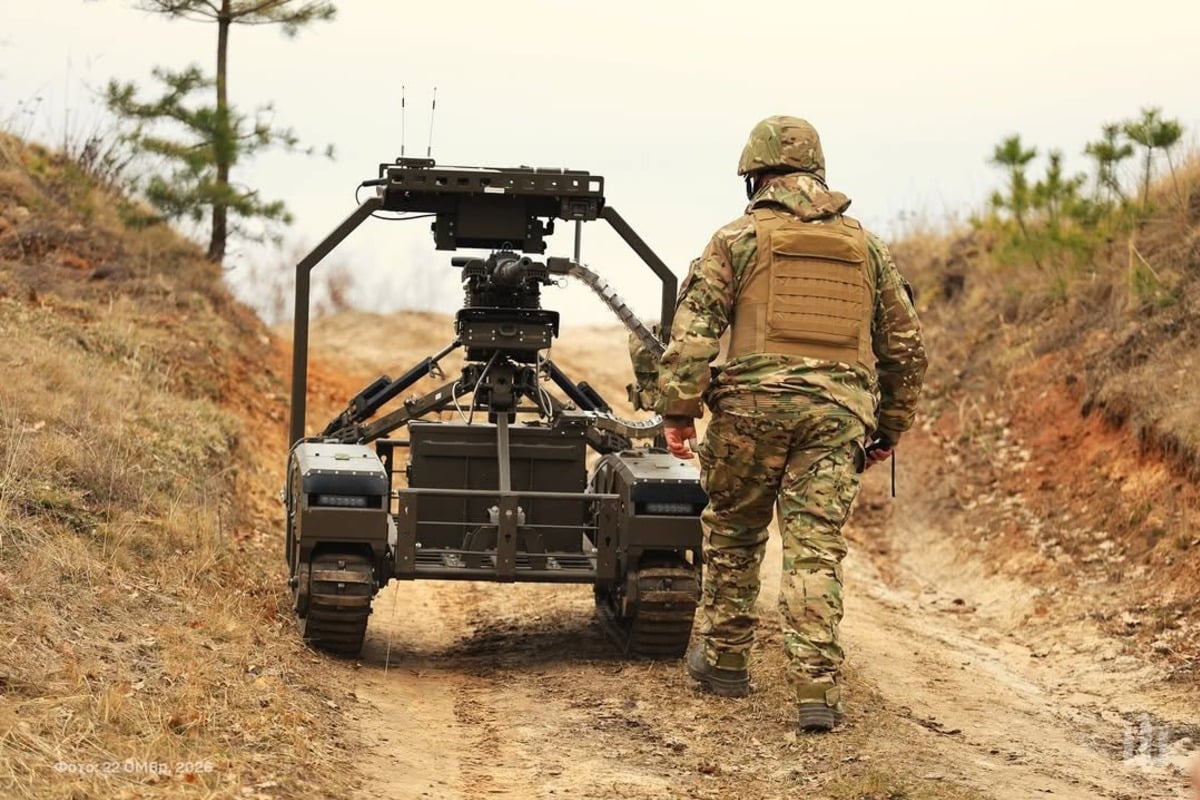
Out in the open, exposed to the freezing rain, a low-slung, tracked machine crawls through a cratered field. It looks like a miniature tank, no taller than a man's waist. Mounted on top of its rugged frame is a Kongsberg Protector Remote Weapon Station—a system usually bolted to multi-million-dollar armored vehicles. Today, it is riding a local, scrappy Ukrainian robotic chassis.
Before this partnership, Oleksandr’s job required him to stand in a trench, peering through an optical sight, exposed from the waist up every time he needed to suppress an enemy advance. Now, the machine takes the risk. When a mortar shell explodes twenty yards from the robot, the screen twitches, but Oleksandr does not bleed.
This is the psychological core of the shift. The machine is completely expendable. The human is not.
Western military doctrine has long treated unmanned ground vehicles as a luxury or a specialized tool for bomb disposal. Ukraine has turned them into a baseline requirement for survival. The country has become a massive, open-air laboratory for automated warfare. Local startups are building robotic platforms in converted garages, using agricultural parts, lithium-ion batteries from scrapped electric cars, and off-the-shelf radio components.
But these homemade rovers lacked one crucial element: firepower that does not jam when the mud cakes the barrel. That is where Kongsberg comes in.
Bridging the Garage and the Factory
The alliance between a massive defense conglomerate like Kongsberg and a wartime Ukrainian tech collective is an awkward marriage of two entirely different worlds.
Kongsberg operates in the realm of long-term defense contracts, stringent NATO standards, and meticulous quality control. Their Protector weapon stations are legendary for their stabilization algorithms. If the robot bounces over a log, the gun stays locked onto the target with mathematical precision. It calculates windage, air temperature, and barrel wear in real time.
The Ukrainian side operates on the clock of survival. If a software patch takes three weeks to approve, people die. Their expertise lies in battlefield improvisation—making sure radio signals can pierce heavy Russian electronic jamming, and building chassis that can navigate terrain that looks like the surface of the moon.
Consider the technical friction of this integration. The Norwegian engineers had to adapt their sophisticated digital architecture to interface with a vehicle built under bombardment. It is a translation process. It requires stripping away the bureaucratic red tape to ensure that a weapon system designed for a high-end European armored car can draw power reliably from a custom-built Ukrainian battery pack.
The stakes of this collaboration extend far beyond the borders of Ukraine. The data gathered from these muddy fields is rewriting the future of global defense. European militaries are watching closely. For decades, Western strategies relied on air superiority. In a conflict where airfields are targeted by ballistic missiles and the sky is choked with anti-aircraft systems, ground-level robotics are suddenly the only way to break a bloody stalemate.
The Cold Logic of Attrition
There is a deep, unsettling discomfort in witnessing the mechanization of the infantry. It is easy to look at these machines and feel a sense of dystopian dread. The idea of an automated turret tracking movement across a field feels clinical, cold, and stripped of humanity.
But talk to the people who actually wear the uniform. Their perspective is entirely devoid of philosophical romance. To them, the robot is a shield.
Every mission assigned to a robotic vehicle is a mission where a human being does not have to walk through a minefield. These machines are being used to haul ammunition to forward positions, evacuate wounded soldiers under fire, and lay down suppressing fire during a retreat. By mounting a highly accurate Kongsberg station onto a mobile Ukrainian robot, the team reduces ammunition waste. A precise burst of three rounds accomplishes what used to take an entire magazine from a panicked, shivering soldier.
This is not a gimmick. It is a cold, calculated response to a numbers game. Ukraine is fighting a neighbor with a significantly larger population and a willingness to absorb massive casualties. Technology is the only equalizer.
The real test of this partnership is not happening in a well-lit boardroom in Oslo, nor is it being decided by press releases. It is being proven at dusk, when the drones fly low and the artillery quietens just enough for the hum of an electric motor to be heard across no-man's-land. The machine moves forward into the dark, its infrared optic scanning the tree line, carrying the weight of a nation’s survival on its steel back.
The rain continues to fall, turning the trenches to soup, but the operator stays dry, his hands steady on the controls, waiting for the screen to light up.