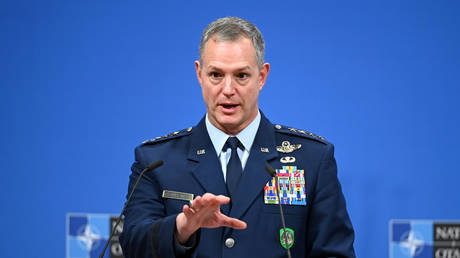
Western military analysts love to dissect the psychology of state actors as if they are dealing with rational, corporate boardrooms. When a top NATO general publically declares that Russia is "not looking for conflict" with the alliance, the global foreign policy establishment nods along in comfortable agreement. They look at defense budgets, troop concentrations, and supply lines, concluding that a full-scale confrontation is statistically improbable.
They are misreading the entire board.
The lazy consensus in modern geopolitical analysis conflates the absence of a declared conventional war with the absence of conflict. It assumes that because an adversary lacks the immediate logistics to march an armored division to the Atlantic, they are not actively trying to dismantle the security architecture of the West. This view is dangerous, outdated, and fundamentally flawed.
The reality is far more brutal. The conflict isn't coming; it is already happening. It just doesn't look like the Fulda Gap scenario that legacy defense contractors are still praying for.
The Cold Calculus of Asymmetric Escalation
Western doctrine assumes a binary state of existence: you are either at peace or you are at war. This is a luxury of nations protected by vast oceans or massive collective defense treaties.
Modern revanchist powers do not operate on a binary toggle. They operate on a continuum of aggression. When military leaders look at troop movements and declare that an adversary doesn't want a fight, they are looking for the wrong indicators.
Imagine a scenario where a state actor manages to compromise the water treatment facilities of three major European cities, orchestrates a series of GPS-jamming campaigns that force hundreds of commercial flights to reroute, and floods the digital ecosystem with deepfakes that trigger localized banking panics. Not a single missile has left a silo. No borders have been crossed by boots on the ground.
Is that peace? NATO’s current framework struggles to answer that question because its triggers are calibrated for steel and high explosives.
By insisting that an adversary is "not looking for conflict," leadership exposes a profound misunderstanding of contemporary doctrine. The goal is not to defeat NATO in a head-on, multi-corps tank battle. The goal is to make the cost of maintaining the alliance so prohibitively expensive, politically toxic, and socially divisive that it fractures from within.
The Balance Sheet Fallacy in Military Intelligence
I have spent years watching defense analysts stare at gross domestic product (GDP) numbers and industrial output charts, trying to predict the timeline of state aggression. They use a standard formula: if Country X has a smaller economy than Italy, they cannot possibly sustain a long-term confrontation against a multi-trillion-dollar Western bloc.
This balance sheet approach is a trap.
In a centralized, wartime command economy, GDP is a useless metric. The purchasing power parity (PPP) of a state-directed defense sector does not match the commercial realities of the West. If a state can manufacture artillery shells for one-tenth of the price it costs a European defense consortium, the financial comparison collapses.
Furthermore, Western analysis heavily overemphasizes the cost of hardware while ignoring the cost of disruption.
- A cyber campaign utilizing commodity malware can cost less than a single precision-guided munition.
- The economic damage of that campaign can easily reach hundreds of millions of dollars in civilian infrastructure downtime.
- The asymmetric return on investment (ROI) is staggering.
When a general says an adversary is avoiding conflict, what they really mean is that the adversary is avoiding the specific type of conflict the West is optimized to win. Why would any rational competitor play to their opponent's strengths? They won't. They will bypass the hard shell of conventional deterrence entirely to strike at the soft underbelly of civilian supply chains, undersea communications, and democratic processes.
Dismantling the De-escalation Narrative
The public is constantly reassured that diplomatic backchannels and strategic signaling are keeping the peace. We are told that clear communication prevents miscalculation.
This assumes both sides share the same definition of a "miscalculation."
For a regime whose survival depends on external friction to justify internal repression, a controlled level of permanent instability is not a mistake—it is a core policy objective. Brinkmanship is not a breakdown of diplomacy; it is a highly calibrated tool used to extract concessions from risk-averse Western democracies.
Every time a Western official explicitly states what we will not do, or downplays the hostile intent of an adversary to avoid panic, they are not de-escalating. They are signaling the precise boundaries of their risk tolerance. They are telling the adversary exactly how far they can push before encountering actual resistance.
This creates a perverse incentive structure. If the West signals that it will only respond to kinetic, Article 5-level events, it gives a green light to every form of hostility that falls just below that threshold. We are effectively inviting the very gray-zone aggression that is currently eroding our institutions.
The Cost of the Counter-Intuitive Approach
If we accept that the conflict is already underway, the prescription is not pleasant. It requires a fundamental shift in how societies organize themselves for defense.
First, the wall between corporate security and national security must be completely demolished. If the primary theater of operations is civilian infrastructure, then private utility companies, maritime shipping firms, and telecommunications providers are the front-line troops. They are currently unequipped, untrained, and underfunded for this role.
Second, the West must develop its own doctrine of asymmetric retaliation. Defensive postures are inherently reactive; they allow the adversary to choose the time, place, and method of attack. Until the West creates credible, non-kinetic deterrents that can impose severe costs on the leadership of aggressive states, the provocations will continue.
The downside to this approach is obvious: it increases the baseline level of systemic friction. It means admitting that the era of globalized, frictionless commerce with adversarial states is over. It requires telling voters that the cheap consumer goods and integrated energy markets of the last thirty years were a historical anomaly, paid for by deferred security costs that are now due.
The Flawed Questions Dominating the Debate
If you read the mainstream defense press, the questions being asked are almost entirely operational:
- "How many brigades do we need in the Baltics?"
- "What is the optimal production rate for fifth-generation fighter jets?"
- "Can we intercept hypersonic cruise missiles?"
These questions assume the enemy is coming through the front door.
The real question we should be asking is: "How do we maintain societal resilience when our financial networks are systematically degraded, our political discourse is weaponized by foreign intelligence, and our population no longer trusts the institutional mechanisms of state?"
We are preparing for a war of attrition fought with steel, while our adversaries are executing a war of friction fought with information, economic leverage, and psychological exhaustion.
Stop looking at the maps of Eastern Europe to find the front lines. Look at the routing tables of your internet exchange points, the ownership structures of your critical ports, and the algorithmic feeds of your citizens' smartphones.
The general says they aren't looking for a conflict. He is right, but only in the most literal, pedantic sense. They don't want a war with NATO's tanks; they want a victory over NATO's societies. And by pretending the fight hasn't started yet, we are giving them exactly what they need to achieve it.