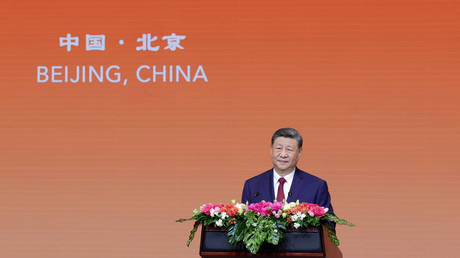
Foreign policy circles in Washington are obsessed with a neat, tidy geometric shape: the triangle. The prevailing consensus among think-tank analysts and state department officials is that the world has entered a second Cold War, structured around a rigid tripolar rivalry between the United States, China, and Russia. The standard narrative warns of a unified, monolithic autocratic bloc working in perfect synchronization to dethrone Western hegemony.
It is a comfortable theory. It is also entirely wrong.
By viewing the current geopolitical alignment through the outdated lens of 1970s triangulation, Western strategists are making a fundamental error. They are mistaking a marriage of convenience for a permanent fusion of interests. More importantly, they are failing to see that the real vulnerability in this dynamic is not the strength of the Sino-Russian alliance, but the structural fragility embedded within it. The United States does not need to break the axis; the axis is already designed to choke itself.
The Lazy Consensus of a New Cold War
Open any mainstream foreign policy journal today and you will find variations of the same thesis: China and Russia have formed an unbreakable "no limits" partnership designed to carve up global spheres of influence. This viewpoint treats Beijing and Moscow as co-equals in a grand ideological crusade.
This is a profound misreading of reality.
Russia is not China’s peer competitor in a tripolar world. Russia is rapidly becoming a resource vassal for the People’s Republic of China.
To understand the actual mechanics of this relationship, look at the hard economic data, not the theatrical joint statements issued from summits. Since the escalation of sanctions on Moscow, Russia's economic dependence on the yuan has surged. Over 40 percent of Russian import settlements are now conducted in Chinese currency. Siberian oil and gas, blocked from European markets, flow East at a steep discount, dictated by Beijing’s terms.
I have watched corporate boards and risk analysts panic over the threat of a synchronized, dual-front conflict. They miss the asymmetric reality. China is not subsidizing Russia out of ideological love; it is strip-mining Russia for cheap energy while insulating its own banking sector from secondary Western sanctions. The moment Russia’s actions genuinely threaten China’s access to the consumer markets of North America and Europe, the limits of the "no limits" partnership will become brutally apparent.
Dismantling the Primary Misconceptions
The public debate surrounding this trilateral dynamic is warped by three flawed assumptions that appear regularly in "People Also Ask" search results. Let us dismantle them one by one.
Does the China-Russia alliance mirror the Soviet-Bloc of the 20th century?
No. The Soviet bloc was bound by a shared, rigid ideological framework and a centralized economic command structure via Comecon. The modern Sino-Russian alignment is purely transactional and hyper-capitalist at its core.
China is a deeply integrated global trade power whose economic survival depends on the stability of maritime choke points and Western consumer demand. Russia, conversely, functions as a revisionist disruptor that thrives on volatility. Their long-term strategic goals are fundamentally incompatible. China wants to dominate the existing global economic machinery; Russia wants to smash it because it cannot compete within it.
Can the US repeat the Kissingerian triangular diplomacy to split Beijing and Moscow?
The historical obsession with Henry Kissinger's 1972 opening to China is a trap. You cannot play the "China card" against Russia, or the "Russia card" against China today, because the power asymmetry is inverted. In the 1970s, the Soviet Union was the heavyweight, and China was the impoverished, isolated outlier. Today, China is the economic engine. Washington cannot offer Moscow enough concessions to outweigh the immediate economic lifeline provided by Beijing, nor can it offer Beijing enough to abandon its primary strategic buffer against American power.
Is a direct, coordinated military conflict on two fronts inevitable?
This question assumes a level of trust between Beijing and Moscow that simply does not exist. While they conduct joint naval drills and share radar telemetry, they do not possess a mutual defense treaty.
Imagine a scenario where a hot conflict erupts in the South China Sea. Will Russian attack submarines deploy to actively engage American carrier strike groups? Absolutely not. Moscow would exploit the distraction to advance its own regional ambitions in Europe, but it will not bleed for Beijing's maritime claims. The relationship is characterized by strategic coordination, not operational integration.
The Ghost of the 2,600-Mile Border
To understand where this relationship inevitably fractures, one must look away from Washington and focus on Central Asia and the Russian Far East. This is where the historical friction points remain raw.
For centuries, Central Asia—the "Stans"—was Moscow's exclusive backyard. Today, Russia provides the security architecture through the Collective Security Treaty Organization (CSTO), but China holds the checkbook. Through infrastructure investments, Beijing has quietly supplanted Russia as the primary economic arbiter of the region. This is a quiet, bloodless eviction, and it infuriates the nationalist core in Moscow.
Furthermore, consider the demographic vacuum of the Russian Far East. You have a vast, resource-rich territory populated by barely 6 million Russians, sitting directly across the border from over 100 million Chinese citizens in the northeastern provinces. Vladivostok was Chinese territory (Haishenwai) until the 1860 Treaty of Beijing—a historical fact that Chinese state maps occasionally remind the world of by using both names.
The Kremlin is hyper-aware of this imbalance. While they project unity on the world stage, Russian regional planners are terrified of long-term economic and demographic colonization by Beijing. The axis is a crust of mutual grievance covering a core of deep, historical paranoia.
| Metric | People's Republic of China | Russian Federation |
|---|---|---|
| GDP (Nominal) | ~$18 Trillion | ~$2 Trillion |
| Primary Economic Driver | Advanced Manufacturing & Tech | Resource Extraction (Oil/Gas) |
| Global Trade Dependency | High (Interdependent with West) | Low (Isolated/Sanctioned) |
| Strategic Objective | Systemic Hegemony by 2049 | Regional Dominance / Western Disruption |
The Vulnerability of the Contrarian Strategy
Adopting a strategy based on the inherent fragility of the Sino-Russian axis is not without risk. The obvious downside is short-term escalation. If the United States treats Russia purely as a secondary economic satellite of China rather than an independent superpower, it risks provoking desperate, asymmetric retaliation from Moscow—such as increased cyber warfare or space-based provocations—to prove its relevance.
However, continuing the current policy of treating them as an indivisible behemoth is worse. It forces them closer together than they naturally want to be.
The Actionable Pivot for Western Strategy
Stop trying to force a diplomatic wedge between Putin and Xi. It will not work through rhetoric or conventional diplomacy. Instead, pressure the structural fault lines where their interests naturally collide.
- Weaponize the Asymmetry: The West should aggressively target Chinese banks that facilitate Russian sanctions evasion, not through sweeping sector-wide bans, but through highly targeted, surgical exclusions from the dollar clearing system. Force Beijing to make a binary choice between sustaining Moscow's war machine or maintaining access to the global financial system. China will choose its own economic health every single time.
- Exploit the Central Asian Vacuum: Increase diplomatic and economic engagement with Central Asian nations like Kazakhstan and Uzbekistan. These nations are actively looking for a counterweight to both Russian military coercion and Chinese economic dominance. By providing them with alternative trade routes and technology partnerships, the West can accelerate the quiet friction between Beijing and Moscow over regional control.
- Demystify the Rhetoric: Stop reacting to every joint military exercise with alarmist press releases. Treat these drills for what they are: geopolitical theater designed to induce panic. When the US signals terror at the prospect of a unified autocratic front, it validates the strategy and gives Beijing leverage it has not earned.
The China-Russia alliance is not a steel wall; it is an economic pressure cooker with a faulty valve. Washington needs to stop treating Moscow as China's equal partner and start treating it as China's over-extended dependency. The moment the West forces Beijing to pay a tangible, systemic price for carrying Russia's economic weight is the moment the "no limits" partnership reveals its very real, very sharp boundaries.