The fluorescent lights of a hospital waiting room in Hong Kong have a specific, unforgiving hum. It is a sound heard by thousands of people every day in Queen Mary Hospital or the Prince of Wales, a low-frequency vibration that seems to slow time down to a agonizing crawl.
Think of a man named Ming. He is fifty-four, a software engineer from Kowloon, a father who still pays his daughter’s phone bill just to stay connected to her life. Ming has a persistent cough. It is probably nothing. The air quality in the city has been heavy lately. But his doctor saw a shadow on a routine scan, an ambiguous smudge smaller than a thumbnail.
To find out what that smudge is, Ming faces the standard ritual of modern oncology. A long, hollow needle must pass through his skin, muscle, and tissue, driven deep into his lung to harvest a fragment of flesh. It is called a tissue biopsy. It is invasive. It carries the risk of a collapsed lung, infection, and weeks of localized pain.
But the physical pain of the needle is not the worst part. The worst part is the waiting.
For two weeks, Ming will sit at his kitchen table, staring at the harbor, trapped in a gray limbo. Is it cancer? If it is, has it spread? The tissue sample must be processed, sliced, stained, and examined under a microscope. By the time the results arrive, the emotional toll on Ming and his family is already profound. And sometimes, the needle misses the mark entirely, yielding a sample too small to test, forcing him to start the cycle all over again.
This is the hidden tax of cancer detection. It is a system built on physical trauma and temporal friction.
But a quiet quiet shift is happening in the laboratories of the Chinese University of Hong Kong (CUHK) and across the city's medical centers. The landscape of diagnosis is being rewritten, not by heavier machinery, but by a single vial of blood.
The Message in the Current
To understand how a blood test can replace a surgical needle, we have to look at what cancer actually does when it hitches a ride inside the human body.
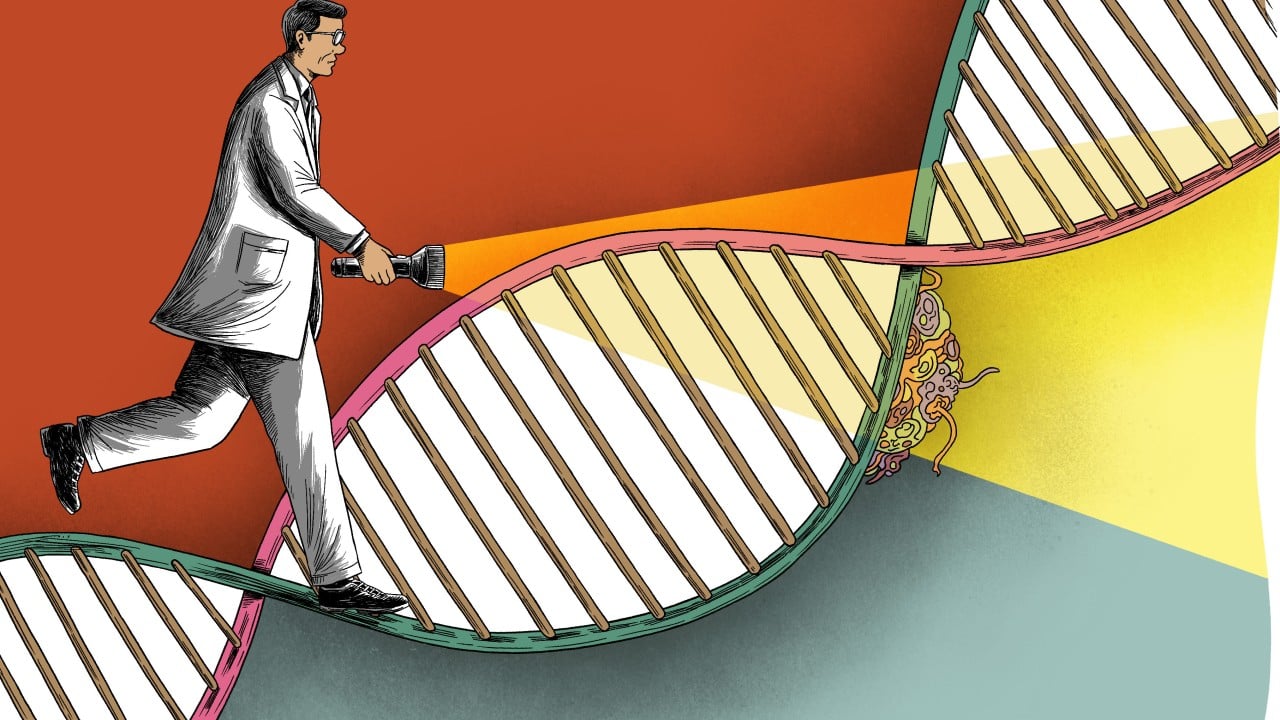
Tumors are messy. As they grow rapidly, their outer cells constantly die and rupture. When these cells burst, they spill fragments of their genetic material directly into our bloodstream. Scientists call this cell-free DNA, or cfDNA.
For decades, this circulating debris went unnoticed. It was biological background noise. Tracking it was like trying to read a shredded letter that had been thrown into a rushing river.
The breakthrough came when researchers realized that cancer DNA carries distinct chemical tags—microscopic flags known as methylation patterns. Think of these patterns like a digital fingerprint. Normal, healthy lung tissue has one set of tags. A malignant lung tumor has a completely different, chaotic signature.
By drawing just a few milliliters of blood from a patient's arm, a specialized machine can now sift through billions of healthy genetic strands to find the few dozen pieces of broken tumor DNA.
The implications of this are staggering.
A blood draw takes five minutes. It can be done in a neighborhood clinic. It requires no sedation, no recovery time, and no hospital stay. For a patient like Ming, the terrifying trajectory of a suspected diagnosis changes completely. The needle is replaced by a routine prick. The two-week panic is compressed into a matter of days.
The Map of the Invisible
There is a common misunderstanding that cancer is a single, localized enemy. We talk about catching it early, as if it sits quietly in one spot waiting to be discovered.
The reality is far more slippery. A tumor is an evolving ecosystem.
When a surgeon performs a traditional tissue biopsy, they are taking a snapshot of one exact coordinate. But a tumor in the left lung might have different genetic mutations than the cells it has shed into the lymph nodes. If you only test the tissue from the needle's path, you might miss the mutation that makes the cancer resistant to standard chemotherapy.
This is where the liquid biopsy excels. Because blood flows through every corner of the body, it acts as a universal catchment basin. A blood test gathers DNA from every part of every tumor simultaneously. It provides a panoramic view of the disease rather than a keyhole glance.
Consider the math of early detection.
In Hong Kong, lung, colorectal, and breast cancers dominate the public health registry. By the time a patient feels a lump or experiences a symptom significant enough to warrant an invasive biopsy, the disease has often progressed to stage three or four. The surgical options narrow. The survival rates drop sharply.
If you can detect those chemical tags in the bloodstream when the tumor is only a few hundred cells wide—long before it shows up on an X-ray or causes a cough—the conversation changes from management to eradication.
The Friction of Transition
If the technology is this profound, why isn't every clinic from Central to New Territories using it tomorrow morning?
The answer lies in the messy, human reality of medical infrastructure.
Medical science moves with an intentional, conservative slowness. This caution is necessary; when lives are at stake, you do not abandon a proven, century-old method like tissue pathology for the newest technology without extraordinary proof.
First, there is the challenge of sensitivity. In the ultra-early stages of cancer, the amount of tumor DNA in the blood is extraordinarily faint. A test must be sensitive enough to find that one mutant strand among millions of normal ones, but precise enough not to trigger a false alarm. A false positive—telling a healthy person they have cancer—inflicts a devastating psychological wound.
Then there is the logistical hurdle. The machinery required to sequence this DNA and analyze the methylation patterns is incredibly sophisticated. It requires specialized laboratories, highly trained technicians, and significant capital.
Currently, these tests are becoming integrated into Hong Kong’s top-tier private hospitals and research institutions. The challenge over the next few years is democratization. For this technology to fulfill its true promise, it cannot remain a luxury product for the wealthy residents of the Mid-Levels. It must become as standard and accessible as a cholesterol screening at a public health clinic in Sham Shui Po.
We must also confront the psychological shift required from patients and physicians alike. For generations, seeing is believing in medicine. A doctor wants to see the cells under a microscope; a patient wants to see the mass on a screen. Trusting a sequence of data from a vial of clear plasma requires a new kind of faith in abstract science.
The Weight of the Unseen
Every year, thousands of families in Hong Kong receive the phone call that divides their lives into a distinct before and after. The period between the first suspicion and the final confirmation is a unique form of human suffering, an invisible state of suspension where careers are put on hold, marriages are strained, and sleep vanishes.
Reducing that window of terror is not just a clinical victory. It is an act of profound empathy.
Imagine Ming a few years from now. He walks into his doctor's office. There is no discussion of scheduling a surgical suite, no warnings about punctured lungs, no anxieties about local anesthesia. He rolls up his sleeve. The nurse tightens the plastic band around his bicep. A small tube fills with dark red fluid.
He goes home and makes dinner for his family. He watches the neon signs of the city flicker to life across the water. Two days later, an email or a text message arrives, confirming that the shadow was just an old scar from a long-forgotten bout of bronchitis.
The horizon remains clear. The needle stays on the shelf. The hum of the waiting room fades into silence.