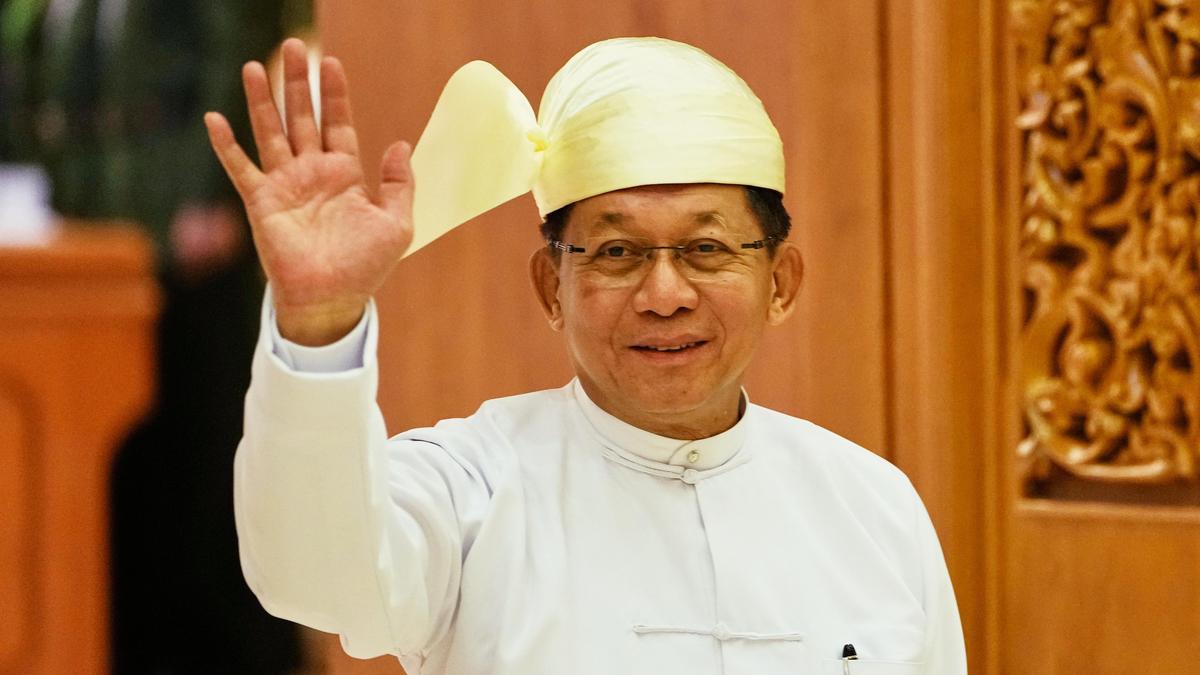
Mainstream media outlets love a predictable moral arc. They look at the geopolitical chessboard, see a military general, and immediately reach for the standard "democracy versus tyranny" template. The recent coverage of India hosting Myanmar’s State Administration Council Chairman Min Aung Hlaing is a masterclass in this lazy, surface-level analysis. The common consensus laments New Delhi’s willingness to sit down with a junta leader, quoting exiled opposition groups who label him a terrorist, while hand-wringing over the apparent death of democratic values in regional foreign policy.
This view is not just naive; it is dangerous.
Western commentators and keyboard activists view international relations through the luxury of distance. India does not have that luxury. When you share a highly porous 1,640-kilometer border plagued by insurgency, drug trafficking, and ethnic conflict, your foreign policy cannot be dictated by Western-style virtue signaling. India’s engagement with Myanmar’s military leadership is not an endorsement of authoritarianism. It is a cold, calculated necessity driven by national security and regional stability.
The Myth of the Effective Government-in-Exile
The standard narrative centers heavily on the outrage of the National Unity Government (NUG), Myanmar's exiled administration. Media reports amplify their claims, framing them as the sole legitimate voice of the Burmese people. While their aspiration for democracy is clear, the geopolitical reality on the ground is fractured.
I have spent decades analyzing regional security architectures, and if there is one constant, it is that borders respect power, not proclamations made from foreign capitals. The NUG lacks centralized command over the dozens of Ethnic Armed Organizations (EAOs) actually fighting on the ground. To treat Myanmar as a binary conflict between a singular evil junta and a unified democratic resistance is a fundamental misunderstanding of the country's complex ethnic balkanization.
If New Delhi were to cut ties with Naypyidaw to appease Western sensibilities, who fills the vacuum? The NUG cannot secure the border. They cannot stop the flow of narcotics from the Golden Triangle entering India’s northeastern states. They cannot prevent Indian insurgent groups, like the United Liberation Front of Asom (ULFA) or the National Socialist Council of Nagaland (NSCN), from using the dense jungles of Myanmar as a safe haven. The military junta, whatever its domestic faults, holds the keys to the state apparatus required to police these borders.
The China Elephant in the Room
Let's look at the map. The critics screaming for India to isolate Myanmar completely ignore the geopolitical vacuum that isolation creates. Every time a democratic nation pulls back from Myanmar on moral grounds, Beijing moves in with billions of dollars in infrastructure investments.
China’s footprints are already heavy across the country, from the Kyaukphyu deep-sea port to the pipelines cutting straight to Yunnan province. Beijing wants a compliant Myanmar to bypass the Malacca Strait, securing a direct gateway to the Indian Ocean. If India walks away from the table, it hands Myanmar to China on a silver platter.
Imagine a scenario where India completely shuts its doors to Min Aung Hlaing. The junta, facing economic strangulation and diplomatic isolation, becomes entirely dependent on Chinese economic lifelines and Russian military hardware. Suddenly, India finds its entire eastern flank neutralized, surrounded by a hostile string of pearls. Engaging with the junta is not about liking them; it is about balancing Chinese influence in a critical buffer state. It is a defensive necessity.
The Kaladan Project and the Cost of Inaction
Geopolitics is anchored in concrete and steel, not just rhetoric. India’s Kaladan Multi-Modal Transit Transport Project and the India-Myanmar-Thailand Trilateral Highway are massive strategic investments. The Kaladan project, in particular, is designed to connect India's landlocked northeast to the Bay of Bengal via Myanmar’s Sittwe port.
[Kolkata Port] ---> (Sea Route) ---> [Sittwe Port, Myanmar] ---> (River/Road) ---> [Mizoram, India]
This infrastructure is vital for the economic development of India's Northeast, a region historically isolated from the mainland's economic engine. You cannot build, maintain, or secure these multi-million-dollar transit corridors by negotiating with an exiled government operating via Zoom calls from Washington or Chiang Mai. You have to deal with the entity that controls the territory, the ports, and the security forces on the ground.
I have watched governments lose billions by pausing infrastructure projects to wait for a "perfect" political climate that never arrives. The reality is that infrastructure projects dictate long-term regional alignment. If India stops working on these corridors, China will gladly build its own parallel routes, permanently altering the economic gravity of Southeast Asia.
Dismantling the Moral High Ground Punditry
The critics frequently ask variations of the same flawed question: How can India claim to be the world's largest democracy while rolling out the red carpet for a military dictator?
This question assumes that a nation's foreign policy must be a mirror image of its domestic governance. History proves this premise false. The United States maintains deep strategic partnerships with absolute monarchies in the Middle East when oil and counter-terrorism are on the line. European nations routinely ink trade deals with autocracies when energy security is threatened. Yet, when India prioritizes its own immediate border security and economic survival, the commentators accuse it of moral bankruptcy.
Let's answer the question honestly: A nation’s primary moral duty is to ensure the security and prosperity of its own citizens. It is not to fix the governance models of its neighbors at the expense of its own stability.
There is an inherent downside to this approach, and we must acknowledge it. Dealing with a military regime damages India’s soft-power image among democratic purists. It alienates a segment of the local Burmese population who feel abandoned by a democratic neighbor. It is a messy, compromised strategy that offers no clean moral victories. But the alternative—a chaotic, failed state on India's eastern border dominated by hostile foreign actors—is infinitely worse.
Security First, Ideology Second
Look at the historical precedent. In the 1990s, India initially took a hardline stance against the Myanmar military regime following the suppression of the 1988 pro-democracy uprisings. New Delhi openly supported Daw Aung San Suu Kyi and democratic dissidents.
The result? India’s northeastern insurgencies exploded as rebel groups found sanctuary across the border. China rapidly expanded its influence inside Myanmar, and India found itself strategically sidelined. By the mid-1990s, New Delhi realized its mistake and initiated "Look East," pivoting to a policy of constructive engagement with the junta. This shift directly led to coordinated military operations that successfully flushed out anti-India insurgents from Myanmar’s territory.
History teaches that moral crusades in foreign policy usually yield strategic disasters. India tried the ideological approach and paid for it in the blood of its security forces and the destabilization of its northeastern states. The current administration is simply refusing to repeat the mistakes of the past.
Stop looking at the invitation to Min Aung Hlaing as a betrayal of values. It is an exercise in survival. In the real world, you do not choose your neighbors, and you rarely get to choose the leaders they end up with. You deal with the hand you are dealt, secure your borders, protect your investments, and leave the moralizing to the pundits who do not have to live with the consequences of a burning frontier.