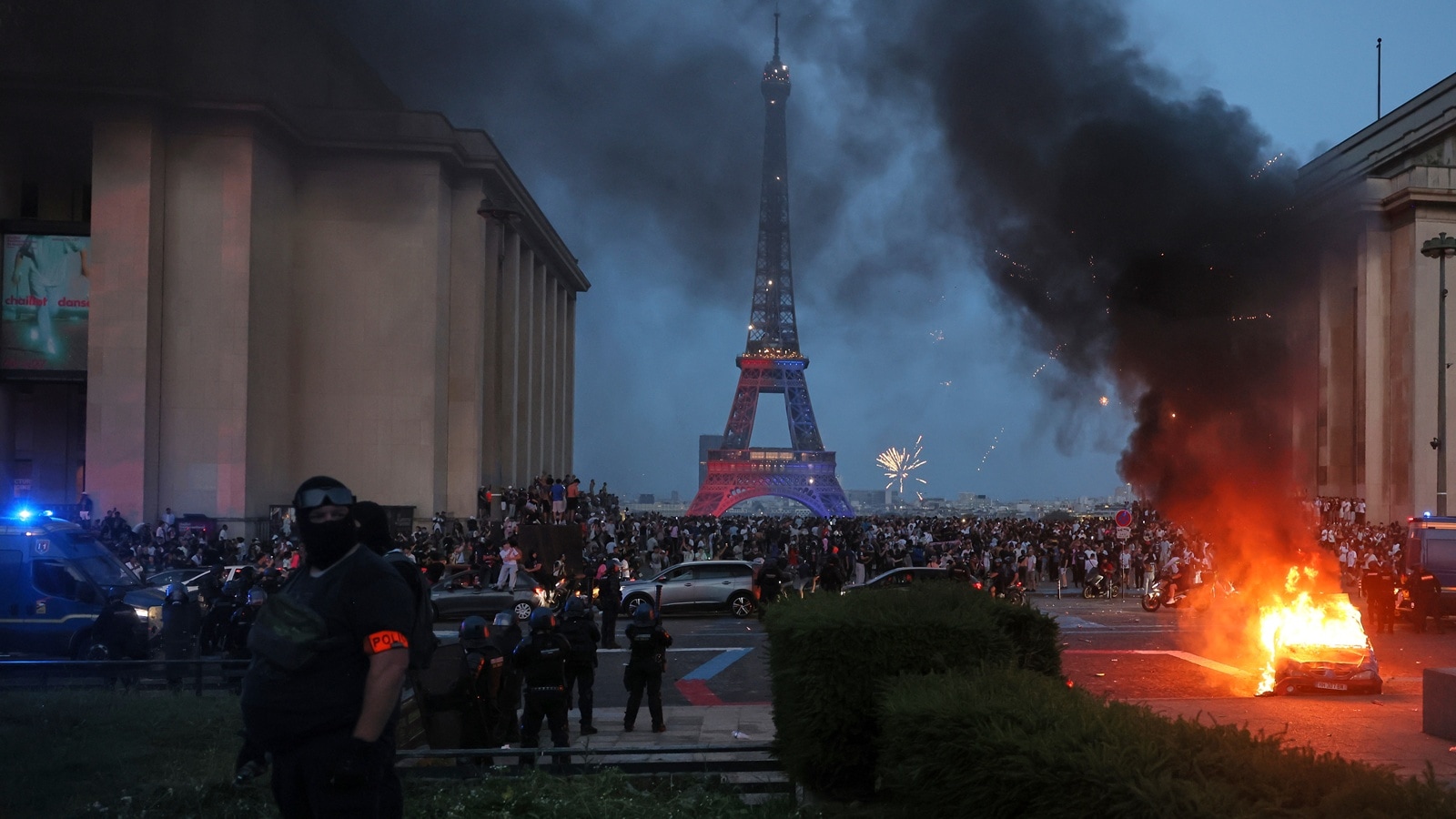
The air in the French capital always carries a specific weight in late May. It is the scent of blooming chestnuts mixed with diesel fumes, the collective exhale of a city shaking off winter. But on this particular Sunday night, the atmosphere didn't just carry weight. It carried a charge.
You could feel it in the cobblestones of the Marais and the wide, exposed asphalt of the Champs-Élysées. Paris Saint-Germain had just won the Champions League.
For the uninitiated, a victory like this is not just a sporting achievement. It is a validation of identity. For decades, Paris was a city of culture, fashion, and history, but its football club was a chaotic, beautiful mess that constantly broke hearts. When the final whistle blew in Munich, confirming PSG’s ascent to the peak of European football, an entire metropolis let out a roar that had been building for generations.
Then, the smoke began to rise.
By 2:00 AM, the celebration had mutated. What started as tears of euphoria devolved into tear gas, shattered storefronts, and a tally of destruction that left the nation staring into a mirror, wondering how love could look so much like hatred. 780 people were in handcuffs. One young man was dead.
To understand how a moment of pure sporting transcendence became a battlefield, you have to look past the standard police blotters and sports commentary. You have to look at the anatomy of a riot born from joy.
The Chemistry of the Crowd
Imagine standing on the Champs-Élysées at midnight. It is a human ocean. You are pressed shoulder-to-shoulder with thousands of strangers. The collective energy is intoxicating. In psychological terms, this is what researchers call deindividuation. The individual ego dissolves into the collective mass. You are no longer a bank teller, a student, or an accountant. You are part of the Tribe.
When the club won, the initial wave of energy was pure light. Flares illuminated the Arc de Triomphe in blood-red hues. People danced on the roofs of city buses.
But crowds are volatile chemical compounds. They require only a tiny catalyst to change state.
Consider a hypothetical fan. Let’s call him Lucas. Lucas is twenty-two, works a dead-end retail job in the suburbs, and feels invisible six days a week. Tonight, he is part of something historic. He is powerful. When a small group of radicalized supporters—the ultras—begin to clash with a police cordon near the Avenue de la Grande Armée, Lucas doesn’t walk away. The adrenaline pulsing through his veins makes the danger feel like an extension of the game.
The shift happens in a heartbeat. A glass bottle flies through the air, catching the streetlamp light before shattering against a riot shield.
The sound change is immediate. The singing stops. The roaring begins.
The Invisible Fracture Lines
The media often portrays sports riots as sudden, inexplicable outbursts of madness. They are not. They are the sudden venting of subterranean pressures that have been building for years.
Paris is a deeply segregated city, not by walls, but by economics and infrastructure. The périphérique—the ring road that encircles the historic center—acts as a psychological barrier separating the affluent interior from the disenfranchised suburbs, the banlieues. For many young men living in the high-rises outside the city gates, PSG is the only bridge to the capital. It is their flag. Their religion.
When the club wins, it feels like a conquest. The fans from the periphery reclaim the center of the city.
But that reclamation happens in a space heavily policed by authorities who view them with perpetual suspicion. The French police strategy, historically reliant on aggressive containment and the use of tear gas, creates a binary dynamic: us versus them.
When the celebration overflowed into the streets, the authorities deployed thousands of officers. They weren't there to celebrate; they were dressed for war. Body armor. LBD launchers. Shields. To a crowd already drunk on victory and adrenaline, the presence of militarized police is not a deterrent. It is an invitation.
The numbers from that night tell a staggering story, but they lack context. 780 arrests do not happen because a few people had too much beer. They happen when systemic resentment meets an extraordinary, unrepeatable moment of lawlessness.
The Human Cost of a Headline
Behind every statistic lies a specific tragedy.
Among the chaos on the Boulevard Voltaire, far from the primary flashpoints of the Champs-Élysées, a twenty-four-year-old man named Maxime was walking home. He wasn't throwing cobblestones. He wasn't smashing the windows of luxury boutiques. He was a kid from the 11th arrondissement who had spent the night cheering at a local bar with his friends.
In the confusion of a sudden police charge designed to disperse a crowd, a stampede formed. People panicked. In the crush of bodies against a narrow alleyway, Maxime tripped.
The autopsy would later cite asphyxiation compounded by blunt force trauma.
The next morning, while city workers washed the soot from the pavement and replaced the shattered glass of bus shelters, Maxime’s mother stood behind a police tape, staring at a small stain on the concrete. The headline in the morning paper read: 780 Arrests, 1 Killed.
To the world, Maxime became the "1." A footnote in a story about football hooliganism. But his death represents the terrifying randomness of collective violence. When a city loses control, the fire doesn't choose its victims based on their guilt. It simply consumes whatever is closest.
The Mechanics of Destruction
Why do people destroy the things they love? Why burn the city that houses your team?
It is an apparent paradox that defies simple logic. The answer lies in the nature of transgression. For a certain segment of the population, the victory provided a shield of immunity. If fifty thousand people are breaking the law simultaneously by blocking traffic and lighting illegal pyrotechnics, the law effectively ceases to exist.
This vacuum of authority acts as a magnet for opportunistic elements.
As the night wore on, the genuine football fans—those who had wept when the final whistle blew—began to retreat to the safety of Metro stations. They were replaced by the casseurs, black-clad rioters whose primary objective is destruction. They don't care about the Champions League. They care about the vulnerability of the state.
Luxury stores along the Golden Triangle were looted. Not for survival, but for sport. Nike sneakers, high-end smartphones, and designer jackets were dragged through shattered glass windows while smartphones recorded the exploits for social media. The riot became content.
The Day After the Carnival
By dawn, Paris looked like a hungover giant.
The smell of burnt rubber hung low under a gray sky. The pristine avenues looked scarred, marked by the black circles of torched vehicles. The triumph of the night before had been completely eclipsed by the hangover of violence.
The Interior Minister held a press conference, praising the "bravery of the security forces" and condemning the "savagery of a minority." The football club issued a sterile statement expressing sadness over the incidents. Everyone retreated to their ideological corners, using the night’s events to score political points.
But on the streets, the feeling was one of profound exhaustion.
Football is supposed to be an escape. It is the one arena where people from every walk of life can share an identical emotion at an identical microsecond. It is a beautiful, fragile ecosystem built on shared mythology.
When that mythology is dragged through the mud, when a young man loses his life for the crime of being in the wrong street during a celebration, the magic evaporates. You are left with nothing but the cold reality of a fractured society, a pile of broken glass, and the quiet, devastating realization that sometimes, winning feels exactly like losing.
A lone street sweeper on the Place de la République picked up a discarded PSG scarf, soaked in rain and tear gas residue. He looked at it for a moment, shook his head, and tossed it into the back of his truck. The carnival was over. The city had to go back to work.