The air in Manhattan usually tastes like exhaust fumes, roasted nuts from the street carts, and the collective anxiety of eight million people rushing somewhere else. But on a Tuesday night in late spring, the air tasted like sulfur. It tasted like cheap beer spilled on hot concrete. It tasted, for the first time in an entire generation, like pure, unadulterated relief.
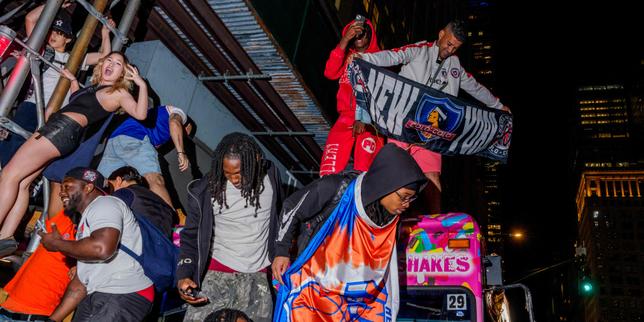
If you looked at the wire services or the standard news feeds that night, you saw the basic facts. The headlines were functional, dry, and predictable. They noted that the New York Knicks had secured a spot in the NBA Finals. They mentioned the score. They included a gallery of photographs showing crowds gathering outside Madison Square Garden, people climbing onto the roofs of transit buses, and flares illuminating the intersection of 33rd and Seventh in a blinding, crimson haze.
But a photograph of a crowd is just a headcount. It tells you how many, but it never tells you why.
To understand why thousands of people who would normally avoid eye contact on the subway suddenly started hugging each other like wartime survivors, you have to look past the box score. You have to understand a specific kind of sub-zero loneliness that only sports fans truly comprehend. It is the weight of thirty years of collective embarrassment, carried by a city that prides itself on never being second-best at anything.
The Geography of a Heartbreak
For three decades, being a basketball fan in this city was an exercise in generational trauma. Consider the typical thirty-year-old New Yorker. They were a newborn baby the last time Patrick Ewing hoisted a trophy in the Eastern Conference. Their entire conscious life has been defined by management blunders, draft lottery busts, and the slow, agonizing realization that the world’s most famous arena had become a tourist trap rather than a house of hoops.
Every October brought fresh hope. Every February brought the familiar, sickening slide into irrelevance.
The rest of the country laughed. They called the fans delusional. They mocked the celebrity row regulars who paid thousands of dollars to watch a mediocre product. But the fans kept showing up, paying exorbitant ticket prices just to feel the faint, ghostly vibration of old victories beneath the floorboards.
Then, everything changed. It didn't happen overnight, despite what the highlight reels suggest. It was a slow, grinding assembly of overlooked players, a coach who looks like he hasn’t slept since 1997, and a point guard who plays with the chip-on-the-shoulder intensity of a guy who got cut from his high school varsity team. They weren't a collection of superstars; they were a construction crew.
When the final buzzer sounded on that Tuesday night, the dam didn't just break. It evaporated.
The Red Flare on Seventh Avenue
Step into the center of the intersection right after the game ended. The police barricades, usually so rigid and imposing, became completely useless against the human tide pouring out of Penn Station.
Marcus, a forty-two-year-old transit worker from the Bronx, stood on top of a concrete planter. His uniform shirt was half-unbuttoned, and his voice was already a raspy whisper. He wasn't watching the game on a screen anymore; he was just watching the faces of the people around him.
"My dad took me to the '94 Finals," Marcus said, squinting through the smoke of a road flare someone had ignited near the subway entrance. "I was twelve. I thought we’d be back every year. My dad passed away five years ago. We used to argue about this team every single Sunday on the phone. I’m just standing here looking at these kids who are twenty now, realizing they’ve never seen this. They don't know what it feels like to actually win."
The flare cast a deep, theatrical red glow across the limestone facade of the Garment District buildings. In that light, everyone looked like they were part of a renaissance painting. A guy in a tailored Tom Ford suit was high-fiving a teenager in a knock-off jersey. A group of delivery drivers stopped their mopeds in the middle of the street, abandoned their kickstands, and started dancing on the asphalt.
This is the hidden mechanics of a sports obsession. It isn't actually about the billionaires who own the teams or the millionaires who play for them. It is a massive, city-wide utility bill for emotional connection. In a city where people live stacked on top of each other in tiny, expensive boxes, anonymity is the default setting. You walk through the streets with your headphones in, defensive parameters fully engaged, ignoring the world.
Except on this night. On this night, the armor came off.
The Economics of Joy
The skeptics will tell you that a basketball game changes nothing. The rent is still due on the first of the month. The subway trains are still delayed. The trash still piles up on the curbs during a heatwave.
They are right, of course. A championship series doesn't fix a broken infrastructure or lower the cost of a gallon of milk. But it changes the internal weather of the population. It alters the way people treat the stranger standing next to them in the bodega line.
Consider the sheer financial absurdity of what happens when a team enters this stratosphere. Local bars that usually see a trickle of patrons on a Tuesday night found themselves packed four-deep at the taps by 7:00 PM. Merchandise shops stayed open until 2:00 AM, selling out of shirts that had literally been printed three hours prior. The economic ripple effect is measurable in millions of dollars, but the psychological dividend is impossible to quantify.
A city that has been bruised by years of anxiety, political division, and economic uncertainty found a singular, undisputed focal point. For a few hours, nobody cared about political parties, neighborhood rivalries, or income inequality. The only metric that mattered was whether you were wearing blue and orange.
The Language of the Street
The celebration wasn't polite. New York doesn't do polite. It was loud, chaotic, and aggressive in its happiness.
Car horns became musical instruments. Drivers didn't honk out of anger; they tapped out the rhythm of the team’s classic chant. A city bus became a moving grandstand, its roof flexing under the weight of a dozen fans who had scrambled up the back ladder while the driver simply sat in the cabin, smiling and shaking his head.
"I can't even get mad at them," the driver, a woman named Elena, said through her open window. "I’ve got an hour left on my shift, and I’m supposed to be halfway uptown by now. But look at this. How can you tell someone to get down when they’ve been waiting their whole life for this moment?"
The standard news articles focused on the disruption. They listed the street closures, the traffic jams, and the minor property damage. They treated the event like a natural disaster—a flash flood of human bodies that clogged the arteries of midtown.
But that perspective misses the entire point of living in a metropolis. The streets aren't just conduits for vehicles; they are the living rooms of the public. When something monumental happens, you don't stay inside and watch it on a screen. You go to the pavement. You look for validation in the eyes of someone you’ve never met.
The Hangover and the Hope
By 3:00 AM, the smoke from the flares had drifted up into the dark sky, disappearing between the skyscrapers. The streets began to look like streets again. The discarded beer cans rattled down the gutters in the wind, and the street sweepers moved in with their heavy, rotating brushes to erase the physical evidence of the madness.
The people went home. They woke up a few hours later with headaches, sore throats, and the grim reality of a morning commute.
But something fundamental had shifted in the dirt of the city. The collective memory of thirty years of failure had been replaced by a new anchor point. Now, when people look at Madison Square Garden as they walk home from work, they won't just see a concrete cylinder where expensive concerts happen. They will see the place where the spell was broken.
The series ahead will be brutal. The opponents are formidable, the stakes are terrifyingly high, and there is no guarantee of a happy ending. But as the city rinsed the soot from its face the next morning, nobody seemed to care about the odds. They had already proven that the longest winter eventually ends, provided you are willing to stand in the cold long enough to see the spring.
A single blue jersey remained draped over the arm of a bronze statue on Greeley Square, its letters slightly faded by the morning dew, waiting for the sun to hit the asphalt.