The sound did not begin as an explosion. It began as a low, rhythmic thrumming, like a broken refrigerator vibrating against a kitchen wall, or a diesel truck idling in the driveway.
In the border towns of eastern Romania, people have learned to decode the geometry of sound. For two years, they lived with the background noise of a war that was technically happening to someone else, just across the Danube. They watched the sky turn orange over Ukrainian ports from their balconies. They heard the dull thud of anti-aircraft fire. It was close enough to rattle the teacups, but distant enough to allow for the comforting lie of national borders.
Then came the night the lie broke.
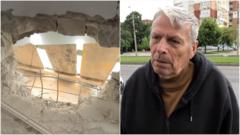
When a stray military drone slammed into a residential apartment building in a quiet Romanian town, it did more than shatter concrete and blow out windows. It tore through the fragile psychological curtain separating peace from conflict. It proved that modern warfare does not care about treaty lines, riverbanks, or the sovereign airspace of NATO nations.
The Architecture of Panic
Consider a typical apartment block. It is a structure built for predictability. Families buy these spaces to lock out the world, to establish a predictable routine of dinners, bedtime stories, and morning coffee. The walls are supposed to be barriers.
When the drone struck, those barriers vanished in a flash of heat and a cascade of plaster.
Imagine waking up not to an alarm, but to the sensation of your ceiling becoming dust. A woman—let us call her Elena, representing the half-dozen residents who spoke to local reporters with trembling hands—described the immediate aftermath not as a roar, but as a terrifying silence. The blast waves from these delta-wing kamikaze drones strip the air from a room. For a few seconds, you cannot breathe. You cannot scream. You simply sit in the dark, breathing in pulverized mortar, wondering if the rest of the building is about to collapse beneath you.
Outside, the Danube continued to flow, dark and indifferent. But inside the block, the geography of the entire neighborhood had changed permanently.
The physical damage was cleared within days. Workers swept up the glass. Engineers inspected the structural pillars. Tarps were nailed over the blackened gap where a living room used to be. But the psychological masonry of the town remains fractured. How do you go back to sleep in a bed when you know the sky above you is a highway for loitering munitions?
The Illusion of Distance
We live with a comforting delusion about modern conflict. We look at maps colored in neat geopolitical shades—this country is blue, that country is red, this country is neutral—and we assume the colors mean something to a machine programmed by coordinates.
They do not.
A drone is not a pilot; it has no eyes to see the Romanian flag fluttering from a government building. It is a collection of circuit boards, fuel tanks, and high explosives guided by satellite signals that can be jammed, spoofed, or simply miscalculated by a fraction of a degree. When a drone loses its way, a peaceful NATO member state becomes a crash site in a matter of seconds.
The residents of these border communities are experiencing a specific, modern form of trauma: the secondary shockwave. They are not the targets, yet they are casualties of proximity.
[ Ukrainian Border / Danube River ]
       │
       ▼ (Drone Path Deviation)
[ Romanian Airspace ] ──► [ Civilian Apartment Block ]
This spillover is the real danger of prolonged regional attrition. It shifts the stakes from political rhetoric to visceral reality. When local authorities issue air defense alerts on citizens' mobile phones at three in the morning, the messages do not feel like routine bureaucracy. They feel like a lottery where the prize is survival. The screech of an emergency alert on a smartphone has replaced the air-raid sirens of the past, a digital intrusion of terror into the palms of our hands.
The Bureaucracy of Fear
In the days following the strike, officials did what officials always do. They issued statements. They condemned the violation of airspace. They promised increased radar surveillance and deployed anti-drone systems to the border banks.
But state-level assurances feel incredibly small when you are standing in a courtyard looking at a crater.
The disconnect between geopolitical strategy and human survival is vast. A politician looks at a radar screen and sees a trackable anomaly that was successfully logged and analyzed. A father looks at the same event and sees the exact trajectory that almost took his daughter’s life. The state talks about protocols; the citizen thinks about pillows stained with plaster dust.
The true cost of these border incidents is not measured in the price of real estate or the budget for military radar. It is measured in the quiet transformations of daily life.
- It is the decision to sleep in the hallway because it has two layers of walls between the bed and the window.
- It is the sudden, uncontrollable flinch when a motorbike accelerates down a dark street.
- It is the conversations at dinner tables where people no longer talk about the future, but rather about the proximity of the nearest basement.
The local population is adapting, but adaptation is its own kind of tragedy. When a community becomes accustomed to the vocabulary of missile defense, it loses a piece of its innocence. The town becomes a militarized zone in spirit, even if the cafes are still open and the grocery stores are still stocked.
The Weight of the Next Shadow
The rubble has been carted away now. The news cameras have packed up their tripods and moved on to the next flashpoint, the next press conference, the next crisis.
But the people in the block remain.
As night falls over the Danube, the river turns from a blue ribbon of commerce into a wide, black void. The lights on the opposite bank are sparse, masked by the blackouts of a nation fighting for its existence. On the Romanian side, the streetlights flicker on, casting long shadows across the repaired facade of the apartment building.
Residents look out their windows, not at the view, but at the sky. They listen to the wind. They listen to the distant hum of the world moving on, hoping against hope that the next sound they hear is just a truck on the highway, and not the mechanical buzz of a machine that has lost its way in the dark.