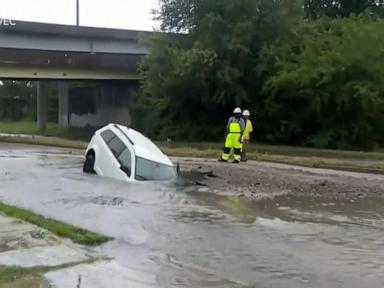
You've probably seen the headline or caught a snippet of the body camera footage online. A car sits half-swallowed in a muddy, rushing pool of water right off a busy highway ramp. A police officer climbs directly into the pit. Strangers form a human chain, gripping the officer's heavy duty belt so he doesn't slide into the abyss.
It looks like a movie scene. But this happened on a Tuesday afternoon at the base of the Interstate 264 West exit ramp onto East City Hall Avenue in downtown Norfolk, Virginia.
When a massive water main break ruptured beneath the pavement, it didn't just cause a traffic mess. It opened up a fast-moving, seven-foot-deep chasm that instantly trapped a woman inside her sinking vehicle. While the internet treats events like this as standard viral fodder, the actual physics of a water-filled sinkhole and the fast instincts of the people on the scene tell a much bigger story about infrastructure vulnerabilities and split-second survival.
The Invisible Threat Behind the Norfolk Sinkhole Rescue
Most people assume sinkholes only happen in Florida or areas sitting on top of massive limestone caves. That's a misconception. In urban areas, the primary driver of catastrophic road collapses isn't geology. It's aging utility infrastructure.
Around 3:30 p.m., a critical water main snapped beneath the intersection of Saint Paul's Boulevard and East City Hall Avenue. When a high-pressure water pipe bursts underground, it acts like a pressure washer against the surrounding soil. The water rapidly erodes the dirt and sand supporting the asphalt from beneath.
To a driver, the road looks completely solid. In reality, it's a hollow crust. The moment the weight of an SUV or sedan hits that weakened asphalt, the ground gives way entirely.
When the victim's car plunged into the opening, the vehicle quickly became trapped as water rushed around the driver's side. The driver couldn't open her door because of the intense external water pressure and the restrictive walls of the newly formed trench. She was stuck in a rapidly filling cage.
How Bystanders and Police Defied Protocol to Save a Life
Standard emergency protocol for a vehicle trapped in a trench usually involves waiting for heavy rescue teams, blocking off a wide perimeter, and stabilizing the ground. Soil around a fresh sinkhole is incredibly unstable. The edges can cave in at any second, dragging down anyone standing nearby.
Norfolk Police Officer A.J. Stevenson arrived first and chose to bypass the textbook response. Water was rushing like a river around the vehicle. The driver was screaming inside.
Stevenson climbed straight down into the seven-foot deep pit. He reached the driver's side door, managed to pry it open against the current, and unbuckled the panicked driver.
What happened next is what standard news reports completely glossed over. This wasn't a solo act of bravery. A group of commuters and passersby stopped their cars. Instead of pulling out their phones to film the disaster for social media, they ran to the edge of the collapsing asphalt.
A citizen named Brennan Feldman was driving past when he heard the screams. He parked, sprinted over, and realized Officer Stevenson needed an anchor. Feldman and a few other strangers grabbed the officer's belt with everything they had, leaning back to counteract the pulling force of the rushing water and mud. They formed a literal lifeline, holding the officer steady while he lifted the woman out of the vehicle and hauled her up to dry land.
Norfolk Fire-Rescue personnel assessed the woman immediately at the scene. Miraculously, she walked away without needing a hospital stay.
What to Do If Your Car Traps You in Rushing Water
The Norfolk incident highlights a nightmare scenario that can happen to anyone during heavy storms or sudden utility failures. If you ever find your vehicle sinking into a flooded road or a sudden trench collapse, your window to act is tiny.
- Do not try to open the door immediately: If the water level is above the bottom of your door, hydrostatic pressure makes it nearly impossible to push open anyway. Trying forces you to waste critical energy.
- Roll down the window fast: This is your primary escape hatch. Do it the second you realize you are stuck. Electric windows usually work for a few minutes even after a car is submerged.
- Unhook your belt first, then kids: If you have passengers, unbuckle yourself first, then assist them.
- Go out through the window: If the window won't roll down, you need a center punch tool or a heavy metal object to shatter the tempered side glass. Never try to break the windshield. It's laminated and reinforced to withstand heavy impacts.
Public works crews spent days pumping out the remaining water and clearing debris from the East City Hall Avenue site before they could even begin patching the pipe and rebuilding the road bed. It's a stark reminder that the roads we drive on every day depend entirely on the invisible, aging systems buried right beneath our tires.
The dramatic rescue captured on the body camera footage is a clear reminder of how fast a normal commute can turn sideways. You can watch the full play-by-play of the intense moments on the ground in this Norfolk Police Department body cam video, which shows exactly how close the situation came to turning tragic before the community stepped in.