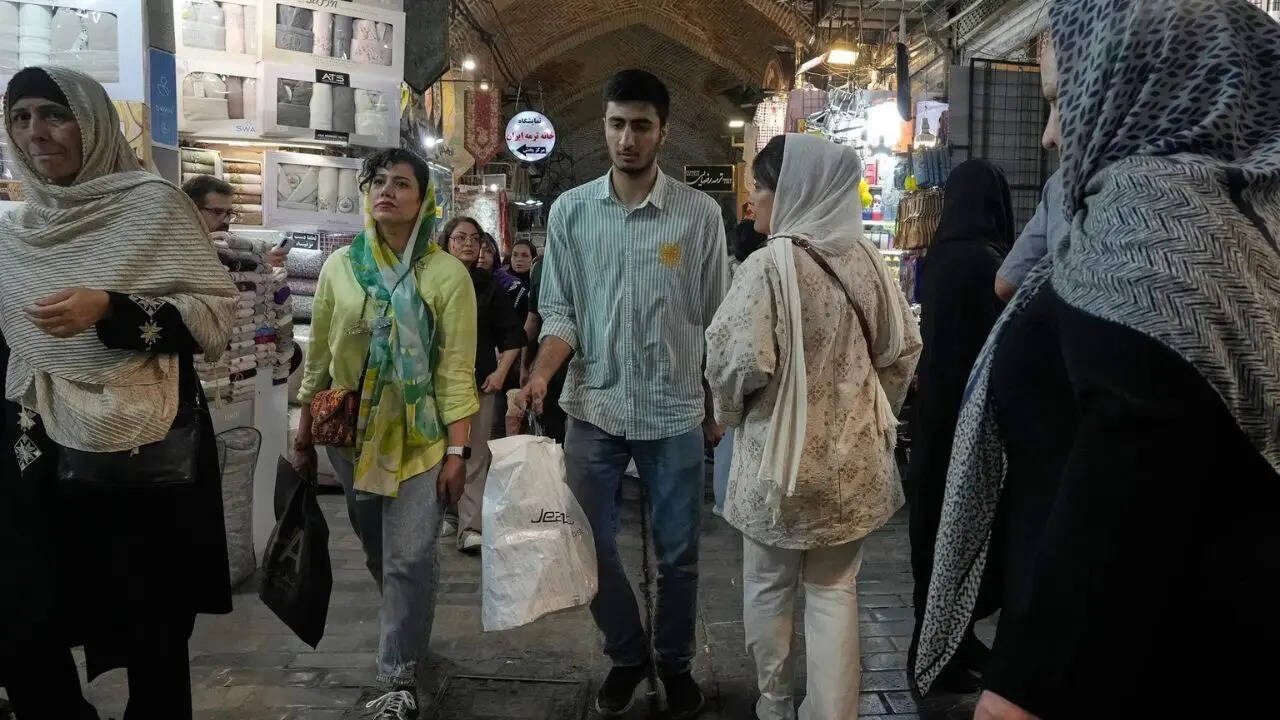
The plastic bags stacked behind the counter of a Tehran bakery do not just hold flatbread. They hold time.
If you stand near the ovens on a Tuesday morning, you will watch an exchange that looks less like commerce and more like a high-stakes poker game. A customer hands over a debit card. The baker swipes it. There is a pause—a fraction of a second where the machine communicates with a central bank—and in that silence, a quiet anxiety fills the room.
The number on the digital screen is staggering. It is a number that would have bought a small apartment a generation ago. Today, it buys lunch.
Iran is currently experiencing an economic phenomenon that transcends standard financial reporting. To read the international financial press is to encounter cold, detached metrics: inflation rates pushing past historic thresholds, currency devaluations, and macroeconomic instability. The numbers are technically accurate. Economists note that current inflationary pressures have pushed the cost of living to heights not seen since the chaotic aftermath of World War II, a time when Allied troops occupied the country and the domestic supply chain completely collapsed.
But a percentage point cannot feel fear. A statistic does not have to look its child in the eye and explain why meat has vanished from the dinner table.
To understand what is happening inside the Islamic Republic, we have to look past the charts. We have to look at the soup.
The Chemistry of Hyperinflation
Consider a hypothetical citizen named Soraya. She is fifty-two years old, a retired schoolteacher in Esfahan, living on a fixed pension. She is not a political activist. She is a mathematician by training, which makes her current daily life a specialized form of torture.
Every morning, Soraya engages in a frantic race against the clock. Money in a bank account is ice in the summer sun. It melts. If she leaves her monthly pension in local rials for more than forty-eight hours, its purchasing power evaporates.
Therefore, economic survival requires turning paper into property instantly. The moment her pension hits, she buys whatever she can find. Cooking oil. Detergent. Saffron. Gold coins if she can scrape together enough, but usually just canned goods. Her spare bedroom no longer looks like a guest room. It resembles a grocery warehouse. She is leveraging her survival against the certainty that by next month, a can of tomato paste will cost thirty percent more than it does today.
This is the psychological mutation of extreme inflation. It distorts human behavior. In a healthy economy, trust is the invisible lubricant. You trust that a dollar, a euro, or a rial earned today will possess a similar value when you spend it next week. When that trust shatters, society reverts to a state of hyper-vigilance.
Money ceases to be a tool of exchange and becomes a hot potato. You must pass it to someone else before it burns your hand.
The root of this crisis is a toxic cocktail of systemic fiscal mismanagement and suffocating international sanctions. For decades, the central government relied on oil revenues to mask structural inefficiencies. When sanctions choked off the oil pipeline, the state did what desperate governments always do. They turned on the printing presses.
Imagine a swimming pool where the water level is dropping rapidly. Instead of fixing the leak, the owner runs a garden hose from the neighbor’s supply, pumping in water that is heavily diluted with mud. The pool fills up, but the water becomes unswimmingly toxic. That mud is unbacked currency. The more the government prints to pay its bills, the less each individual unit is worth.
The scale of this devaluation is difficult to grasp without historical context. During the Allied occupation in the 1940s, the crisis was driven by physical scarcity; there was simply no grain because foreign armies were consuming it. Today, the shops are full of food. The shelves are bursting with yogurt, lamb, pomegranates, and rice.
The tragedy is not that the food does not exist. The tragedy is that people can only afford to look at it through the window.
The Disappearing Middle
The true casualty of this economic erosion is the middle class. A society needs a middle class the way a skyscraper needs a foundational frame. It provides stability, continuity, and a buffer between the ultra-wealthy elite and the desperately poor.
In Iran, that buffer is being pulverized.
Engineers, doctors, professors, and software developers are watching their lifetime savings transform into pocket change. A university professor's monthly salary, when converted to hard currency, now matches what a teenager might earn working part-time at a fast-food joint in Western Europe. To survive, professionals are taking second and third jobs. Surgeons are driving rideshare cars at night. Scientists are selling imported cosmetics on the side.
This creates a profound sense of cognitive dissonance. These are individuals who followed every rule society laid out for them. They studied hard, earned degrees, secured stable employment, and contributed to their communities. Yet, they find themselves trapped in a economic quicksand where the harder they struggle, the faster they sink.
Let us look at the housing market in Tehran to see this destruction in real-time.
+---------------------------------------------------------+
|             THE ESCALATING REAL ESTATE GAP              |
+---------------------------------------------------------+
| [Average Annual Income]                                 |
| ▓▓▓▓▓▓▓▓▓▓▓▓                                            |
|                                                         |
| [Average Price of a Two-Bedroom Apartment]              |
| ▓▓▓▓▓▓▓▓▓▓▓▓▓▓▓▓▓▓▓▓▓▓▓▓▓▓▓▓▓▓▓▓▓▓▓▓▓▓▓▓▓▓▓▓▓▓▓▓▓▓▓▓▓▓  |
+---------------------------------------------------------+
The gap has grown so wide that renting an apartment in a respectable neighborhood now requires multi-generational pooling of resources. Young couples cannot marry because they cannot afford the rahn—the massive interest-free deposit required by Iranian landlords to secure a lease. Instead, they remain in their childhood bedrooms, their lives paused indefinitely, waiting for a stabilization that never arrives.
This reality breeds a specific, quiet despair. It is not the explosive anger of a sudden street protest, though that anger exists just beneath the surface. It is the heavy, exhausting grief of watching your future get smaller every single day.
The Black Market Oasis
When official systems fail, parallel systems inevitably emerge to take their place. In Iran, the real economy does not live in the grand stone buildings of the central banks. It lives on Ferdinand Street in Tehran, among the informal currency traders.
These men stand on street corners, shouting numbers into mobile phones. They are the human tickers of the black market exchange rate, known colloquially as the Bonbast. They track the real-world value of the rial against the US dollar, a rate that fluctuates not by the month or the week, but by the minute.
If a political leader speaks defiantly on television, the rate spikes. If a negotiation in Geneva stalls, the rate spikes. If a drone flies over the Persian Gulf, the rate spikes.
Every citizen, from the taxi driver to the grandmother, tracks these numbers on illicit Telegram channels with the intensity of a day trader on Wall Street. It is a exhausting way to live. Your material well-being, your ability to afford medical treatment, your capacity to send your child to university—all of it is pegged to a volatile digital ledger controlled by shadow brokers.
The government has attempted to criminalize these traders repeatedly. They have executed prominent gold dealers, raided exchange shops, and enforced artificial pricing controls. But these measures are akin to trying to stop a fever by breaking the thermometer. The fever remains because the infection is deep within the body politic.
The reliance on informal networks has also fundamentally altered how business is conducted. Barter systems are returning. A dentist might repair a mechanic’s teeth in exchange for a transmission overhaul. A landlord might accept rent in the form of imported electronic appliances rather than local currency. Trust is no longer placed in the state's legal tender; it is placed only in tangible assets that possess intrinsic, universal value.
The Generational Fracture
The long-term consequence of this crisis is not merely financial; it is demographic. The country is experiencing a massive, unprecedented brain drain.
The youth of Iran are highly educated, deeply plugged into the global digital culture, and profoundly ambitious. Yet they look around and see a landscape that offers no path forward. The economic crisis has effectively severed the contract between generations. The older generation could promise that hard work would lead to a stable life. The current generation knows that promise is a fiction.
Consequently, anyone who can leave, leaves.
It is a migration of intellect. Nurses, computer scientists, mathematicians, and artists are packing their lives into suitcases and departing for North America, Europe, and the Gulf States. Those left behind are often the elderly, the unskilled, or those without the financial means to buy an exit visa.
This leaves the nation’s infrastructure teetering. Hospitals are facing acute shortages of specialized doctors. Tech startups are collapsing because their core engineering teams have emigrated en masse to Berlin or Dubai. The collective knowledge base of the country is draining away, a silent hemorrhage that will take decades to reverse, regardless of when or how the economic policy changes.
Consider what happens next when a nation loses its brightest minds. The institutions that require high-level expertise begin to decay from within. Power grids fail more frequently. Water management systems break down. Educational standards plummet. The economic crisis mutates into an operational crisis, touching every element of basic human survival.
The View from the Kitchen
It is easy to get lost in the macro-narratives of geopolitics, nuclear deals, and international sanctions. It is easy to view Iran merely as a chess piece on a global board. But the chess piece is made of ninety million people.
The true weight of history is not felt in parliament buildings. It is felt in the kitchen.
It is felt when a father cuts a piece of meat into smaller and smaller portions so his children can believe they are still eating a full meal. It is felt when a mother hides her dental pain because she knows the cost of a root canal would wipe out the family's grocery budget for two months. It is felt in the quiet, dignified shame of an elderly man who must ask his adult children for financial help just to buy his blood pressure medication.
This is the invisible crisis. It does not always announce itself with smoke and sirens. It announces itself with a sigh at the supermarket checkout counter. It is the slow, grinding erosion of human dignity by an economic machine that has lost its connection to reality.
Back in the Tehran bakery, the oven continues to roar. The scent of burning wood and toasted flour fills the air, a timeless smell that has comforted people in this region for millennia. The baker hands a warm, golden sheet of bread to an old woman. She takes it, presses it to her chest to feel the warmth, and walks out into the crowded street.
She does not look at her receipt. She already knows what it cost her.