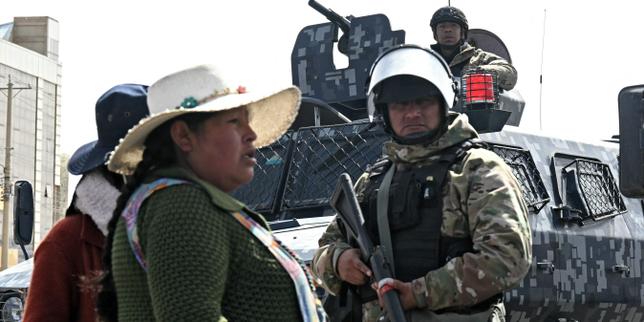
Bolivia has entered a dangerous new phase of governance where military force dictates domestic stability. The decree of a state of exception and the subsequent mobilization of joint military and police forces have successfully cleared the highway blockades that choked the nation's economy for six grueling weeks. However, the clearance of asphalt does not equate to the resolution of a crisis. By deploying the army to break the logistical stranglehold maintained by loyalists of former President Evo Morales, the current administration has traded an immediate economic bottleneck for a volatile, long-term political gamble. The roadblocks are gone for now, but the structural rot that caused them remains entirely untouched.
To understand how Bolivia reached this breaking point, one must look past the immediate theater of riot gear and burning tires. This was never a simple dispute over food prices or fuel shortages, though those pressures acted as the accelerant. At its core, the six-week paralysis was the explosive culmination of a civil war within the ruling Movimiento al Socialismo (MAS) party. It is a bitter personal and ideological feud between current President Luis Arce and his former mentor, Evo Morales.
The blockades were a calculated deployment of geopolitical leverage. Morales supporters strategically targeted the "central axis" of Bolivia—specifically the Cochabamba tropics—effectively severing the economic transport links between the eastern lowlands of Santa Cruz and the western administrative capital of La Paz. By cutting these arteries, the protestors simulated an economic heart attack.
The Anatomy of an Economic Siege
The mechanics of a Bolivian blockade are sophisticated. This is not a disorganized gathering of disgruntled citizens standing in the road. It is a highly disciplined, agrarian-led logistical operation capable of sustained resistance.
Protestors utilize topography to their advantage, choosing narrow mountain passes or critical bridges where a few tons of dumped gravel and dynamite can halt thousands of vehicles. For six weeks, these tactics yielded devastating results:
- Perishable Ruin: Millions of dollars in agricultural exports from Santa Cruz rotted in the tropical heat, unable to reach international markets or domestic consumers.
- Fuel Starvation: Tanker trucks carrying imported diesel and gasoline were stranded on the highways, worsening an already severe national foreign currency shortage.
- Inflationary Spike: Basic food staples like chicken, rice, and cooking oil saw their prices triple in La Paz markets as supply chains evaporated.
The Arce administration initially hesitated, fully aware of the historical precedent in Bolivia. In this country, excessive state violence against indigenous protestors routinely topples governments. For over a month, the state relied on sporadic, low-intensity police actions that failed to clear the routes.
As the economic losses mounted past the billion-dollar mark and shortages threatened urban centers with actual starvation, the political calculus shifted. The government felt it had no choice but to escalate to a state of exception, bringing in the one institution capable of matching the protestors' logistical footprint: the armed forces.
When the Military Becomes the Police
Deploying the military to resolve domestic civil unrest is a move fraught with historical trauma in Latin America. The state of exception suspends specific constitutional guarantees, giving security forces expanded powers of arrest and detention without the standard judicial oversight.
When the joint forces finally moved on the strategic choke points, they did so with overwhelming numbers and heavy equipment. Bulldozers cleared the debris while armored vehicles pushed through tear gas and sporadic dynamite blasts from the hillsides. The operation was fast, calculated, and violent.
But clearing a road with an army is not the same as securing it. A highway stretching across hundreds of miles of mountainous terrain cannot be policed indefinitely by soldiers standing every fifty yards. It requires an unsustainable expenditure of state resources.
The immediate tactical victory belongs to the government. Trucks are moving again, and fuel is trickling back into the gas stations. Yet, the strategic vulnerability remains acute. The underlying grievances—ranging from the disqualification of Morales from the upcoming presidential election to the desperate scarcity of US dollars within the Bolivian banking system—have not been addressed.
The Core Illusion of Executive Force
The primary flaw in the government’s current strategy is the belief that stability can be mandated by executive decree. This approach mistakes compliance for resolution.
The blockades were cleared because the protestors chose to retreat and reassess, avoiding a prolonged slaughter that would alienate the broader public. They have not surrendered their objectives. The leadership structures of the cocalero unions and agrarian syndicates remain intact, their communication networks operational, and their anger magnified by the state's use of force.
Furthermore, the economic crisis that triggered the initial unrest is accelerating. Bolivia's foreign exchange reserves are nearly depleted. Decades of declining natural gas production—the country’s primary economic engine—have left a massive deficit in state revenues. The government can no longer afford to heavily subsidize fuel imports, leading to the very shortages that made the population so volatile in the first place.
Breaking the blockades does not magically replenish the central bank's vaults. If anything, the cost of the military operation and the six weeks of lost productivity have pushed the financial system closer to the edge.
The Looming Electoral Collision
The immediate horizon offers no relief. The political calendar is marching toward a presidential election that promises to be the most contentious in the country's modern history.
Morales, despite facing multiple legal challenges and an explicit constitutional ban on re-election orchestrated by the executive and judicial branches, still retains a fierce, fiercely loyal base of support among the rural poor and indigenous communities. To his followers, the legal maneuvers against him are not legitimate judicial processes; they are a political assassination attempt disguised as law.
[Morales Loyalists / Rural Base] <---> [The Choke Points (Cochabamba)] <---> [Economic Paralysis]
                                                                                  |
[Arce Administration / Military] <---> [State of Exception Decrees]   <---> [Tactical Clearance]
The use of the military to clear the roads has set a dangerous precedent for the upcoming electoral cycle. Having successfully used the state of exception to resolve an economic crisis, the administration will face immense temptation to use the same mechanism to suppress political opposition when the campaign intensifies. This turns the upcoming election from a democratic contest into an existential battle for survival for both factions of the left.
The Dangerous Path of Governing by Decree
Bolivia's history shows that when a government begins to rely on the military to maintain daily order, civilian institutions begin to wither. The judiciary has already been heavily politicized, used as a weapon by both sides to disqualify rivals and protect allies. Now, the executive branch has demonstrated that its ultimate argument is no longer debate or compromise, but the deployment of mechanized infantry.
This leaves the country in a fragile equilibrium. The roads are open, but the traffic moves through a landscape fractured by deep ideological and economic rifts. Investors are fleeing, the currency is losing value on the black market daily, and the population is exhausted.
The state of exception is a temporary dam holding back a reservoir of systemic discontent. It has bought the government time, but time is a useless commodity if it is not used to fix the underlying structural failures. If the currency continues to collapse and the political isolation of a massive segment of the population persists, the gravel will return to the highways. Next time, the army might not be enough to move it.