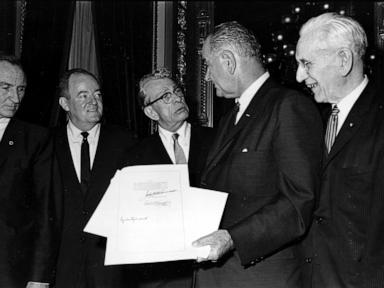
The foundational architecture of American democracy has been systematically dismantled over the last decade, not through a single dramatic event, but through a series of surgical judicial strikes. The Voting Rights Act (VRA) of 1965, once the most effective piece of civil rights legislation in the nation's history, has been reduced to a shadow of its former self. By stripping away the enforcement mechanisms that once prevented discriminatory laws before they could be enacted, the Supreme Court has fundamentally shifted the burden of proof from the state to the citizen. This transition marks the end of an era where the federal government acted as a proactive guardian of the ballot box.
The current legal environment is the result of a long-term ideological project. For nearly fifty years, the VRA functioned as a "super-statute," providing the Department of Justice with the power to freeze changes to voting procedures in jurisdictions with a history of discrimination. Today, that preemptive power is gone. The impact is not just theoretical; it is visible in the rapid proliferation of restrictive voting laws across dozens of states. To understand how we got here, one must look past the headlines and examine the specific legal levers the Court pulled to unspool sixty years of progress.
The Shelby County Fracture
The collapse began in earnest in 2013 with Shelby County v. Holder. This case targeted Section 5 of the VRA, the "preclearance" provision. Preclearance required specific states and counties—mostly in the South—to prove to the federal government that any proposed change to voting laws would not have a discriminatory effect. It was an extraordinary tool because it stopped suppression before it happened.
The Court’s majority argued that the "coverage formula" used to determine which areas needed oversight was based on data from the 1960s and was therefore unconstitutional. They claimed the country had changed. While the legal logic focused on the principle of "equal sovereignty" among states, the practical result was an immediate green light for local legislatures. Within hours of the Shelby decision, several states moved to implement strict voter ID laws and purge voter rolls—actions that had previously been blocked or delayed by federal oversight.
This was the first major blow. It removed the smoke detector, leaving the public to wait until the fire was already raging before they could call for help.
Section 2 and the Brnovich Narrowing
Once Section 5 was neutralized, voting rights advocates turned to Section 2 as their primary remaining weapon. Section 2 is a nationwide ban on voting practices that result in a denial or abridgment of the right to vote on account of race. For years, it was understood as a broad protection against any policy that made it harder for minorities to participate in the political process.
The 2021 decision in Brnovich v. Democratic National Committee changed that. The Court introduced a set of "guideposts" that significantly raised the bar for proving a violation. The majority suggested that if a voting burden was "typical" of the era when the VRA was passed, it might not be considered a violation today. They also emphasized "voter convenience," arguing that if most people can navigate a hurdle, the fact that it hits minority communities harder might not be enough to strike it down.
This narrowed the definition of discrimination. It shifted the focus away from the disparate impact on specific communities and toward a generalized standard of what is "reasonable" for a hypothetical average voter. By doing so, the Court made it nearly impossible to challenge laws that target the specific ways minority voters interact with the system, such as Sunday "souls to the polls" events or the distribution of water to voters in long lines.
The Myth of Race Neutrality
A recurring theme in recent rulings is the concept of colorblindness. The Court increasingly operates on the assumption that unless a law explicitly mentions race or can be proven to have been written with "discriminatory intent," it should be treated as race-neutral. This ignores the reality of how modern suppression works.
Modern barriers are rarely as overt as literacy tests. Instead, they take the form of precinct closures in specific zip codes, the elimination of ballot drop boxes in urban centers, and the tightening of registration deadlines. To a judge looking only at the text of the law, these changes appear neutral. To a community organizer on the ground, they are targeted strikes.
The Court’s insistence on "intent" rather than "impact" creates a massive loophole. Legislators are savvy; they no longer leave a paper trail of racial animus. They frame their policies as measures to ensure "election integrity" or "voter confidence," even when no evidence of widespread fraud exists. By accepting these justifications at face value, the judiciary has effectively retreated from its role as an arbiter of civil rights.
The Redistricting Battlefield
The struggle has now moved into the realm of map-making. Every ten years, states redraw their congressional and legislative districts. Under a weakened VRA, this process has become a masterclass in "dilution."
There are two primary methods used to neutralize minority voting power: packing and cracking. Packing involves cramming as many minority voters as possible into a single district, ensuring they win that seat but lose influence everywhere else. Cracking involves splitting a minority community across several districts so they never form a large enough block to elect their preferred candidate.
In cases like Alexander v. South Carolina State Conference of the NAACP, the Court has made it harder to challenge these maps. The majority ruled that if a state claims it was gerrymandering for "partisan" reasons rather than "racial" ones, federal courts generally cannot intervene. Since race and party affiliation are often highly correlated in the United States, this provides a perfect legal shield. A legislature can target Black voters under the guise of targeting Democrats, and the law, as currently interpreted, will often allow it.
The Burden of Litigation
Without preclearance, the only way to stop a discriminatory law is through a lawsuit. This is a slow, expensive, and often futile process.
Consider the timeline of a typical voting rights case. A state passes a restrictive law in January. Advocates file a lawsuit in February. The legal discovery process, hearings, and appeals take years. By the time a court finally rules that the law is discriminatory, several election cycles may have already passed. The winners of those elections, put into power by the contested rules, are then the ones responsible for drawing the next set of maps or appointing the next round of election officials.
This creates a "fait accompli" in politics. Even if you eventually win the legal battle, you have already lost the political war. The damage to the electorate is done, and it cannot be easily reversed. The sheer cost of this litigation also means that many smaller, local instances of suppression go entirely unchallenged. There aren't enough civil rights lawyers in the country to fight every precinct closure in every county.
The Federalism Trap
The Court’s current trajectory is rooted in a specific interpretation of federalism—the idea that states should have primary control over their own elections. This was a central argument in the 19th century and was used to justify the Jim Crow era. The VRA was designed specifically to break that cycle by asserting federal supremacy in matters of basic constitutional rights.
By pivoting back toward state sovereignty, the Court is returning to a pre-1965 philosophy. They argue that the "extraordinary" conditions that justified federal intervention in the 1960s no longer exist. However, this logic is circular. It is like saying you can throw away your umbrella because you are no longer getting wet. The "dryness" was caused by the umbrella itself.
The removal of federal guardrails has not led to a new era of state-led innovation in voting access. Instead, it has led to a race to the bottom in states where political power is most contested. When the referees leave the field, the players don't start playing fairer; they start fouling more aggressively.
The Human Cost of Complexity
Beyond the high-level legal arguments, there is a tangible impact on the individual voter. The constant churning of election laws creates a climate of confusion. When rules about registration, mail-in ballots, and ID requirements change every two years, many people simply stop trying.
This confusion is a feature, not a bug. It acts as a soft form of disenfranchisement. It doesn't require a police officer at the door; it only requires a complicated form and a fear of making a mistake that could lead to legal trouble. For marginalized communities, who often have less time to navigate bureaucratic hurdles and a historical distrust of state systems, this complexity is an effective barrier.
The Path to Reconstruction
If the Supreme Court will not protect the right to vote, the responsibility falls back to Congress. There have been multiple attempts to pass the John Lewis Voting Rights Advancement Act, which would restore a modern version of the preclearance formula.
Such legislation would target jurisdictions not based on 1960s data, but on contemporary violations. It would create a new "transparency" requirement, forcing states to publicize changes to voting rules well in advance of elections. However, in a polarized legislative environment, the prospects for such a bill remain dim.
The alternative is a state-by-state battle to pass "State Voting Rights Acts." Some states, like New York and Virginia, have already done this, creating their own preclearance systems at the state level. But this creates a patchwork democracy where your rights depend entirely on your zip code.
The Institutional Shift
We are witnessing a fundamental change in how the American judiciary views its role. For decades, the Court was seen as the "last resort" for those whose rights were being trampled by the majority. Today, the Court increasingly sees itself as a protector of the "political process" as defined by the legislatures currently in power.
This shift has profound implications for the stability of the country. When people believe the electoral system is rigged or that their participation is being intentionally stifled, they lose faith in the peaceful transfer of power. The VRA was not just a moral triumph; it was a pragmatic tool for national stability. It provided a legal outlet for grievances that might otherwise turn into civil unrest.
The erosion of the VRA is not an abstract legal debate. It is the dismantling of a peace treaty. By removing the legal mechanisms that ensured everyone had a seat at the table, the Court has reopened old wounds and invited new conflicts.
The era of the "landmark law" is over. We have entered an era of "trench warfare," where every election is preceded by a barrage of lawsuits and every victory at the polls is subject to a challenge in the courts. This is the new normal of American democracy. It is a system where the rules are written by the winners to ensure they never become the losers. The only way out is a massive, sustained mobilization that demands the restoration of federal protections, but that requires a level of political will that is currently nowhere to be found in Washington.
The law no longer protects the voter; the voter must now protect the law.



