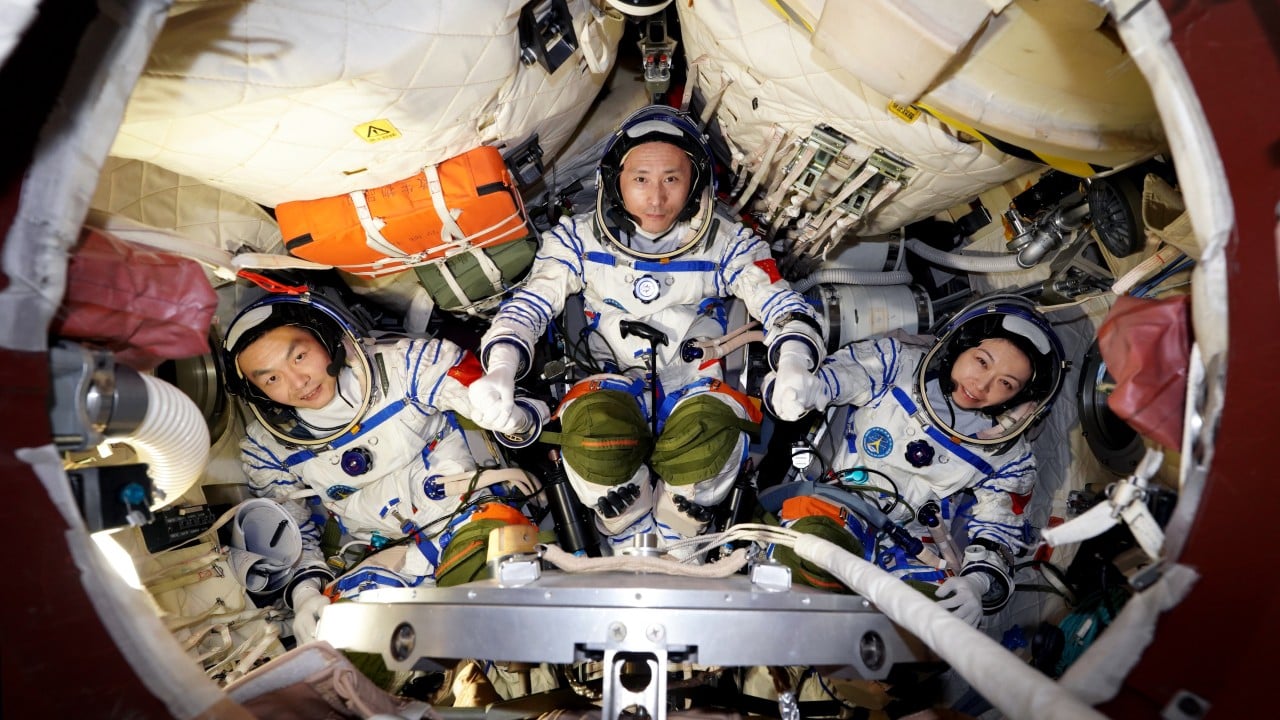
When the Long March 2F carrier rocket cleared the launchpad at the Jiuquan Satellite Launch Center, it carried more than just three passengers toward the Tiangong space station. It carried an entirely reconstructed political and scientific narrative for a city that has spent years in administrative transition.
Dr. Lai Ka-ying, a 43-year-old mother of three and a Superintendent within the Hong Kong Police Force, made history as the first orbital traveler from the Special Administrative Region. Media broadcasts framed her presence on the Shenzhou-23 mission as an unmitigated validation of local scientific talent, proof that the financial hub can transform from a mere financial supporter into an active executor of national engineering goals. But the standard media narrative glosses over the institutional mechanisms that actually drove her selection. Behind the celebratory headlines lies a deliberate structural shift in how Beijing utilizes high-stakes technological programs to bond Hong Kong to the mainland. For a deeper dive into similar topics, we suggest: this related article.
Moving Past the Military Monopoly
For decades, China’s crewed spaceflight program operated within tight institutional parameters. The initial cohorts of taikonauts were selected strictly from the ranks of the People's Liberation Army Air Force fighter pilots. They were military men accustomed to rigid top-down command structures and physical endurance training built around high-G maneuvers.
The construction and stabilization of the Tiangong space station altered those requirements. Once an orbital outpost becomes operational, the demand for stick-and-rudder pilots diminishes, while the need for scientists who can operate highly complex laboratory equipment increases. China’s fourth batch of astronaut candidates intentionally opened the door to civilian payload specialists, explicitly reserving slots for candidates from Hong Kong and Macao. For further context on this topic, extensive reporting can also be found at ZDNet.
Lai’s background presents an anomaly that complicates the clean division between "civilian scientist" and "state operative." She is not an academic plucked from a university physics lab. She holds a doctorate in computer science and information systems from the University of Hong Kong, specializing in digital forensics and cryptography. Her doctoral research focused on tracing illegal file distribution networks. Following her academic track, she climbed the ranks of the Hong Kong Police Force's information technology division to become a superintendent.
This specific combination of skills—advanced technical proficiency mixed with verified loyalty to the administrative state apparatus—made her the ideal candidate for a mission that requires absolute precision and unquestioned reliability.
The Operational Reality in Orbit
In orbit, a payload specialist occupies a distinct niche. While the mission commander, Colonel Zhu Yangzhu, and the pilot, Colonel Zhang Zhiyuan, focus on vehicle dynamics, orbital mechanics, and station maintenance, Lai's responsibilities center entirely on execution of scientific protocols.
Her primary task during her tenure in orbit involves the operation of MUSICO, a lightweight, high-resolution synergistic observatory designed to measure point-source emissions of carbon dioxide and methane. Operating an advanced greenhouse gas monitoring system from low Earth orbit requires more than just flipping switches. It demands an understanding of data streams, software calibration, and real-time troubleshooting in an environment where a single corrupted line of code can ruin an experiment worth millions of dollars.
- Data Integrity: Managing the high-throughput sensor telemetry coming off the MUSICO observatory.
- System Diagnostics: Utilizing digital forensics methodologies to isolate hardware anomalies within the station's research racks.
- Cross-Disciplinary Coordination: Bridging the gap between mainland engineering protocols and the international data frameworks used in environmental science.
This is where the selection of a computer forensics expert reveals its practical utility. Modern space stations are fundamentally complex, distributed computing networks operating under extreme environmental stress. Code execution errors, radiation-induced bit flips, and sensor discrepancies are routine. Having a crew member whose professional career was built on diagnosing software anomalies and maintaining digital chain of custody provides the mission with an added layer of operational security.
The Tech Transfer Pipeline
The official rhetoric coming from the Hong Kong government frames Lai’s mission as an inspiration for local youth to enter science, technology, engineering, and mathematics fields. However, the economic reality for tech talent in Hong Kong has historically been challenging. The city's economy is heavily skewed toward real estate, logistics, and financial services. High-end engineering and aerospace research have long suffered from a lack of local industrial infrastructure.
To remedy this, the local government has quietly established the Innovation and Technology Fund, injecting resources into aerospace-related research projects across local universities. Six distinct projects received targeted funding immediately following the opening of the astronaut selection process. This points to a deeper institutional objective: creating a self-sustaining tech transfer pipeline that feeds intellectual property and trained specialists directly into mainland programs.
This integration is not without friction. Hong Kong's scientific community historically thrived on international collaboration, open data exchanges, and deep ties to Western research institutions. The integration of local laboratories into China’s aerospace sector, which operates under strict security classifications and faces significant international sanctions, complicates these global relationships. Local universities must now choose between maintaining open-ended international partnerships or alignment with lucrative national strategic initiatives.
The Symbolic Weight of the Uniform
It is impossible to separate Lai's orbital achievement from her status within the Hong Kong Police Force. The force has been the primary vehicle for enforcing the administrative and legal transformation of the city over the past several years. By selecting a high-ranking officer from this specific institution to represent Hong Kong on the national stage, the state sends a clear signal regarding the traits it values most: discipline, institutional loyalty, and adherence to legal and systemic frameworks.
[Traditional Selection] -> Military Pilots -> Tactical Focus
[Modern Selection]      -> Tech Bureaucrats -> Systems & Enforcement Focus
This alignment serves a dual internal purpose. To the mainland audience, it demonstrates that Hong Kong’s civil service is fully integrated into the national fabric, capable of producing individuals who can pass the rigorous physical and psychological screening required of the country's elite spacefarers. To the local populace, it reframes an institution associated with domestic security into an engine of scientific progress and pride.
The Long Road to Self Reliance
The Shenzhou-23 mission occurs at a critical juncture in global space politics. With the International Space Station nearing the end of its operational lifespan and geopolitical divisions complicating global space exploration, Beijing is pursuing total self-reliance across its entire technological ecosystem.
Lai’s journey from a digital forensics lab in Hong Kong to the Tiangong space station is a microcosm of this macro strategy. The mission proves that the state can successfully identify, vet, and train specialists outside the traditional military structures to operate advanced orbital assets. The long-term success of this strategy will not be measured by the celebratory banners hung across Hong Kong's streets, but by whether the city can build a real industrial base to support these endeavors when the current mission returns to Earth.
The final metrics will be found in laboratory output, data accuracy, and the structural integration of the city’s universities into the broader aerospace framework. Spaceflight remains an unforgiving domain where symbolic victories are quickly erased by operational failures. For Lai and the administration backing her, the true test is happening right now, high above the atmosphere, measured in streams of environmental data and the precise execution of orbital science.