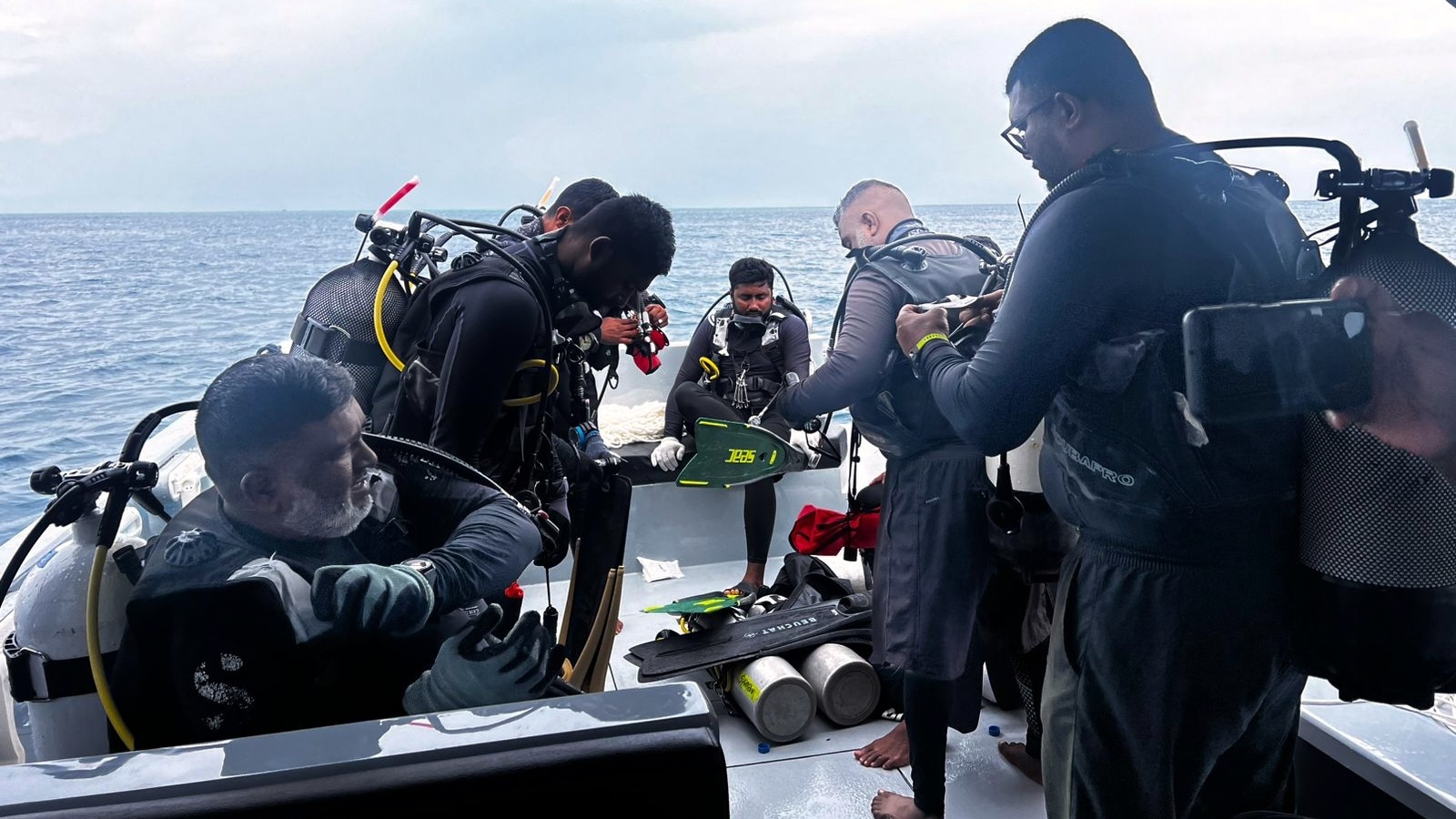
The catastrophic loss of six lives in the dark recesses of the Thinwana Kandu cave system in the Maldives is not a mystery. It is a textbook demonstration of what happens when recreational diving habits collide with the unyielding physics of the deep overhead environment.
Five Italian nationals—including a prominent marine ecologist, her daughter, and their veteran dive guide—perished 160 feet below the surface of the Vaavu Atoll. A sixth victim, a local military rescue diver, died during the subsequent recovery operation. While mainstream reports point vaguely to "bad weather" or "mysterious circumstances," anyone who has spent decades analyzing diving accidents recognizes the classic, grim sequence of events. This was a tragedy born of equipment mismatch, extreme depth, and the fatal deception of a familiar environment.
The Illusion of Safety on a Luxury Liveaboard
The victims were not reckless amateurs. They were highly educated, experienced marine professionals and enthusiasts operating from the MV Duke of York, a luxury liveaboard vessel. Monica Montefalcone, an associate professor of ecology at the University of Genoa, was in the Maldives on an official scientific mission to study coral reefs.
But the fatal excursion to the "shark cave" near Alimathaa Island was undertaken privately. It occurred outside the scope of official university research. This distinction matters because it removed the institutional safety protocols that usually govern scientific diving.
The Maldives National Defence Force received the first distress call in the early afternoon when the group failed to surface. The body of the diving instructor, Gianluca Benedetti, was found floating near the mouth of the cave. The remaining four divers—Montefalcone, her daughter Giorgia Sommacal, researcher Muriel Oddenino, and graduate Federico Gualtieri—were trapped deep inside.
The Lethal Physics of 50 Meters on Recreational Gear
The legal recreational diving limit in the Maldives is 30 meters. The Thinwana Kandu cave system sits at 50 to 60 meters. This difference is not just a regulatory boundary. It is a biological tipping point.
According to investigators and local operators, the group entered this deep overhead environment using standard recreational scuba gear. They were not wearing the redundant twin tanks, sidemount rigs, or independent backup gas systems mandatory for technical cave exploration. They were breathing standard compressed air or a basic Nitrox mix from single cylinders.
At 50 meters, two distinct physiological hazards become immediate, deadly realities.
Central Nervous System Oxygen Toxicity
If the divers were using standard air, the partial pressure of oxygen ($P_{O_2}$) at 50 meters reaches approximately 1.26 atmospheres. If they were using a typical recreational Nitrox blend—often used to extend bottom time at shallower depths—the $P_{O_2}$ would violently spike past the critical threshold of 1.4, entering the zone of Central Nervous System (CNS) oxygen toxicity.
Oxygen toxicity does not give warning signs. It triggers sudden, violent grand mal seizures. Underwater, a seizure causes the diver to spit out their regulator. Drowning is instantaneous.
Nitrogen Narcosis
At 160 feet, breathing ambient air induces severe nitrogen narcosis. The effect is often compared to drinking multiple martinis on an empty stomach. Cognitive function plummets. Spatial awareness vanishes.
A simple task, like reading a pressure gauge or finding a cave exit, becomes an insurmountable intellectual challenge. In a confined space, a narcotized diver cannot process an emergency.
The Siltout and the Chain of Panic
Thinwana Kandu is colloquially known as the "shark cave" because reef sharks use its quiet, dark chambers to rest. The cave structure is divided into three distinct rooms connected by narrow, restrictive passages.
In a pristine underwater cave, visibility can appear infinite until a diver's fin touches the floor. The bottom of these chambers is covered in fine, microscopic sediment accumulated over centuries.
When a recreational diver enters a cave without specialized propulsion techniques like the "frog kick," their downward fin strokes push water directly onto the floor. This triggers an immediate siltout. Within seconds, the water transforms from crystal clear to a zero-visibility abyss resembling chocolate milk.
[Recreational Fin Kick]
       │
       ▼
[Sediment Disturbance] ──► [Zero Visibility Siltout] ──► [Loss of Guideline] ──► [Fatal Panic]
Without a continuous, physical guideline anchored to the open ocean, exiting a silted-out cave is mathematically impossible. You cannot swim toward the light because there is no light. You cannot feel your way out because every surface feels identical.
When one diver panicked or suffered an oxygen toxicity seizure, the commotion would have instantly destroyed the remaining visibility. The others, impaired by deep nitrogen narcosis, would have been unable to find the exit. They sat in absolute darkness, breathing down their single tanks until the air ran out.
The Cost of the Recovery
The tragedy did not stop with the tourist party. The Maldives government deployed local military assets to locate the bodies. Staff Sergeant Mohamed Mahdi, a specialized diver with the Maldives National Defence Force, lost his life during the initial high-risk search operation.
The death of a military professional underscores the extreme hostility of the environment. Cave rescue requires highly specific technical training that even advanced military or open-water commercial divers rarely possess. The local recovery efforts were paralyzed until a specialized team of deep-cave rescue experts arrived from Finland to map the system and extract the remains from the third chamber.
Following the incident, the Maldives Ministry of Tourism and Civil Aviation suspended the operating license of the MV Duke of York pending a full investigation.
The Myth of Experience
The industry routinely covers up a uncomfortable truth: open-water experience does not equal overhead environment expertise. Thousands of logged dives in coral gardens provide zero preparation for the psychological horror of a cave siltout at 50 meters.
By treating a technical, deep cave as a casual excursion on standard recreational equipment, the group bypassed every safety margin established by modern diving science. The ocean does not negotiate with credentials, and at 160 feet inside a subaquatic labyrinth, it offers no second chances.