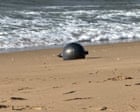
Six metallic spheres, colloquially known as space balls, recently washed ashore on Forrest Beach in northern Queensland, triggering emergency exclusion zones and hazard operations. The Australian Space Agency confirmed these objects are highly likely pressure vessels from a foreign rocket body that underwent an uncontrolled atmospheric re-entry. While local authorities established a 50-meter perimeter and secured the objects in hazmat drums, the incident exposes a systemic crisis in global space governance. The orbital launch industry relies on the statistical probability of the open ocean swallowing its toxic remnants, leaving coastal communities to deal with the physical fallout when those calculations fail.
The Chemistry of an Orbital Incursion
The shiny, unscorched spheres recovered north of Townsville are not typical pieces of twisted fuselage. They are high-performance titanium alloy pressure vessels, engineered specifically to withstand extreme internal pressures while feeding propellant to rocket engines.
The fact that these spheres arrived on the shoreline structurally intact, bearing minimal signs of thermal degradation, offers a stark look at the mechanics of orbital re-entry. During a rocket’s descent, external aluminum skin panels and carbon-composite fairings burn away rapidly at temperatures exceeding 1,500 degrees Celsius. Titanium, however, possesses a melting point near 1,650 degrees Celsius. Combined with a spherical geometry that naturally distributes thermal load, these components frequently survive the furnace of the upper atmosphere entirely unscathed.
The immediate operational panic surrounding the Forrest Beach discovery stems from what resides inside these vessels. Titanium spheres are commonly used to store helium for pressurization or, more critically, highly toxic propellants.
- Hydrazine: A hypergolic fuel that remains liquid at ambient temperatures and is notoriously stable until triggered.
- Nitrogen Tetroxide: A highly corrosive oxidizer used in orbital maneuvering systems.
Even trace amounts of residual hydrazine inside a breached tank pose an acute chemical hazard. It is highly volatile, readily absorbed through the skin, and classified as a severe respiratory carcinogen. When emergency responders deploy in full-body protective suits and drop metallic debris into sealed isolation barrels, they are not acting out of an abundance of bureaucratic caution. They are treating the beach as an active chemical spill site.
The Myth of the Controlled Descent
The international aerospace sector operates under a calculated gamble. The mathematical reality is that roughly 70 percent of the Earth's surface is covered by water, making the oceans the default dumping ground for expended launch vehicle stages.
When a multi-stage rocket lifts off, its lower stages are spent long before reaching stable orbit. In a perfect operational profile, these heavy components are steered toward designated drop zones in the unpopulated expanses of the South Pacific or the Indian Ocean. This is known as a controlled re-entry.
Yet, the influx of space junk on the Australian coastline reveals how frequently the ideal profile breaks down. Over the last several years, the nation’s shorelines have turned into a geographic net for orbital castoffs. A massive cylindrical dome from an Indian Polar Satellite Launch Vehicle (PSLV) embedded itself in the sand of Western Australia. Prior to that, a charred three-meter chunk of a SpaceX Dragon trunk splintered into the earth of New South Wales sheep paddocks.
Uncontrolled re-entries occur when an object is left in a decaying low Earth orbit without sufficient fuel or functional attitude control to dictate its final descent vector. The upper atmosphere acts as a chaotic brake. Variable solar activity expands the thermosphere, creating unpredictable drag forces that can shift an object's projected landing site by thousands of kilometers. Instead of sinking into the deep ocean trench of the micro-targeted "spacecraft graveyard," these objects skip across the upper atmosphere and drop wherever gravity finally wins the tug-of-war.
The International Legal Gridlock
Identifying the country responsible for the Forrest Beach debris involves navigating a dense thicket of geopolitical liability and ambiguous corporate ownership. Under the 1967 United Nations Outer Space Treaty and the subsequent 1972 Space Liability Convention, the "launching state" retains absolute ownership of, and liability for, any space object it sends into the void.
If a piece of debris causes physical damage or injury on foreign soil, the launching country is strictly liable to pay compensation. If it simply washes up on a beach, the sovereign state that launched it is legally obligated to cover the costs of recovery and disposal upon request.
Actually enforcing these treaties is a masterclass in diplomatic frustration.
[Debris Discovered]
       │
       ▼
[Identify Serial/Metallurgy] ──► [Engage Foreign Launching State]
                                            │
                                            ▼
                               [Geopolitical Negotiation]
                                            │
                                            ▼
                               [Disposal/Repatriation]
The process moves at a glacial pace. The Australian Space Agency must analyze serial numbers, weld patterns, and metallurgical compositions to definitively match the hardware against global launch tracking ledgers. Once the nation of origin is identified, a delicate game of geopolitical passing-the-buck begins. Launching states frequently delay formal acknowledgment to avoid the public relations embarrassment of being labeled an orbital litterbug, or to protect proprietary aerospace engineering secrets from foreign exploitation.
While diplomatic cables are exchanged behind closed doors, local municipal councils and regional emergency services absorb the immediate financial and logistical burden of managing hazardous industrial waste dropping from the sky.
The Price of an Unregulated Sky
The incident in Queensland is a symptoms of an exponentially compounding problem. The global commercial space race has dramatically lowered the cost of entry to orbit, leading to an unprecedented surge in launch cadences. Thousands of new satellites are being deployed into low Earth orbit annually, riding atop massive multi-stage boosters that eventually must come down.
The current international framework governing space sustainability lacks teeth. There are no binding penalties for failure to ensure a clean, controlled burn-up of spent hardware. Rocket builders are incentivized to optimize for payload capacity and fuel efficiency rather than adding the extra weight and fuel reserves required to execute a precise, powered de-orbit maneuver at the end of a mission.
Until international regulators shift from voluntary guidelines to binding economic penalties for uncontrolled hardware abandonment, the risks will continue to shift from the balance sheets of aerospace conglomerates to public infrastructure. The pristine beaches of the Southern Hemisphere are increasingly serving as the final, unmonitored scrapyard for humanity's orbital ambitions.