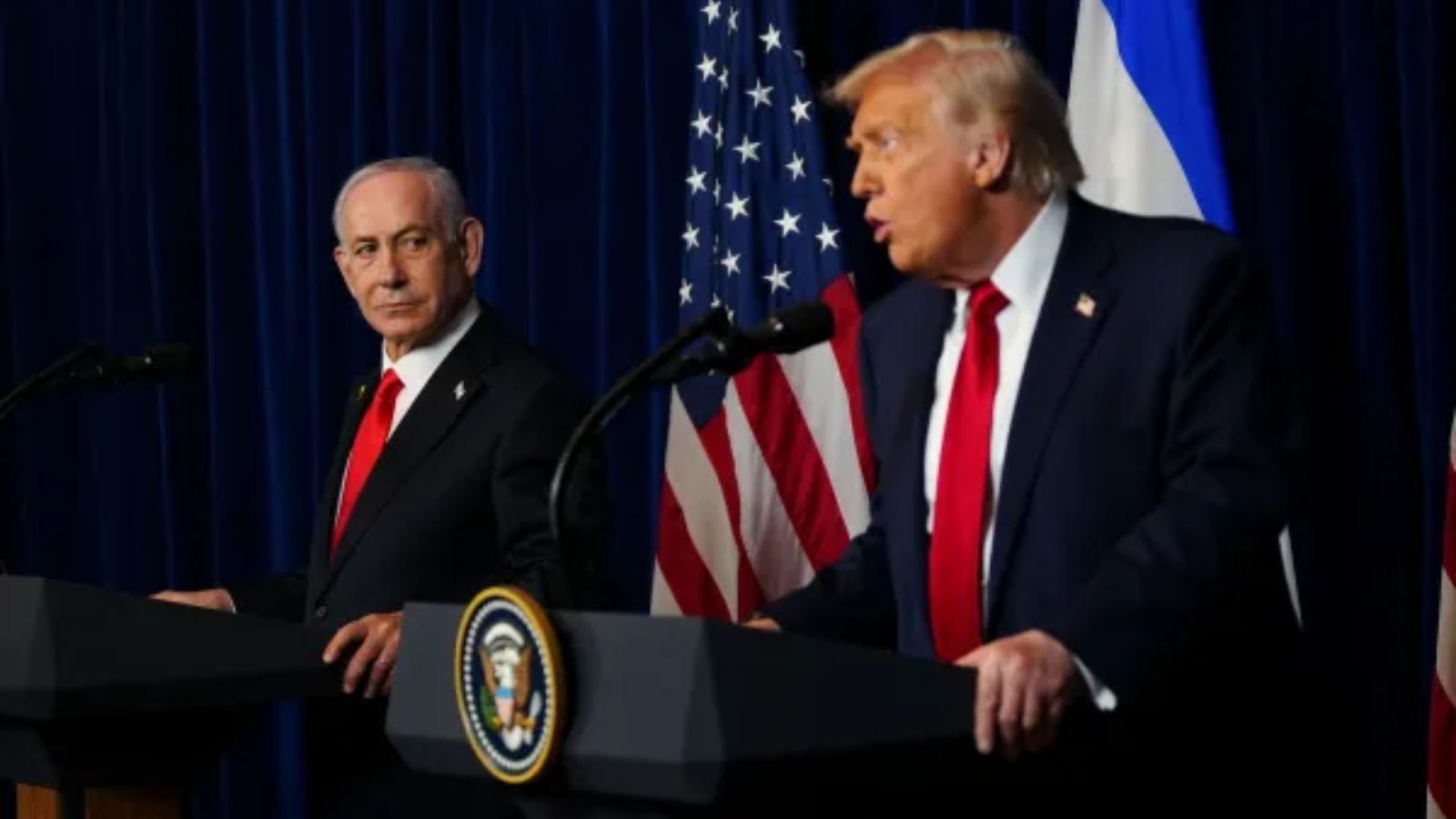
Donald Trump’s public lashing of Benjamin Netanyahu over an Israeli airstrike in Beirut exposes a fundamental rupture in the traditional Washington-Jerusalem alliance. Driven by a desperate need to stabilize global oil markets and secure a signature foreign policy victory ahead of the fast-approaching midterms, the White House is pushing an electronic signing of a memorandum of understanding with Tehran. The primary barrier to this immediate peace deal is no longer the Islamic Republic, but Israel. By minimizing Israeli security anxieties to protect a fragile 60-day diplomatic window, the administration is committing a grave strategic error that ignores the ground realities of Middle Eastern proxy warfare.
The friction reached a boiling point following an Israeli strike on the southern suburbs of Beirut. The operation was launched in response to three Hezbollah projectiles fired into northern Israel. Trump did not mince words, privately venting that Netanyahu possessed "no judgment" and publicly demanding that all sides stand down so as to not "blow it."
From the vantage point of the Oval Office, the math is simple. The three-and-a-half-month war has choked off the Strait of Hormuz, caused massive energy price spikes, and dragged down global growth projections. Trump wants the shipping lanes cleared and the U.S. naval blockade lifted immediately.
Jerusalem sees an entirely different equation. To the Israeli security establishment, a U.S.-Iran deal that postpones core nuclear restrictions to a later 60-day negotiating period—while offering immediate sanctions relief and oil waivers—is a profound betrayal.
The administration’s current approach treats the Lebanon front as a peripheral nuisance rather than an umbilical cord of Iranian power. Forcing Israel to halt its operations against Hezbollah to facilitate a temporary truce with Tehran misjudges how the regional architecture operates.
The Mirage of a Segregated Ceasefire
The core mechanism of the emerging Islamabad-brokered pact rests on a fundamental contradiction. The U.S. position maintains that the preliminary agreement is strictly a bilateral framework between Washington and Tehran to reopen maritime commerce and establish a 60-day runway for nuclear talks. Yet, Iran's negotiating team, overseen by Supreme National Security Council figures, has repeatedly asserted that Lebanon is an absolute red line.
This diplomatic divergence is where the strategy falls apart. The White House has attempted to compartmentalize the conflict, pressuring Israel to pause its northern offensive while offering Iran a temporary economic lifeline. It is an approach built on sand. Hezbollah’s entire institutional purpose is to serve as Iran's primary deterrent against external threats. Expecting Tehran to finalize an agreement while its premier proxy is being systematically degraded in southern Lebanon assumes a degree of separation that simply does not exist.
The immediate economic incentives embedded in the draft agreement illustrate why Washington is moving with such frantic speed.
- The 30-Day De-Mining Phase: Iranian forces would be required to actively clear the naval mines currently blocking transit through the Strait of Hormuz.
- The Transit Guarantee: Tehran would forfeit the right to levy service charges or tolls on international vessels throughout the 60-day extension window.
- The Oil Export Waiver: The United States would grant immediate, temporary waivers allowing Iran to sell petroleum products on the open market, injecting much-needed supply into a starved global economy.
These measures would offer immediate relief to Western consumers. They do nothing, however, to address the immediate tactical reality faced by communities in northern Israel.
Sidelined Allies and the Islamabad Channel
The deep-seated resentment brewing within the Israeli cabinet stems from the unconventional architecture of these negotiations. Rather than utilizing traditional diplomatic channels where Jerusalem maintains significant leverage, the administration has routed the entire process through Pakistani intermediaries in Islamabad.
This structural isolation has left Israeli intelligence viewing the draft text with immense skepticism. According to leaks from regional diplomats, the memorandum contains no binding clauses regarding Iran’s ballistic missile stockpiles, nor does it mandate an immediate, verifiable halt to the funding of regional militant networks. Instead, the United States has deferred these existential security matters to the secondary negotiation phase.
"America either lacks the will to fulfill its commitments or the ability to do so," warned Mohammad-Bagher Ghalibaf, Iran’s parliamentary speaker, explicitly utilizing the Beirut strikes to question Washington’s mastery over its ally.
This statement captures the exact trap the White House has walked into. By publicly upbraiding Netanyahu, Trump has signaled to Tehran that the United States is willing to act as a restraining mechanism on Israel in exchange for maritime compliance. This provides Iranian negotiators with immense leverage. They can now threaten to walk away from the electronic signing whenever Israel reacts to tactical provocations along the Blue Line.
Why the Strategic Calculus Fails
The administration’s belief that a complex, multi-front conflict can be paused via a rapidly assembled memorandum of understanding ignores decades of diplomatic precedent. The original Joint Comprehensive Plan of Action took years of meticulous, multi-lateral engineering to finalize. Attempting to enforce a top-down cessation of hostilities across Iraq, Syria, Lebanon, and the Persian Gulf in under two months is logistically unfeasible.
Furthermore, the economic benefits of the deal are wildly overstated. Even if the electronic signatures are secured, global shipping companies will not immediately send multi-million-dollar tankers back into the Strait of Hormuz. Lloyd’s of London underwriters will require weeks, if not months, of verified stability before war-risk insurance premiums drop to manageable levels. The infrastructure damaged during the opening salvos of the war will take significant time to repair.
The domestic political pressure on Trump is undeniable. High fuel prices are actively damaging his party's prospects ahead of the midterms. A major foreign policy breakthrough would offer a potent counter-narrative to domestic critics. Yet, by prioritizing a short-term drop in Brent crude over the long-term containment of Iran’s regional architecture, the White House is merely delaying an even larger conflagration.
Israel cannot afford to let Hezbollah rebuild its rocket infrastructure under the umbrella of a U.S.-led diplomatic pause. If the price of a stabilized Strait of Hormuz is the abandonment of Israel’s northern border security, Jerusalem will continue to act unilaterally. Netanyahu’s defiance of Washington is not mere political theater; it is a calculated assertion that national survival supersedes the economic expedience of its superpower benefactor. The deal may very well be signed within hours, but the structural flaws inherent in its design ensure it will begin unraveling the moment the ink dries.